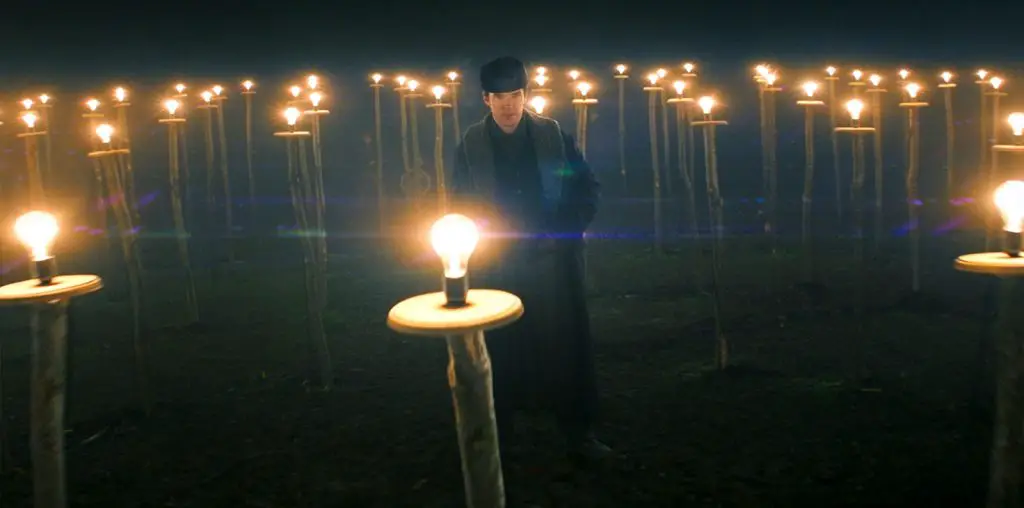
TORONTO INTERNATIONAL FILM FESTIVAL 2026 REVIEW! We live in a polarized age, with media delivering a sensationalized and immediate message, tailored to what you want to hear. While this is immediately gratifying, the consequence is that we may lose an understanding of broader perspectives. How did we get here? Danny Boyle’s latest film, Ink, examines this with a fascinating look at a turning point in history — Rupert Murdoch’s (Guy Pearce) acquisition of the The Sun tabloid in the UK in the late 1960’s and its subsequent meteoric rise under editor Larry Lamb (Jack O’Connell).
Rupert Murdoch is one of the richest and most controversial figures in the modern world, having created communication empires on many continents, owning hundreds of media outlets, including in the US alone Fox News, The Wall Street Journal, and The New York Post. Extraordinary amounts of column inches and video run time have been devoted to this man, but Ink takes a unique angle. Guy Pearce is the “movie star” here, and portrays a young Murdoch, but he isn’t the central figure. Instead, the film’s focus is this specific period in history where a tabloid like The Sun could come to dominate the newspaper industry by dispensing with the highbrow and focusing on more of what they thought the working class would want to hear. The main character is editor Larry Lamb, who transformed the failing paper into one of the largest in the world.
Ink is set in the late ‘60s and early ‘70s, with immersive and tasteful, but not distracting, set and costume design. Lamb recruits a team of misfits and disgruntled newspaper veterans to rethink what a newspaper should be. He finds failed photographers, washed-up writers, aspiring young people, and anyone else who will take the job at a paper whose circulation is terrible, but who can be enticed by the money thrown at them by a well-heeled owner. One of the standouts is Jules Davies (Claire Foy), a fictional character inspired by reporters working for newspapers in the area at the time. She’s perfectly complicated in that she’s trying to get her own ideas expressed while facing a misogynistic culture and simultaneously having an affair with the boss.
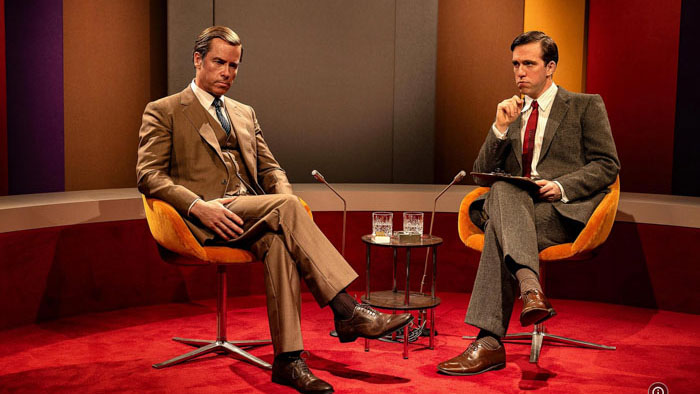
Rupert Murdoch and Larry Lamb sit side by side for a television interview in Ink.
“…this specific period in history where a tabloid like The Sun could come to dominate…focusing on more of what they thought the working class would want to hear.”
We see Lamb go to extraordinary lengths to dominate the publishing landscape, from clashing with his competitors and former colleagues, to violating the norms of the industry, to fighting with law enforcement, and even pushing the boundaries of his publisher, Rupert Murdoch. Jack O’Connell is a rising star (Sinners, 28 Years Later), and his performance here as Lamb, charismatic, ambitious, and flawed, will send him over the top as a star.
The main problem that many will have with Ink, which is only a problem from a certain perspective, is that Guy Pearce is an extraordinarily charismatic figure, and Rupert Murdoch is extraordinarily far from that. And even worse, while he sets Lamb loose to change the publishing world in pursuit of money, at times Murdoch is the voice of reason. That doesn’t quite sit right with our modern understanding of Murdoch as a ruthless destroyer of culture and norms in pursuit of money. Perhaps it is historically accurate — I find it believable that he started as more morally centered than he is today, but without some sense of that evolution it is jarring.
"…Ink is Danny Boyle at his best — it feels like early Danny Boyle, propulsive, captivating, brash, profound, and controversial."