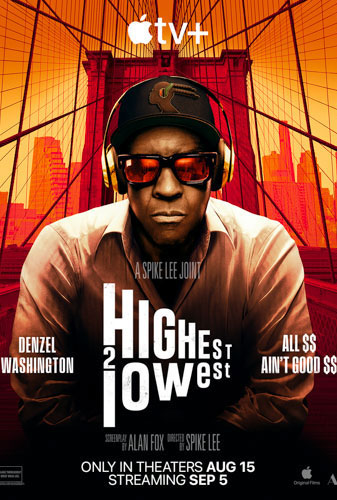
Spike Lee delivers an unrepentant “Spike Lee Joint” in his new crime thriller/morality play Highest 2 Lowest. The film centers on a middle-aged New York City music mogul named David King, played impeccably by Denzel Washington. King’s ride or die best friend is Paul Christopher (Jeffrey Wright). They came up in the hood together, and while Paul spent some time in prison, he’s now cleaned up his life, embraced his faith, and works as King’s driver and confidante. When we meet King, his career is coasting. He runs his record company and tries to pull in new talent, but he doesn’t have the zeal for it that made him a youthful success. He is trying to avoid a buyout by another label, but the other stakeholders want to sell. They all see this is the big payoff for years of work, but King rails against the prospect of turning his catalog and artists over to a company that uses AI and streaming. He is gathering his assets to offer a buyout to keep the company focused on real music and performers.
At this point, the news comes that his son, Trey (Aubrey Joseph), has been abducted, and the kidnapper demands a ransom that would bankrupt King and end his business ambitions. He readily agrees, but then Trey is found and returned home. There was a mix-up, and Paul’s son Kyle (Elijah Wright, Jeffrey Wright’s real-life son) was taken instead of Trey. This revelation hangs in the air like a bad odor. Suddenly, the all-in, “save the kid no matter what” ferocity takes a hit, and even the police seem less interested in getting Kyle back. Loyalties are tested across the board, and the weight of it all rests on the King. What will he choose?

“…King’s son has been abducted and the kidnapper demands a ransom that would bankrupt them…”
The film is a remake of Akira Kurosawa’s High and Low from 1963, which is based on a 1959 novel called King’s Ransom by Ed McBain. Kurosawa focuses on the police procedural, where Lee leans in on the moral dilemma. This messy conundrum asks if ethics should be situational/hierarchical. King is willing to give up his fortune, his company, and his status to bring his own son home. When it turns out that Kyle is being held, the mood changes.
The massive scenery-chewing performances of the leads eclipse everyone else in the film, and there are points when it is clear that Washington and Wright could have swapped roles and it would be just as good. Of course, it’s hard to see Washington as a disgraced ex-con. It would be equally hard to see Jeffrey Wright that way, had he not just lampooned that character in American Fiction. In that film (which you should see) educated academic writer Thelonious “Monk” Ellison (Wright) becomes frustrated that his well reviewed books don’t sell because they are not “Black enough.” Responding to another writer’s book, which is cynically built on Black stereotypes, he invents a wanted fugitive “street writer” persona named Stagg R. Lee. Then he pens a book in that idiom, which flies off the shelf. Monk is forced to become Stagg R. Lee for marketing. Wright’s incredible performance directly translates to Paul in Highest 2 Lowest.
"…brilliant filmmaking done as only Spike Lee can."