NOW IN THEATERS! Co-writer/director Genki Kawamura’s Exit 8 is based on the Japanese indie horror game of the same name, a minimalist puzzle built around a single endless underground loop. In a world of awful video game adaptations, what Kawamura and co-writer Kentaro Hirase bring to the screen is a very personal story: a man caught between a life decision he hasn’t made and a maze that won’t let him leave until he does.
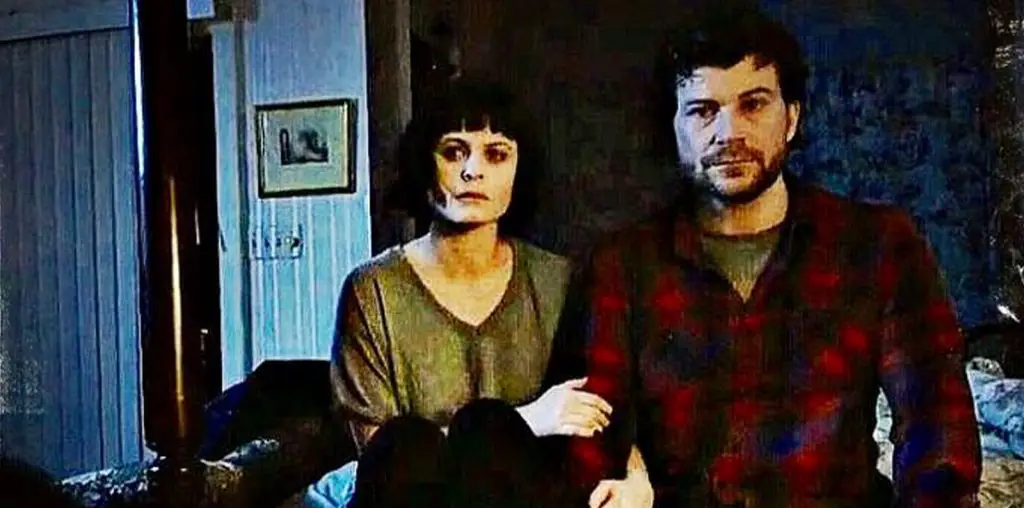
A man (Kazunari Ninomiya) is riding the Tokyo subway when his phone rings. His ex-girlfriend is calling from the hospital — she’s pregnant with his baby, and the two are in the middle of a painful conversation about what to do. But before they can get anywhere in the conversation, the cell signal cuts out. As the train reaches the station, the man notices another passenger screaming at a mother and her crying baby on the platform. Rather than insert himself in the conflict, he keeps his head down, exits the train, and walks down a long corridor toward Exit 8.
In The Twilight Zone fashion, the hallway doesn’t end. He keeps walking and arriving at the same familiar stretch of tunnel. It’s madness: the same fluorescent lights, the same walls, the same numbered exits counting toward eight. Soon, everything clicks as the man finds the instructions are posted next to the exit signs, detailing the rules: watch for anomalies, anything out of place, and turn back. If everything looks normal, keep going. Get it wrong, and you’re reset to zero. There’s also a figure known as The Walking Man, who reappears again and again, moving through the corridor with the stiff rhythm of an NPC — not quite human, not quite not.
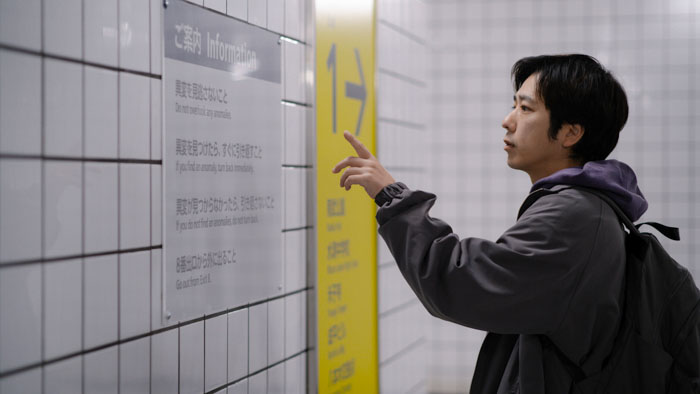
“…the man finds the instructions are posted next to the exit signs, detailing the rules: watch for anomalies, anything out of place, and turn back.”
This loop just keeps going. Other people seem to have been trapped here far longer, cycling through the corridor like they’ve forgotten there was ever a way out. The anomalies keep shifting — faces on posters, text on signs, the Walking Man’s behavior, and countless other details. The endgame is simple: get to Exit 8; otherwise, you’re trapped in this game for eternity. But is that really the goal? Getting to Exit 8 means solving the puzzle, but the puzzle is really about something else entirely.
The opening sequence alone is worth the price of admission. Kawamura opens Exit 8 with a long one-shot of the underground corridor. It is shot practically — no digital tricks — with any cuts hidden seamlessly in post. It’s genuinely awe-inspiring from start to finish. There’s also an intense creepy factor with The Walking Man, who appears again and again, moving through the loop like a glitching NPC — and like the opening shot, it’s all done in-camera. The actor walked the hallway, got on a bicycle, rode all the way back around, and did it again. Strangely enough, crew members would often get lost in the makeshift maze.
The puzzle structure is where Exit 8 really gets under your skin. There are eight levels, and if you miss an anomaly (or turn back when you shouldn’t), you get reset to zero. Simple rules, and you feel every failure. Trapped and desperate are the emotions du jour. In true sci-fi fashion, there is a human element; the mystery isn’t just about how to escape. It’s about figuring out why everyone is there in the first place, and that question is where the real story lives. Getting this wrong is what has made other video game and mystery box movies fail. In Exit 8, the mystery is simple and something we can all relate to. In others, the mystery is complicated and turns into a woke church sermon.
Indulge me on this topic for a moment; this isn’t really a horror or psychological thriller, even though it works as one. It’s science fiction in the purest sense of the word. Sci-fi isn’t about robots or space stations. At its best, it takes some aspect of humanity, pushes it to its extreme, and shows you what breaks. That’s exactly what Kawamura does here. The endless loop, the anomalies, the reset — all of it connects back to who the man is and what his fundamental flaw as a person is. When the ending hits, it doesn’t explain itself. You just sit there and work backward, and then it clicks. That’s the kind of storytelling Star Trek used to do — a tale of humanity dressed up in genre clothes, where the audience does the work. Exit 8 does just that, and it gets a strong recommendation.
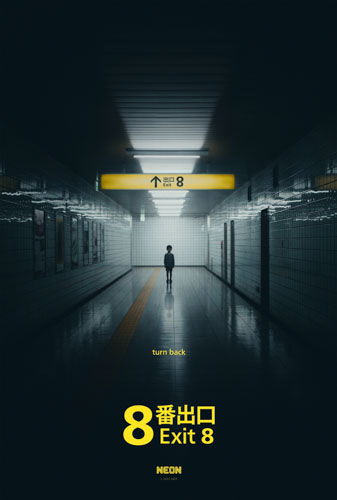
"…takes some aspect of humanity, pushes it to its extreme, and shows you what breaks."