I am a gigging musician on drums, and I have played rockabilly in bands. So Eddie Cochran was never an unknown figure to me. I knew the records. I knew Gene Vincent, Billy Fury, and the other names that form the mythology of early rock ’n’ roll. I knew Cochran was important. What I didn’t know was just how important he was.
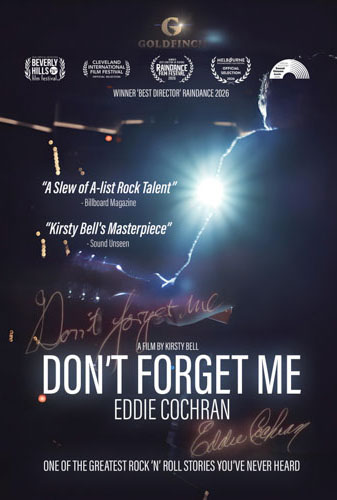
That is what makes Kirsty Bell’s Eddie Cochran: Don’t Forget Me such an unexpectedly moving documentary. It is, above everything else, a love letter not simply to Cochran, but to artistic influence itself. It is a film about remembering where things came from and about understanding that almost everything worthwhile in the arts is built on something that came before.
Eddie Cochran had a short life, and much is not documented, as it was not the time one did such things. The film stretches relatively limited material across a feature-length running time, and the structure can feel remarkably old-fashioned. There are photographs, newspaper clippings, archive footage, fan letters and dramatic recreations in which actors portray Cochran and his mother talking on the telephone. At times the reconstructions are almost charmingly theatrical, with some of the best reenactments I have seen of pivotal events.
“He reportedly signed autographs with the words “Don’t Forget Me.””
What emerges is a portrait of a remarkably sophisticated young musician. Cochran was not simply a handsome rock ’n’ roll singer with a guitar. He understood recording, overdubbing, arrangement and tone. The discussion of his Gretsch 6120 Chet Atkins guitar and his experimentation with pickups and strings is fascinating because it gets to the heart of the matter. That is something music documentaries too often neglect.
The film also makes clear that Cochran’s influence traveled much further than I had thought, as I am not a guitar player. Keith Richards, Roger Daltrey, Rod Stewart, Cliff Richard, Sting, Alice Cooper, Tim Rice, John Waters and others explain what Cochran meant to them. Keith Richards says, essentially, that everyone wanted to be Eddie. Paul McCartney recalls that “Twenty Flight Rock” was the song he used when he auditioned for John Lennon.
As someone who has actually played “C’mon Everybody” in a band, that revelation lands differently. I am well acquainted with musical history and have visited many places that are mentioned in this film. I knew we were doing something timeless in content and sentiment. You are participating in a chain that runs through Cochran to the Beatles, the Stones, the Who, and virtually everything that followed. There are lovely family moments with his brother, his sister, and some fan club members who wrote to him and received phone calls after shows and letters back from him when it was time to do this.
"…What emerges is a portrait of a remarkably sophisticated young musician."