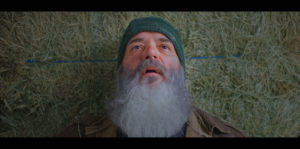
In the short film, Chiquita, written and directed by Trivikram Gajulapalli, Charles (Jody Dean) is a biker in his 60s living alone in a quiet Texas town. He spends his days in blissful solitude until thoughts of his granddaughter, Olivia (Evelyn Owen), stir feelings of longing and family. To reconnect, he invites his daughter, Anna (Brett Butler), and her family to visit, but Anna will not come until his house is empty of his Hindu idols. He hires his neighbor, Freyja (Cy Gan), to help clear out the house, and at night, tells her the story of how he became interested in Eastern spirituality.
Years before, after learning about his then-wife’s romantic feelings for another man, a heartbroken Charles rides out into the Texas wilderness on his motorcycle. Late that night, he lost control and crashed into a remote valley. Slightly injured, he stared at the sky and experienced an overwhelming sense of serenity. He then saw the radiant vision of a young Indian girl, later called Chiquita (Ananya Krishna Enuganti). The next morning, a mysterious biker named Henry (Tom Costello Jr.) helped him push his bike to the mechanic and mentioned he had once seen the same apparition. After fixing his bike, the mechanic told Charles Henry had died years before. Mind blown, the encounter took on a deeper spiritual meaning. That vision led him to research Henry’s life and discover meditation and yoga.
Over time, he began rebuilding his life guided by the lessons of contentment he believed Chiquita embodied. When Anna and her husband, Joel (Zack Michael Brown), arrive with Olivia, tensions surface between Charles’ Eastern spirituality and their devout Christian beliefs. Joel’s discomfort grows as he insists on a Christian prayer for grace. Anna struggles between loyalty to her husband and her embrace of her father’s new life.

“He then sees the radiant vision of a young Indian girl, whom he later calls Chiquita.”
Gajulapalli drew inspiration for Chiquita from his own spiritual journey and fascination with the meeting of Eastern and Western worlds. He envisioned the story as a meditation on surrender, healing, and the universality of faith, using the rugged Texan landscape as a mirror to the inner terrain of self-discovery. Gajulapalli describes the film as a “cross-cultural bridge” that moves beyond clichés of East-meets-West storytelling, blending Hindu philosophy, Texan realism, and human vulnerability into a single, contemplative narrative.
At its heart, the film explores how moments of divine encounter—whether understood as spiritual visions, intuition, or grace—can awaken transformation in ordinary lives, ultimately showing that peace is found not through escape, but through acceptance and connection. Religiously speaking, I am a Christian. I started in the fundamentalist church that saw all other religions as “sinful” and “of the devil.” But this is a short film review, not a critique of which religion is right or best.
Gajulapalli has firm control over the narrative of Chiquita, with bright colors, tones, and mystical qualities reminiscent of Indian films I’ve seen about Hindu gods. He balances explanations of Hinduism with its practice and asks that we, as viewers, keep an open mind when we encounter practitioners. I’ve always found that I understand the world and people better when I’m not closed off completely because of my beliefs—religious or otherwise.

"…Gajulapalli has firm control over the narrative..."

The film review is honest, gets to the depth of the understanding what the filmmaker tried to convey. He has summed up the story very beautifully. Helps people to decide one way or the other whether to watch the film or not.