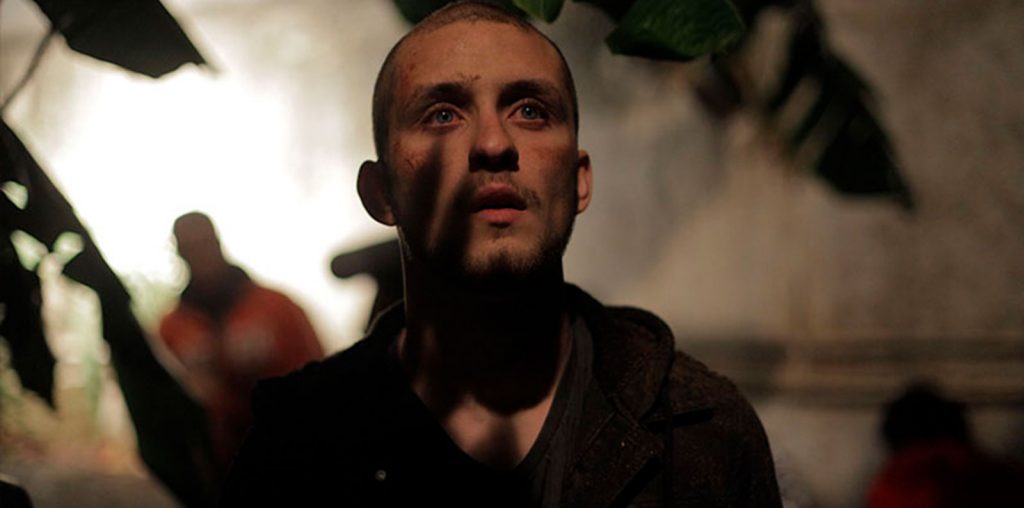
In this Rashomon-style tale from the country of Kyrgyzstan comes the thriller Burning, from director Radik Eshimov. When a house burns in the village, a group of nearby neighbors points to a possible curse on the family, connected to the death of their firstborn child. A discussion forms as they recount the events leading up to the fire, each offering a different version of what happened.
The film opens with firefighters rushing to put out a burning house. Nearby, at a convenience store, neighbors gather after all the commotion. Jyrgal (Ruslan Orozakunov), who lived next door, is asked what he knows and begins his story, which starts with the arrival of Farida (Kalicha Seidaliev). Farida has come to stay at the home of her son Marat (Omurbek Izrailov) and his wife, Asel (Aisanat Edigeeva).
Farida is a cold, unsettling woman, and from the moment she enters the house, both her son and Asel are intimidated by her presence. Asel is pregnant, and Farida lectures her about the responsibilities of having a baby, reminding her of the tragedy and death of their first son the previous year.
Farida performs strange prayer rituals that feel almost witch-like, and makes rice porridge for Asel. Though reluctant, Asel forces herself to eat it, triggering a hallucination straight out of a scene from The Lost Boys, maggots, anyone? She tries to hold back vomiting, sees worms squirming inside the porridge, and finally throws it all up, worms and blood included. Farida, meanwhile, remains eerily calm, as if nothing is happening. When Asel runs to the bathroom to vomit again, all that comes up is the porridge; no worms, no blood.
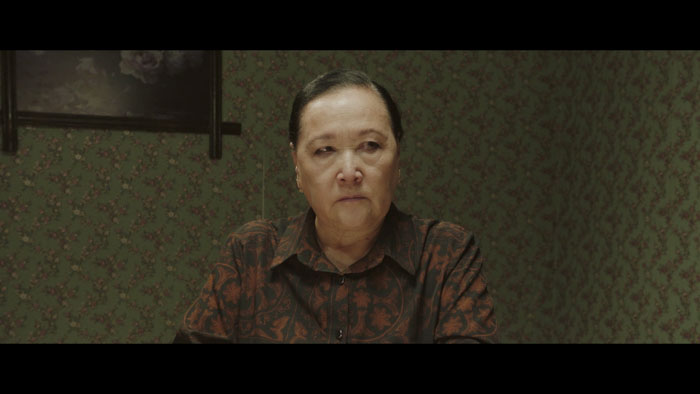
Farida (Kalicha Seidaliev) stares coldly in a scene from Burning.
“Farida performs strange prayer rituals that feel almost witch-like, and makes rice porridge for Asel.”
The next day, alone with Farida again, Asel is gripped by paranoia that her mother-in-law wants to take her unborn baby. Farida has even called a doctor and some nurses to the house. Asel manages to escape, and Marat finds her and tries to reassure her that everything will be fine, until Farida and the others arrive to bring her back. At the house, it appears the doctor is attempting to abort the baby. Asel breaks free again, locks herself in the kitchen, turns on every knob on the gas stove, and lights a lighter. Through the window, we see Jyrgal looking on.
After hearing Jyrgal’s version, Marat’s friend Durus (Askar Kachkynbaev) offers his own account. It shares many of the same details, but this time Asel isn’t confronting a cold mother-in-law; she’s a hysterical wife imagining her pregnancy, and Farida is simply there to help her make sense of the delusion.
I’d never seen a film from Kyrgyzstan, a country in Central Asia bordering Kazakhstan, before this one. The characters are all Muslim, and faith and mythology are woven beautifully into this captivating story. One character is a mullah, an educated Muslim trained in Islamic theology and sacred law. There’s also talk of a jinn, a supernatural spirit from Arabic mythology and Islamic belief said to coexist with humans while remaining hidden from sight. Even without that background knowledge, it isn’t hard to sense that some kind of supernatural possession may be at play.
The film’s biggest highlight is the performance of its three lead actors. As the Rashomon storytelling takes place, in each of the different sequences, the three actors take on different personalities and at times deliver lines that we initially saw another character say. Eshimov, as director, does solid work at executing these scenes and staying consistent with each character. Even in the third act, with the final story being told, it feels more unique than the other two: unexpected and grounded, shifting the supernatural tone of the film.

"…straight out of a scene from The Lost Boys, maggots, anyone?"