There’s a good chance that if you’re a horror fan, you’ve seen some of our revered anthologies, like Romero’s Creepshow, Tales from the Darkside: The Movie, and, of course, Roger Corman’s Tales of Terror. And while director Frank Palangi’s four-part At Death’s Door doesn’t exactly reinvent the anthology wheel, it does invite us in for a closer look at the horrors of suffocating vulnerability.
Leading the charge is Shadows the Clown; this gonzo tale is told through disjointed, cloudy childhood-POV memories and Dutch-angle flashbacks, as Felicia, a young woman, is in an aggressive therapy session. Through these vignettes, we learn her life has been plagued by the death of her father, and most recently her boyfriend at the hands of a mysterious killer clown–still on the loose. As memories and reality begin to blur, she’s forced to confront the truth she hoped to forget. Unrelenting and suffocating, with just the right amount of zanyness.
Everyone Has One introduces us to Rusty, who, by all accounts, is a doting son with a weekly phone date with mom. Unfortunately, once the gab session starts rolling, we gradually learn through flashbacks that he has a murderous family history plus some brutal hobbies. Without giving too much away, the premise is exciting, but I wish there were more tension for a bigger build—but as long as Mother is happy, so am I.
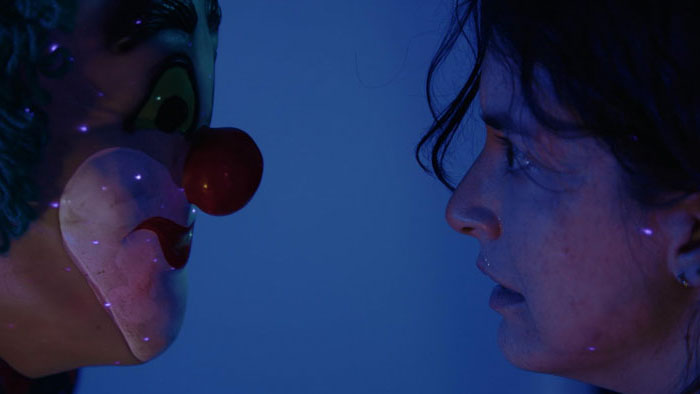
Felicia faces the mysterious killer clown in a tense, blue-lit moment from the Shadows the Clown segment of At Death’s Door.
“As memories and reality begin to blur, she’s forced to confront the truth she hoped to forget.”
Things get hellishly hot in Beyond Is Calling as John, a self-proclaimed psychic with a late-night radio show, opens the hotlines and answers questions about the Great Beyond. Each call-in becomes stranger than the last, revealing John’s twisted past as he struggles to distinguish actual reality from the one he might have exaggerated.
Either way, the ghosts from the past are seeking justice, and the listeners don’t seem too happy either. This segment could have benefited from a tighter story, more gore, and a faster ramp-up, but I appreciate the Twilight Zone tone achieved.
The final segment, Room Number 4, is probably the strongest in the bunch for cohesiveness and dread, and features my favorite performance of the entire anthology, with Kat Mackenzie as Wendy, a spunky B&B owner. We follow newly single Shauna, who’s taking a vacation from her problems, only to stumble on an otherworldly presence that won’t let her rest, sending her spiraling into madness. Though Mackenzie’s moments were brief and made me want more, she completely stole every scene.
I wouldn’t say I was particularly scared by any of these segments, but I did enjoy their unique approach to familiar themes and the gusto captured. Fans of indie supernatural anthologies should give At Death’s Door a spin.
"…At Death’s Door doesn’t exactly reinvent the anthology wheel, it does invite us in for a closer look at the horrors of suffocating vulnerability."