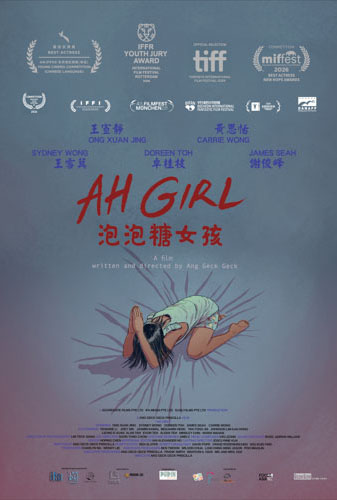
TORONTO INTERNATIONAL FILM FESTIVAL 2026 REVIEW! Writer and director Ang Geck Geck Priscilla’s debut feature beautifully channels the insignificant moments from childhood—the feeling of the wind through your hair on a bus ride, squabbles with a sibling, and the elation of puddle jumping on a rainy day. But as Ah Girl demonstrates, it’s the instances of hardship that really stick with you. Based on Ang’s own childhood in Singapore, the film follows a young girl forced to grow up quickly as she finds herself in the middle of her parents’ messy separation.
The film quickly introduces us to 7-year-old Swee Swee’s (Ong Xuan Jing) complicated family dynamics. Her parents are no longer together, and along with her younger sister Ah Tian (Sydney Wong), she bounces back and forth between their homes. The relationships with both her mother (Carrie Wong) and father (James Seah) are distant and fraught, with much of the parenting responsibilities falling to her grandmother (Doreen Toh). It becomes clear that Swee Swee has inherited a lot more responsibility than a young girl ever should, bearing the weight of her parents’ anxieties and shortcomings and caught between their constant quarrels.
The story is filled with conflict after conflict. Some are minor, but to a child, they feel massive, like her grandmother forcing her into a haircut. But some clashes are much more significant, like her parents’ plan to send Ah Tian away to live with relatives. Amidst all of that unease, she still leads the life of a child. We watch her go to school, a birthday party, and even crush on a classmate. But without knowing how to process the friction in her life, it starts to manifest as bad behavior. She argues with authority figures and even starts selling bootleg gum in the schoolyard, made even more significant by Singapore’s gum ban. That gum becomes her act of rebellion, taking hold of a part of her life she can actually control.
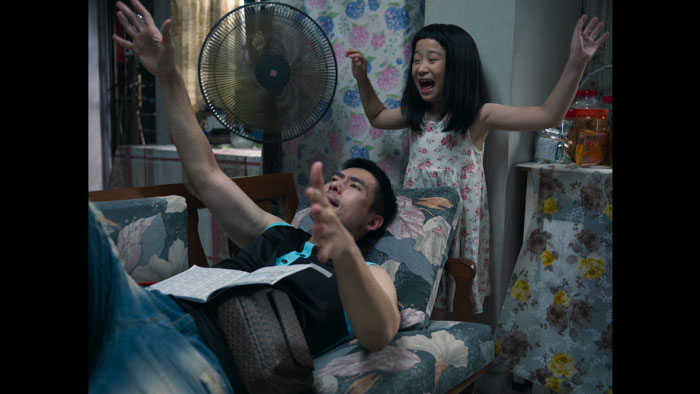
Swee Swee (Ong Xuan Jing) and her father (James Seah) share a tense, animated moment in Ah Girl.
“…a young girl forced to grow up quickly as she finds herself in the middle of her parents’ messy separation…”
Ang’s screenplay is so unmistakably personal while also feeling completely universal. We’re not just watching a family struggle through the eyes of a character; we’re immersed in Ang’s own personal experiences. At the same time, there’s something in the story all of us can relate to—the anxiety of overhearing your parents fight, the heartbreak of getting spurned by someone you like, or the feeling that life is spinning out of control. And that immersion isn’t just in the text; Ang perfectly crafts the atmosphere of 1990s Singapore with color, costumes, and precise scenic design.
But it’s really the stunning performance at the center of the film that gives it so much heart and life. Newcomer Ong Xuan Jing delivers one of the best child acting performances I’ve ever seen on screen. Her emotions feel so raw and genuine. The moments of fleeting joy act as a jolt of adrenaline pulsing through the audience. We watch her quietly observe the world around her, listening in on adult conversations and mirroring behavior. Those subtle acting choices immediately draw you into the authenticity of the story.
“Don’t grow up so fast; adults are always confused,” Swee Swee says to a baby in the final moments of Ah Girl. Unfortunately, she’s speaking from personal experience. She carries the burden of her parents’ flaws, rarely getting a chance to simply be a kid. It’s heartbreaking, but Ang leaves us with a glimpse of hope as the young girl finally finds her peace of mind amidst the steady strife. For once, she appears weightless. She won’t let this define the woman she’ll become.
Ah Girl screened at the 2026 Toronto International Film Festival
"…one of the best child acting performances I’ve ever seen on screen..."