Noboru Tanaka’s A Woman Called Sada Abe is a film about pleasurable excess under the term decadence, although what constitutes that is itself one of its most interesting questions. To one person, the behaviour depicted here may seem depraved; to another, it may simply represent a form of erotic freedom. The picture does not provide an easy moral position from which to judge the characters of Sada and Ishida. Instead, we watch them surrender increasingly to appetite and ask what remains when desire becomes more important than survival itself.
Based on the real 1936 case of Sada Abe and Kichizo Ishida, the film begins almost playfully. Sada, working as a maid at Ishida’s restaurant, enters into an affair with him, and the two soon abandon conventional life for a succession of rooms and inns. Their relationship becomes increasingly isolated, sensual, and obsessive. They drink jars of sake, get prepared meals delivered by the staff, talk about Ishida’s wife, and fornicate. They are so sexual that one of the staff mentions when cleaning that the bed smells like “Him”. Eventually, they seem to exist for nothing except one another.
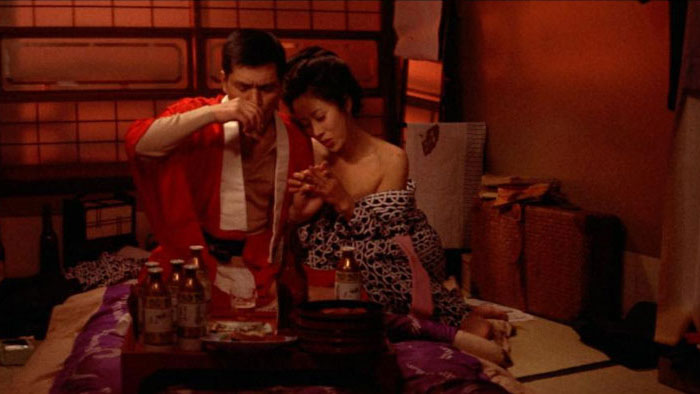
Sada Abe and Kichizo Ishida share sake in their red-lit room in A Woman Called Sada Abe.
“Sada, working as a maid at Ishida’s restaurant, enters into an affair with him, and the two soon abandon conventional life for a succession of rooms and inns.”
Masaru Mori’s cinematography makes this enclosed world extraordinarily seductive. Reds dominate the interiors and Sada’s clothing, while bottles, food, naked bodies and shadowy rooms create an atmosphere of sensual excess. It is decadent in the classical sense: pleasure has become an environment rather than an occasional indulgence. The staff even remark that she stays in bed all day and find it ‘disgusting ‘.
What looks decadent to an outsider may simply be the couple’s version of intimacy. They are not necessarily experiencing themselves as corrupt or fallen. They are lovers creating their own rules. The tragedy is that those rules ultimately have no limit, moving from symbiotic to parasitic, and the sexually deepens to ‘drug’ proportions
That is where A Woman Called Sada Abe becomes more than an erotic film. Desire gradually ceases to be something the characters experience and becomes something that consumes them. Sex becomes possession. Possession becomes jealousy. Jealousy becomes violence. The boundary between pleasure and destruction disappears.

"…Love becomes indistinguishable from annihilation."