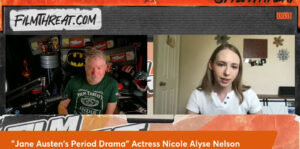
If you saw Jane Austen’s Period Drama in a theater — and you really should have — you know exactly what happened when it screened. The audience lost its mind. Film Threat’s own Chris Gore caught it at AMC Burbank 16 alongside a packed house, and by the time the short was over, it had gotten the biggest reaction of any film in the program. That kind of thing doesn’t happen by accident.
The short, a sharp period comedy that plays its absurdity completely straight, earned Nicole Alyse Nelson one of the best showcase roles a young actress could ask for. It also earned the film an Oscar nomination for Best Live Action Short — and a 9.5 out of 10 from Film Threat, plus a win at our annual Award This ceremony (for which, we should note, no one came to claim the trophy). We’ll let it slide.
Chris Gore sat down with Nicole to talk about how she landed the role, what it takes to keep a straight face opposite a live chicken, the wild ride through the festival circuit, and what it actually feels like to sit in the Dolby Theatre with your stomach in your throat.
The Role That Found Her
Nicole didn’t seek out Jane Austen’s Period Drama — it found her, thanks to a friend. Actor Dustin Ingram, who would go on to play Dr. Benley in the film, was already in conversations with writers and directors Julie and Steve when he thought of Nicole for the lead.
“He was like, I just feel like this is the girl. Like I feel like she’s gonna kill this,” Nicole recalls. “And so they didn’t know me, so I auditioned.”
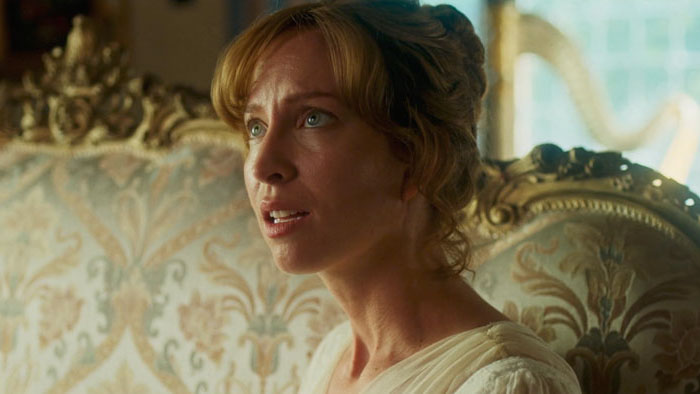
“The chicken needs to, she can only nail it as many times as we let her nail it. So I was like, we gotta be on it, guys. The chicken’s working.”
The character description she received before her tape was sparse: Jianna, 14–20 years old, the youngest sister who desperately wants to fit in with her older sisters. There was one additional note: Must be comfortable handling a live chicken. That was it.
As for the character’s name — the joke at the center of the whole film — Nicole admits she didn’t entirely clock it at first. “I know this is the 1800s, but I was like, are there names that existed back then that have just phased out over time? I was very confused.” She pauses. “I don’t think it is a name.”
It is not a name. That’s the point. And the film wrings extraordinary comedy from that fact.
Deadpan Is a Discipline
Anyone who’s seen the short knows the key to its success is that no one in it is in on the joke—at least not on screen. The escalating ridiculousness is played with complete sincerity, and Nicole somehow manages to keep a straight face through it all.
Her secret? Rehearsal and a firm grip on the stakes.
“The trick with any comedy is to just fully commit to the stakes of this scenario,” she explains. “My sister needs me to do this. I have to deliver. If we don’t sell this story, my sister’s gonna lose the love of her life. If you ground yourself to those stakes, even though everything in between is ridiculous, you can get there.”
The live chicken, however, required its own brand of focus. “The chicken needs to, she can only nail it as many times as we let her nail it,” Nicole says. “So I was like, we gotta be on it, guys. The chicken’s working.”
The Long Road to Oscar Night
The path from completed short film to Oscar nomination is more labyrinthine than most people realize, and Nicole was learning the rules in real time. The film opened at Santa Barbara, then screened at Tribeca and New York — both of which produced the kind of raucous audience reactions that made it clear they had something special.
But qualifying for Oscar consideration required winning Best Short at an Academy-approved festival, and for a comedy, that presented a specific problem. “In the world of prestigious film, it’s really hard to stand out against really powerful dramas,” Nicole says. “It’s a system that definitely awards the dramas. And to be a comedy at all in that mix is wild.”
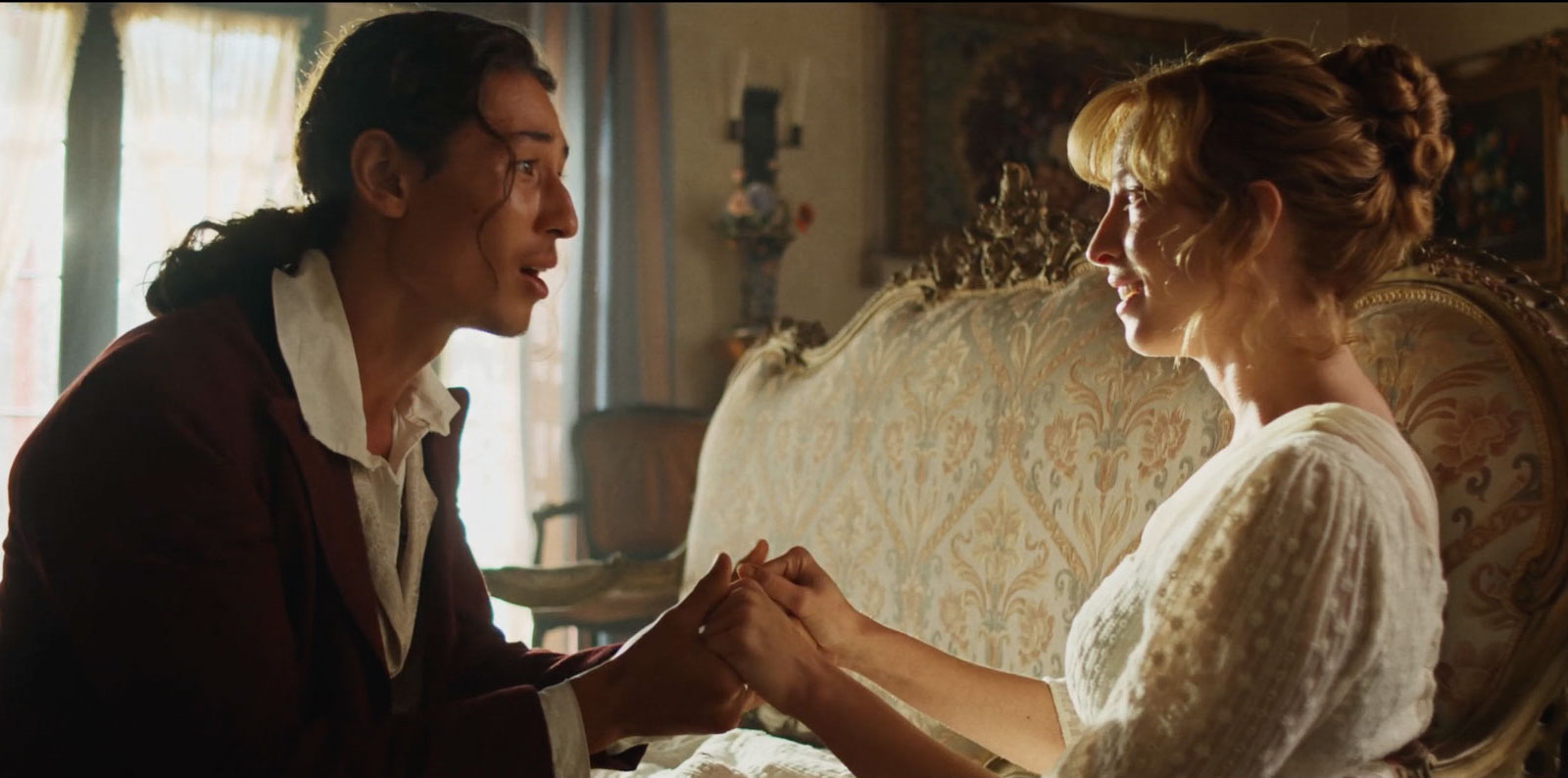
“I fully thought at that point we were nominated. And then I was like, oh wait — this is a long list.”
They found their lifeline at Aspen, which Nicole notes is one of the only festivals with a dedicated comedy category. They won. They qualified. On the last possible festival of the run.
Then came another learning curve. When Nicole first heard the film had made “the list,” she assumed they were nominated. They were not. “I fully thought at that point we were nominated,” she laughs. “And then I was like, oh wait — this is a long list. And then there’s a short list. And then there’s a nomination. I was like, my God, there are so many steps.” She estimates her premature Oscar excitement lasted about an hour.
Oscar Night, Row by Row
When the nomination came through for real, the production pulled out all the stops, getting people to the Dolby Theatre. Nicole credits the Academy for being generous with tickets — the team kept requesting more and kept getting them. By the end, nearly the entire cast attended, along with every department head from costumes to art direction, as well as the directors’ parents.
“To be there in that row, we were all in one row — when that category comes up, to just hold hands and be like… they could say our name,” Nicole says. “And if that happens, we’re all standing and cheering like it’s a football game.”
There was a twist. Partway through the ceremony, it was announced there would be a tie in the Best Live Action Short category — two winners. Suddenly, the odds felt better. But the films are announced alphabetically in the event of a tie, and once the first winner was called — its title starting with a letter well past J — the math became clear.
“We found out shortly after that if there is a tie, they always go in alphabetical order,” Nicole explains, offering a piece of Oscar trivia that even die-hard ceremony watchers (including Gore himself) didn’t know. “So we would’ve known had we known that — once they said the [first winner], they passed J.”
They didn’t win. But they were there. The whole crew, holding hands in one row.
On the hosting front, Nicole joins the chorus of people who thought Conan O’Brien absolutely delivered. The opening bit — a prerecorded segment that transitioned into actual children physically running up the aisle of the Dolby — caught even the audience inside the room off guard. “I was like, they are here,” she says. “They hired these kids, and they’re running. I was like, that’s so good.”
As for the celebrity encounters, Nicole attended with her partner Jonah, who did dialect coaching on Jane Austen’s Period Drama and also appeared as the pianist in the Oscar-nominated Blue Moon alongside Ethan Hawke. Two separate projects, two separate nominations, one couple.
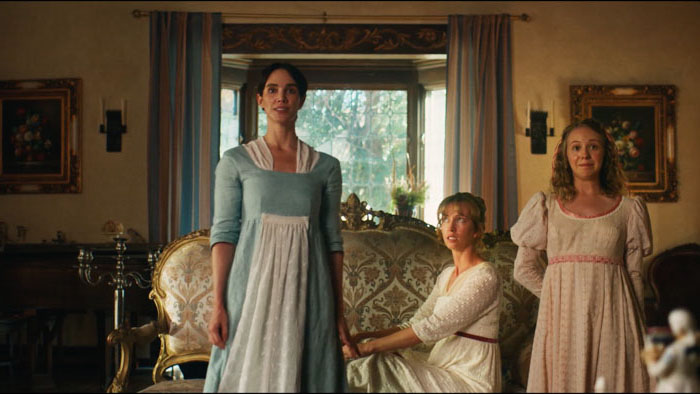
“…when that category comes up, to just hold hands and be like… they could say our name.”
“Neither of us has ever gone before,” Nicole says. “And now we’re going as a couple with two separate projects.” The standout interaction of the night came when they ran into Bobby Cannavale — a familiar face for Jonah from the Blue Moon set — and got to properly meet his wife, Rose Byrne. “It wasn’t just like you’re seeing somebody in passing,” Nicole says. “I’m having a conversation with you, and I genuinely like your work.”
What Comes Next
Nicole is an actress who auditions constantly and has a strong team keeping her working. But she’s also thinking bigger. She’s written a feature film herself, is producing it, and intends to star in it — with a target of going into production in 2026.
“It’s my first time writing, producing, and hopefully starring,” she says. “We’ll see.”
Gore offered the advice he gives every actor he respects: produce yourself. Control your own narrative. Point to Reese Witherspoon, who built Hello Sunshine into a full production company around female-led stories and freed herself from waiting for the right role to come along.
Nicole agrees. “The older you get, the more you know in the business — it’s just really smart.” She cites Witherspoon specifically: “She’s still getting stuff made for other people. And I love that.”
Jane Austen’s Period Drama is the kind of short that reminds you why the format matters. It’s tight, it’s funny, it commits completely to its bit, and it gives a performer like Nicole Alyse Nelson a chance to do something genuinely difficult — make you laugh without ever letting you see her trying. When her feature is ready, Film Threat will be first in line.
Film Threat gave Jane Austen’s Period Drama 9.5 out of 10 and named it Best Short at the 2024 Award This ceremony.