
There’s a moment in director Johannes Vang’s short film Borderline (På Grensa) where three strangers — a Norwegian customs officer, a Finnish fisherman, and a Swedish woman with a bag full of secrets — all realize simultaneously that none of them can invoke the law without violating the law of another country. It’s the kind of absurdist punchline that only works when the setup is airtight, and at twelve minutes, Vang nails it. The film, which recently won the Tromsø Palm for Best Short Film, is a sharp, funny, and quietly political piece of Sámi cinema that plays with language, national identity, and jurisdiction in a way that would make any border bureaucrat sweat. We sat down with Vang to talk about where the idea came from, what it’s like making a family production in the middle of a mosquito swarm, and why comedy might be the most powerful tool in the Indigenous filmmaker’s toolkit.
The premise of Borderline — three strangers from three countries, all with something to hide, meeting at the exact point where their borders converge — is such a specific and absurdist setup. Where did that idea first come from, and how did it evolve into a comedy?
The Sámi people have always moved around the Scandinavian peninsula, not caring about what arbitrary borders were drawn by the settlers. I’ve wanted to make a film on that and a cross-border production for quite some time. I actually live close to the border cairn, so it is an area I know very well. We — my sister and I — prefer to write and work with comedy, and I think it was quite natural to set this film in a wacky, absurd situation rather than a drama.
The Sámi people have historically had their lands and identities divided by national borders that were drawn without them. How much of that history is baked into the DNA of this film, even though it’s playing it for laughs?
Funnily enough, we didn’t think about the politics when we wrote it. But because language and identity are always in my work, the history is just there. We left it open for the audience to see the borders and prejudices. For me, comedy is the best way to talk about our society without making it look grim.
You’ve talked about wanting to move away from the “grim and sad” narratives that dominate Indigenous cinema. What’s the argument for comedy as a vehicle for Sámi storytelling — and is there any pushback from within the community when you take that approach?
Sámi and Indigenous films are often very tough and sad because of the tough and sad things our peoples have been through. Those stories are important, of course, but if we only tell sad stories, we might lose our fun ones at the same time. We need to diversify the stories we tell and how we tell them. And there has been nothing but great feedback from our local audience, cheering on the films we make and the way we choose to make them.
This was a true family production — your sister Wilhelmina wrote it, your brother Jonathan edited it. What does that kind of creative shorthand look like in practice, and did the family dynamic ever complicate the work?
I feel very lucky to be working with my siblings. We can use our shared language and reference pool to communicate and generate ideas. It’s a lot of fun to base a character on our old math teacher or to use “that trip to wherever” as a reference for a scene or setting. The workflow is quite nice, too. I usually have an idea for a film and share it with my sister, who writes it. She has banned me from touching the script, as she words things way better than I do anyway. Then I bring it on set to create it. And then in the edit, I work through it with my brother Jonathan. He has been dubbed the killer of darlings, as he is the one who cuts out lines Wilhelmina loved or takes that I’ve said, “we worked so hard for this, so we have to keep it” — all for the sake of the edit’s flow and structure. He has a lot of guts for being the younger brother, but it seems we get along pretty well.
You shot at the actual Three-Country Cairn in the mountains over two days in July. What did it take to pull off a production at that location — logistically, physically, and creatively — and how did the environment shape what ended up on screen?
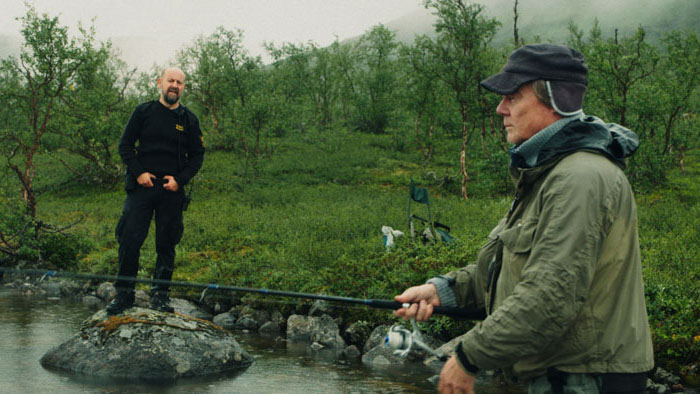
The location was an hour-long boat ride and an hour-long walk away, so getting our cast and crew of 12 there was the first challenge. All the equipment had to be carried by hand, and we had no electricity. And as you can clearly see in the first two acts of the film, it was raining heavily on the first shoot day — so naturally, the rain becomes part of the story. And then there were the mosquitoes. Holy hell, there were a lot of them. Although they were a pain on set, they became a great part of the film, as our cast were constantly swatting at them or being affected in other ways. So we had to do some extra sound recording to build them into the soundscape.
You’re 24 years old, you just won the Tromsø Palm for Best Short Film, and you’re already working on your first feature. How does Borderline fit into the larger story you want to tell as a Sámi filmmaker?
Winning the Tromsø Palm for the best Nordic short film in my home field is one of the largest milestones in my career. My work looks at Sámi identity and language, historical and contemporary. Borderline explores the humor and tone of the films I want to make. Our first feature film, which I’m writing with Wilhelmina, is a mockumentary set in a fictional Sámi municipality where everything that could go wrong does.