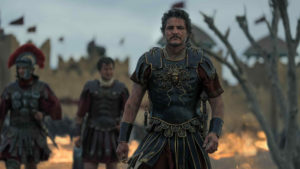
When Gladiator arrived in 2000, it looked complete. Maximus had his revenge, Rome had lost a tyrant, and Ridley Scott had closed the story with the kind of final image that usually tells audiences not to expect chapter two.
Then something curious happened. The film refused to become a museum piece.
More than two decades later, Gladiator II returned to the arena with Paul Mescal as Lucius, and the result proved that the title had grown beyond one character. The sequel earned about $462 million worldwide, while Paramount said viewing of the original jumped 96% during the 28 days after the new film opened.
Maximus Died. The Idea Didn’t
Russell Crowe’s Maximus is still the emotional center of the first movie, but Gladiator was never built on one man alone. Its real engine is bigger than that: Rome, power, revenge, public spectacle, and the brutal thrill of the arena.
Those images still land because they are instantly readable. A bronze helmet. A roaring crowd. Sand, fire, steel. You see them and you already know the mood. That is a big reason Gladiator outlived its own ending. It stopped being just a film and became a visual language that other corners of entertainment still borrow.
You can spot that carryover in smaller ways too. A quick search on Betinia Ontario brings up Gladiator Ways, a slot that leans into the same Roman iconography and arena energy that the film helped fix in modern pop culture. The point is not that the movie directly created every gladiator-themed game on the market. It is that Gladiator gave this old world a fresh pulse, and that pulse never really faded.
That helps explain why Gladiator II could shift the focus to Lucius without feeling disconnected. The franchise could lose its original protagonist and still keep its identity. Hollywood chases that kind of longevity all the time. Gladiator got there by building a world people never quite stopped wanting to revisit.
The 24-Year Gap Became Part of the Marketing
A sequel arriving 24 years later should feel awkward. Here, the gap added weight.
People who saw the original in theaters had time to build a relationship with it through DVD, television, streaming, quotes and endless rewatching. By the time Gladiator II appeared in 2024, Paramount wasn’t introducing an old title again. It was waking up a piece of shared movie memory.
That distinction matters. The first movie won Best Picture and turned Maximus into one of the defining screen heroes of its era. The sequel could therefore sell recognition before audiences knew much about Lucius. Rome was the hook. Ridley Scott was the hook. The arena was certainly the hook.
And yes, nostalgia helped. But nostalgia alone doesn’t carry a large-scale studio release. The new film still needed a cast, spectacle and enough narrative room to justify another trip through those gates.
A Franchise Now Lives Outside the Theater
Modern movie franchises have another advantage: they don’t disappear when the credits stop. Their imagery keeps circulating through streaming menus, social clips, games, edits, memes and other digital spaces.
That wider media habit is important for Gladiator. Roman-arena imagery has a strong visual life beyond cinema, built around gold, stone, armor, banners and theatrical competition.
For a film studio, this changes the shelf life of intellectual property. A title no longer needs a new theatrical installment every three years to stay familiar. It can go quiet, keep circulating, then return when the audience appetite is there.
Gladiator may be one of the cleanest cases of that model because it spent most of its gap doing almost nothing officially. The audience did much of the preservation work.
So, Is Gladiator III Inevitable?
Ridley Scott has already talked publicly about a third film, and Paul Mescal has expressed interest in returning. Scott has also discussed a possible direction built around Lucius dealing with power he may not actually want.
Still, there is no official release date. That distinction is worth keeping. Franchise talk can move faster than green lights, schedules and finished scripts.
Yet the larger point is already settled. Gladiator is no longer a single film with a late sequel attached. It has become a reusable story world.
That might sound very corporate for a movie about honor, grief and men hitting each other with swords. Fair enough. But franchise-building works best when audiences don’t notice the business model first. They notice the feeling.
The sand. The crowd. The gates opening.
Twenty-four years passed, and people still knew exactly what those images meant. That is why Gladiator never really ended.
19+ in Ontario. Set a budget before you play — and if it ever stops being entertainment, ConnexOntario is free and confidential at 1-866-531-2600.