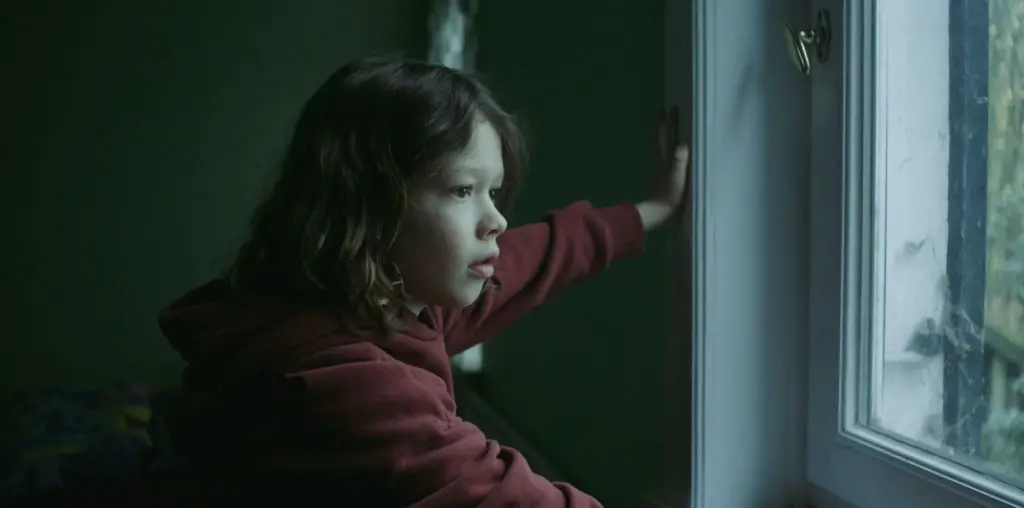
Parker Hajiaskari’s horror series puts real, practical creatures in the room and films its night scenes in total darkness. More than 10 million subscribers keep coming back.
Every episode of Life of Luxury asks its audience to believe that something impossible is standing at the foot of a bed. So how does the series make its monsters look so real? The answer is simpler than most would guess: the monster is actually there.
The series’ creator, Parker Hajiaskari, has spent seven years making horror happen in front of the camera instead of adding it afterward. Creatures, costumes, props and sets are designed to exist in the room when the cameras roll, not built later on a computer.
The audience suggests it works. Life of Luxury has more than 10 million YouTube subscribers and over 1.2 billion views, and its long-form episodes average more than 20 million views each. Two seasons stream free on Tubi, and the series holds a 7.7 viewer rating on IMDb.
“For the past four or five years, our north star has been to make work that feels like it has Hollywood-level visual effects, style and design,” Hajiaskari says. “Since the beginning, our goal has been to make content that leads viewers to wonder: ‘How did they do that?'”
If you want it to look real, make it real
Hajiaskari’s rule is simple: anything meant to look real should actually happen, as much as possible, while the cameras roll.
“If you want something to look real, you need to make it happen,” he says. “It’s all practical. It’s all real, because it actually happened.”
That rule puts the work into physical craft: creature and costume design, props and the rooms themselves. Hajiaskari’s longtime collaborator and co-star, Chester Beckington, leads character and costume design, focusing on how each creature looks and moves on camera. Hajiaskari leads story, directing and editing, and in his words tries to act as the “glue” between every part of the production.
Judged on the monitor, not fixed in post
On set, the team watches the camera feeds on screens as each scene plays out, seeing what the audience will see while it is still happening. That is where every effect is judged.
“We’re watching the cameras on screens while we film, so we see exactly how it’s going to look,” Hajiaskari says. “If something doesn’t look good while we’re filming it, we know we’re not done filming it.”
The plan is never to rescue a shot with visual effects later. If a creature doesn’t work on the monitor, the team keeps going… until sunrise.
Filmed in real darkness
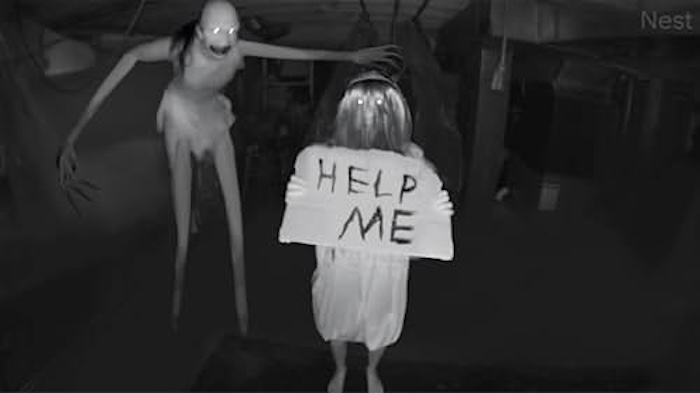
The boldest choice comes after the lights go out. Every Life of Luxury episode has a night sequence: the house goes dark, everyone goes to bed, and night-vision cameras watch what moves through the rooms. Each shot is stamped with a room and a time, such as “Son’s Room – 03:08:00 AM.”
A common shortcut is to shoot night scenes with the lights on and darken them in post. Life of Luxury films them in total darkness, rooms black, with infrared cameras. What viewers see on screen is what was really in the room that night.
That raises the bar for every creature. It has to move, hold its shape and look right in pitch-black rooms, while the team judges each take on the infrared feed.

A method audiences recognize
The series’ two most-watched episodes, “Her Son Can’t Stop Growing at Night..” and “It Waits Until You Fall Asleep..,” have drawn 62 million and 56 million views, and the first led to a sequel. In the comments, viewers debate what they just saw.
Hajiaskari founded Luxury Productions Inc. in 2018. Its five YouTube channels, including the companion series LuxuryDark, have a combined 17.7 million subscribers. And on YouTube alone, the content has drawn nearly 1.7 billion views.