Independent filmmakers have always been digital insurgents. Give a rogue creator a high-end consumer GPU and a custom desktop pipeline built for heavy AI video models, and the old multi-million-dollar Hollywood infrastructure suddenly isn’t the only game in town. For the first time, we can bypass the centralized soundstages and VFX houses right from our own home bases.
That is exactly why the system is scrambling to put us back on the plantation.
Look at MiniMax H3. This dense 33-billion-parameter model from Chinese lab Hailuo is a genuine breakthrough for shoestring-budget filmmaking. Its Reference-to-Video system lets you lock camera moves and physical blocking with fast local proxies, feed in your character sheets or miniature photography, and get coherent, high-fidelity output with native stereo sound in a single pass. It is currently the strongest tool available for decentralized production.
Then you read the license.
Under the standard Community License, if you live in the United States, the UK, the European Union, or South Korea, you are not authorized to use the local weights or even publish the outputs generated from them. The company says people in those territories can apply for a formal authorization, fill out a form, and sign a waiver tied to their ongoing copyright fight with the Hollywood studios. Approval is possible, but it is discretionary, comes with compliance demands, and is not the same thing as open access.
“The bipartisan CAISI framework draws a deliberate line: heavy regulatory burdens apply to frontier developers pulling in hundreds of millions, not to the everyday guys and gals in garages.”
In other words: you can play with the technology for free in your garage. The moment you try to take the work to market in the West, they would prefer you abandon your local hardware, migrate to their cloud, and pay by the second.
This is not a bug, it’s a feature, and the architecture of enclosure.
Monopolies no longer need unbreakable Digital Rights Management (DRM). They just need to make the free local tools legally radioactive to the institutions that control distribution. Sales agents, streaming buyers, and theatrical distributors all demand clean Chain of Title and Errors & Omissions insurance. The second an insurer asks whether you used generative tools and wants a paid corporate invoice instead of a local open-weights workflow, the free pipeline becomes a liability. The gate closes without anyone ever having to touch your machine.
They let you experiment. They just make sure you pay the corporate tax the moment you try to monetize the result to your unelected rulers, the bosses of the self-appointed company store.
Washington has actually begun to notice this playbook. The recent Executive Order on Promoting Advanced AI Innovation and Security rejected mandatory preclearance and federal licensing schemes that would have crushed open-weights development under compliance costs only the largest companies could afford. The bipartisan CAISI framework draws a deliberate line: heavy regulatory burdens apply to frontier developers pulling in hundreds of millions, not to the everyday guys and gals in garages. Even parts of the national security apparatus have warned against total dependence on centralized corporate APIs.
So why are tools like H3 being geographically fenced?
Because international labs look at the copyright lawsuits, the liability frameworks, and the aggressive posture on data provenance in Western courts and decide the safest move is to wall off the biggest commercial markets. They cannot stop the code from existing. They cannot stop an RTX 5090 from running it. So they shift the battlefield to distribution and insurance. Local use stays a hobby. Monetization requires the subscription.
“…the system is scrambling to put us back on the plantation.”
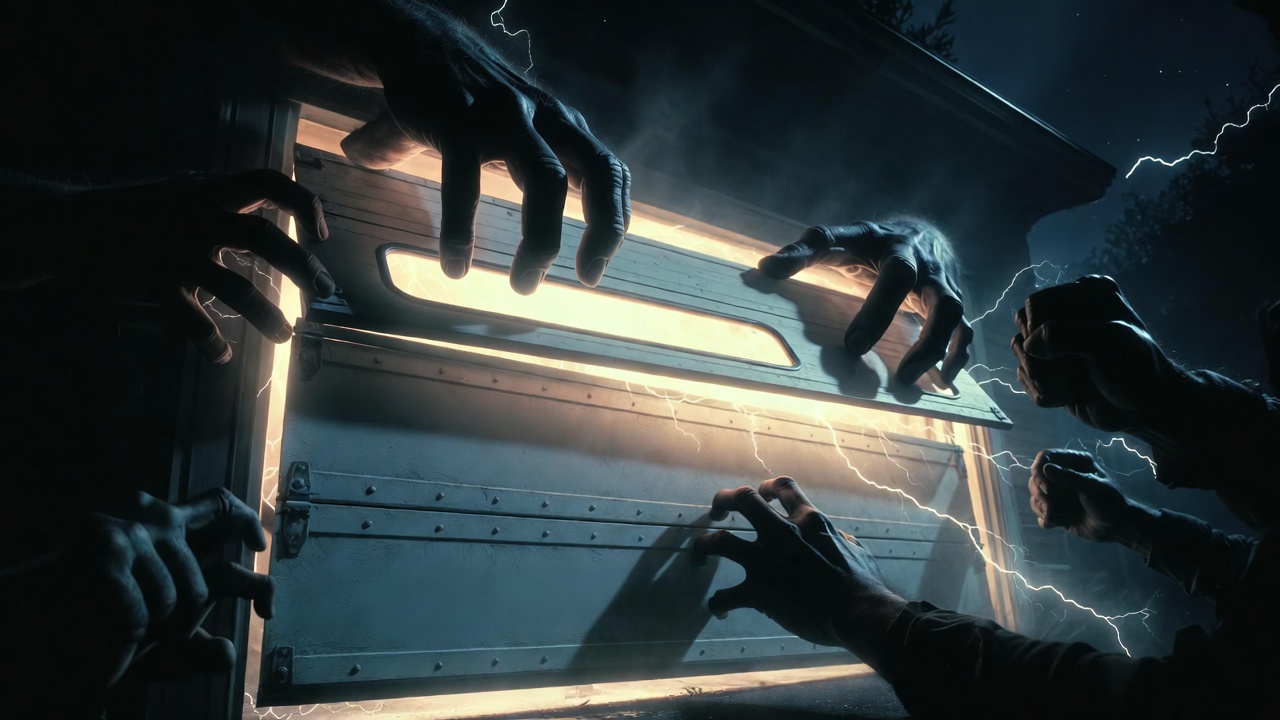
Clawed hands reach through a lightning-lit garage door, a visual metaphor for outside forces closing in on independent filmmakers’ access to AI tools.
This is the new digital border, surrounding their land, which you will be a sharecropper of.
As independent filmmakers, our job has always been to hotwire the system. Use the free local tools to prototype, block, and build. When it is time to deliver final frames for sale, many of us will still end up buying clean commercial generations or heavily transforming the work with practical effects, miniatures, and traditional compositing so the paper trail holds up. That is the current reality.
But it should not be the permanent one.
We need a Digital Bill of Rights.
An American citizen’s ability to own, run, modify, and monetize open-source AI tools on their own hardware should be treated as a core interest, not a privilege that can be revoked by foreign license terms or domestic corporate pressure. I fundamentally believe that our right to local, unmonitored compute is as critical to our future as our right to free speech under the First Amendment, or our right to bear arms under the Second. The philosophical core of the Second Amendment is simple: if the governing bodies and massive corporate entities hold access to immense power, We the People must retain the practical ability to hold equal capabilities in our own hands.
If tech conglomerates and nation-states possess god-like computational platforms, allowing them to force everyday Americans onto a metered cloud leash, where every thought, creative asset, and line of code is filtered, tracked, and taxed, is a direct threat to our sovereign independence. People need to take the time to look past the surface level and understand how deeply this global AI debate impacts our absolute freedoms.
To the people in Washington still paying attention: do not drop this. Protect open-weights development. Resist both foreign risk-off licensing walls and domestic monopoly enclosure. The garage studio is not a hobby. It is an investment of the individual. It is where the next generation of American film is being built.
And to my fellow creators: stop waiting for this to fix itself. Share this article. Send it to your representatives. Demand that the right to local compute be protected before the door is closed for good.
The garage studio is worth fighting for.
Christopher Moonlight is an animator, special effects artist, and the director of the ‘Award This’ winning movie, The Quantum Terror. His upcoming animated sci-fi adventure, Escape From Planet Omega-12, combines traditional film-making special effects with AI to create something never seen before in independent film. You can follow the behind-the-scenes, including tutorials, tips, and tricks, on his YouTube Channel, Substack, and christophermoonlight.productions website.