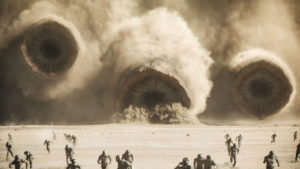
Some movie creatures show up, scare you for two hours, and fade from memory. Dune’s sandworms are not those creatures. They’ve been burrowing through our imaginations since Frank Herbert published his novel back in 1965, and sixty years later, they feel more alive than ever. Denis Villeneuve’s film adaptations turned Shai-Hulud into a genuine cinematic event, the kind of spectacle that makes entire theater audiences hold their breath.
So, what is it about a giant worm that keeps pulling us back into the sand?
Why Sandworms Still Own the Screen
Think about the first time you saw a sandworm erupt from the sand. That gaping circular mouth, ringed with crystalline teeth, swallowing an entire spice harvester like it was nothing. Herbert described them as reaching over 400 meters long. That’s roughly four football fields, for perspective. The largest animal on Earth, the blue whale, would look like a guppy next to one.
What makes them special isn’t just the size, though. It’s the mythology wrapped around them. The Fremen of Arrakis worship these creatures as divine agents, calling them Shai-Hulud. Riding one is a sacred rite of passage. When Paul Atreides finally mounts a sandworm in Dune: Part Two, it’s not just an action scene. It’s a spiritual transformation.
Villeneuve understood that. His team spent an entire year perfecting the sandworm design. They gave the creatures a prehistoric, armored look inspired by dried lake beds. The mouth drew from baleen whales. Every breath, every rumble beneath the dunes was crafted to make you feel the worm before you saw it.
The Ripple Effect Across Pop Culture
Herbert’s sandworms didn’t just stay on Arrakis. They burrowed into the DNA of science fiction itself. Star Wars borrowed heavily from the novel, with Tatooine being a pretty obvious nod to the desert planet. The space slug in The Empire Strikes Back, the Sarlacc pit in Return of the Jedi, these are all cousins of Shai-Hulud in one way or another.
Then there’s Tremors, where Kevin Bacon battles underground Graboids in a tiny Nevada town. Same concept, smaller budget, completely different vibe. Even Beetlejuice threw in its own quirky sandworm variant. Herbert created something universal. A creature so primal and awe-inspiring that it keeps showing up everywhere, decades later.
From the Dunes to the Reels
It’s no secret that slot games have been borrowing from Hollywood for years. You’ll find reels themed around everything from ancient mythology to superhero franchises. Whenever a movie captures the public imagination, it’s only a matter of time before it shows up on a slot grid somewhere. Dune was no exception.
Octoplay released Lord of the Dunes as a direct tribute to the Dune universe, and they clearly did their homework. The game recreates Arrakis with real attention to detail. Golden helmets, glowing crysknife-style blades, and ancient relics fill the grid. But the real star is the Worm Defenders mechanic. As you play, a Threat Meter gradually fills. Cross certain thresholds and a massive sandworm erupts onto the screen, blazing rows and columns with multipliers. It mirrors that classic Dune tension. The quiet before the sand starts trembling.
If you’re not looking to play for real money, titles like Lord of the Dunes also show up on platforms that run entirely on virtual coins. Big Pirate, for example, offers themed slot games alongside its own pirate adventure setting. It’s a laid-back way to enjoy a game like this without anything more than entertainment on the line.
What Makes These Creatures Timeless
There’s a reason we keep coming back to the sandworms. They’re not just monsters. They shaped an entire planet. Arrakis was once a world with water, and the sandworms slowly consumed it all over millennia, turning everything into endless desert. The Fremen built an entire culture around them. Remove sandworms from the story and there is no story. That’s rare for a creature in science fiction. Most movie monsters exist to be defeated. Shai-Hulud exists to remind you that some forces are simply too large to control.
They represent something bigger than themselves. Power, ecology, the consequences of greed, survival. All wrapped up in a creature that could swallow your house without noticing.
Whether you’re watching Paul ride one across the dunes or watching one blaze across your screen in Lord of the Dunes, the feeling is the same. Wonder. A little bit of fear. And the irresistible urge to learn more about the world they inhabit.