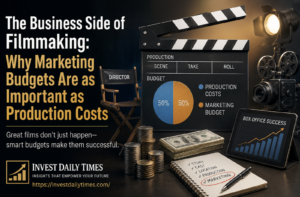
When people think about filmmaking, they often imagine cameras, actors, directors, and visually stunning productions. While these creative elements are essential, they represent only one side of a successful movie. Behind every successful film is a carefully planned business strategy that determines how the project will reach its audience. No matter how compelling a story may be, its commercial success depends heavily on effective marketing.
A film’s marketing budget is more than a promotional expense—it is an investment in visibility, audience engagement, and revenue generation. In an era where hundreds of new films compete for attention every month, strategic marketing has become one of the strongest factors influencing financial success.
Professionals who study business strategy and financial planning often look at industries like entertainment to understand how budgeting decisions affect performance. Publications such as Invest Daily Times regularly discuss financial planning, budgeting, and investment strategies that demonstrate how disciplined resource allocation creates stronger business outcomes across many industries.
Marketing Begins Long Before Release Day
One of the biggest misconceptions about film marketing is that promotion starts only after a movie is completed. In reality, successful marketing often begins during production.
Early announcements, behind-the-scenes content, production updates, teaser posters, and cast interviews gradually introduce the project to potential audiences. These activities create awareness months before tickets become available.
Planning these campaigns early allows marketing teams to spread promotional costs over a longer period while building consistent audience interest.
Understanding the Audience Before Spending Money
Every marketing dollar should have a purpose.
Before creating advertisements, producers must understand exactly who they want to reach. A family animation, horror film, historical drama, and action blockbuster all attract different audiences with different viewing habits.
Audience research helps answer important questions:
- Which social media platforms are most effective?
- What type of promotional content generates engagement?
- Which regions should receive the largest advertising investment?
- What age groups are most interested in the film?
Answering these questions improves efficiency because marketing budgets are focused where they produce the greatest value.
Balancing Creativity With Financial Responsibility
Marketing campaigns are designed to capture attention, but creativity alone is not enough. Every creative idea must also be financially practical.
Large promotional events, celebrity appearances, premium advertisements, and exclusive premieres may create excitement, but they also require significant investment.
Marketing managers constantly balance creativity with available financial resources. The goal is to maximize public interest without allowing promotional expenses to exceed realistic business expectations.
A carefully structured budget helps achieve this balance.
Digital Platforms Have Changed Everything
The entertainment industry has experienced dramatic changes over the past decade.
Today, audiences discover movies through YouTube trailers, TikTok videos, Instagram campaigns, streaming platforms, podcasts, and influencer recommendations.
Digital marketing offers several advantages:
- Real-time campaign monitoring
- Audience targeting
- Lower entry costs
- Flexible advertising budgets
- Detailed performance analytics
Unlike traditional advertising, digital campaigns can be adjusted immediately if certain advertisements outperform others.
This flexibility allows marketing teams to improve efficiency throughout the campaign rather than waiting until it has ended.
Traditional Advertising Still Has Value
Although digital marketing dominates many campaigns, traditional advertising continues to play an important role.
Television interviews, outdoor billboards, magazine features, radio promotions, and press conferences still help generate credibility and reach audiences that may not spend significant time online.
The strongest campaigns often combine both traditional and digital marketing instead of relying exclusively on one approach.
Budget allocation therefore becomes a strategic exercise in balancing multiple promotional channels.
Measuring Return on Marketing Investment
Marketing should never rely solely on intuition.
Every campaign should include measurable objectives that help determine whether promotional spending is producing meaningful results.
Common performance indicators include:
- Trailer views
- Website traffic
- Social media engagement
- Advance ticket sales
- Audience reach
- Brand awareness
- Media coverage
Tracking these metrics helps organizations identify successful strategies while improving future campaigns.
Why Budget Flexibility Matters
Even the best marketing plans require adjustments.
Unexpected opportunities frequently emerge during promotional campaigns.
Positive reviews may increase public interest.
A cast interview might go viral.
A trailer could receive millions of unexpected views.
Flexible budgeting allows organizations to increase investment in successful campaigns while reducing spending on activities that generate weaker results.
Adaptive financial planning often produces stronger overall performance than rigid budgeting.
Learning From Industry Case Studies
Studying real-world budgeting examples helps marketers understand how successful campaigns are developed.
Different productions require different financial strategies depending on audience size, release format, competition, and promotional goals.
Readers interested in entertainment finance can explore the article Film Marketing Advertising Budget, which explains how promotional spending is structured and why budgeting decisions significantly influence marketing effectiveness throughout a film’s release cycle.
Budgeting Reduces Financial Risk
Film production involves significant financial investment before any revenue is generated.
Without careful marketing planning, producers risk overspending on promotional activities that fail to attract audiences.
Budgeting reduces this uncertainty by establishing realistic financial limits while prioritizing high-impact promotional activities.
It also helps investors evaluate potential risks before committing additional funding.
Collaboration Strengthens Budget Efficiency
Successful marketing campaigns involve collaboration between multiple departments.
Finance teams establish spending limits.
Marketing professionals develop promotional strategies.
Distribution partners coordinate release schedules.
Creative teams produce advertising materials.
Executives monitor overall campaign performance.
Strong communication ensures that every promotional decision supports broader business objectives while maintaining financial discipline.
Looking Ahead: The Future of Film Marketing
Technology continues transforming entertainment marketing at an extraordinary pace.
Artificial intelligence, predictive analytics, customer segmentation, personalized advertising, and automation now influence how marketing budgets are planned and managed.
Rather than replacing creativity, these technologies improve decision-making by providing better data and more accurate performance forecasting.
Future marketing campaigns will likely become even more targeted, measurable, and cost-efficient.

Conclusion
A successful film is built through both creative excellence and sound financial planning. While compelling storytelling captures audiences, strategic marketing ensures that people actually discover the film.
A well-planned marketing budget allows producers to allocate resources wisely, monitor campaign performance, adapt to changing market conditions, and maximize promotional effectiveness. As competition within the entertainment industry continues to grow, thoughtful budgeting will remain one of the most valuable investments any production can make.
Understanding the financial principles behind successful marketing campaigns benefits not only filmmakers but also business leaders, investors, and marketing professionals across every industry. Strong budgeting transforms promotional spending from a simple expense into a strategic investment that supports long-term commercial success.



Very good article. Nice investigating on the topic. I would like to add or point out that in the age of digital marketing, it makes it easy for people to simply swipe off or away from an ad. Even those digital billboards are not as effective as they should be because if you’re driving or jogging and you see an attractive ad, you don’t have the time to write or take a photo of that ad because it’ll go into another ad. Same thing with social media platforms, it’s too easy to swipe off an ad. So, it is a delicate balance between traditional media and digital marketing.