
Over the years there have been plenty of popular gambling films produced – but which ones are the best? We believe that gambling films are at their most compelling when a single decision can change a character’s life.
From desperate main characters hoping to survive in underground poker rooms to those chasing big payouts at the top in glamorous casino showdowns, the best examples balance believability alongside the tension that they might just lose everything.
Unlike dramatic wins and losses depicted in gambling films, real casino games operate according to their own rules. For example, players exploring online pokies at SpinBet will experience games where outcomes are random rather than a cinematic plot twist.
That distinction is integral when it comes to judging which gambling films are not only great, but are also more realistic where audiences can relate to the storyline.
However, it’s important to note that realism does not necessarily make a gambling film better. Casino films often get live dealer tables wrong.
A technically accurate poker hand can still be dull cinema, yet an improbable winning streak can see people reach for the remote to turn it off.
How we rank gambling films
Our ranking system factors in three key elements. They are as follows:
- Game accuracy: Are the rules, decisions and outcomes believable?
- Psychological realism: Do characters behave like people under financial pressure?
- Casino realism: Does the film capture the environment, the risks and consequences of gambling?
These criteria helps to separate technical accuracy from “dramatic” effectiveness. Let’s take the casino classic game roulette. This is a game that does not allow players to influence the result through psychological reads. If that happens in a film, watchers will check out. So, with that in mind, lets go through our top five most realistic gambling movies.
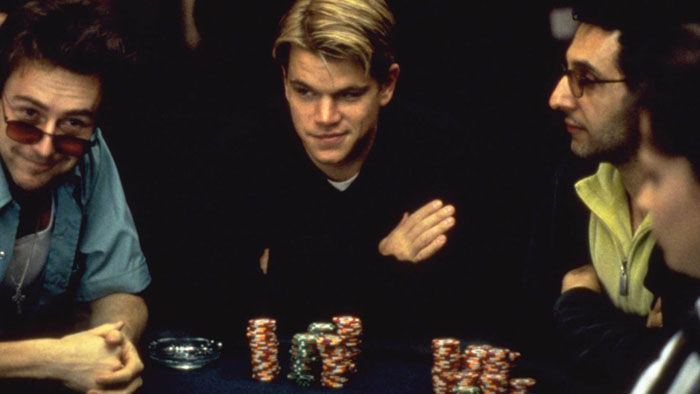
1. Rounders (1998): The benchmark for poker drama
Directed by John Dahl, Rounders follows Mike McDermott, played by Matt Damon, as he returns to underground poker to help his friend repay a huge amount of debt.
The film captures an important element of poker which is why it’s made our list. A strong hand does not always guarantee victory, although a good decision does not always produce a winning result. Players must not only assess their cards, but also betting patterns and try to read their opponents all while knowing there is no clear way of knowing if you have won until all cards are on the table.
McDermott’s final confrontation with Teddy KGB is heightened to add to the intensity of the situation. Mike’s skill is being able to read his opponents better than anyone else at the table throughout the movie, which is where Dahl shows a true understanding that poker is as much about decision-making under pressure as it is about the cards.
This is by far one of the more realistic gambling films out there. The game’s psychology and underground setting feels not only credible, but relatable to those that have experienced the highs and lows of poker.
2. Molly’s Game (2017): The human cost of high-stakes play
Aaron Sorkin’s Molly’s Game, which stars Jessica Chastain, is based on Molly Bloom’s account of running exclusive, high-stakes private poker games. Instead of purely focusing on winning hands, the film showcases the people holding the cards, the power they possess and of course, money.
The film is particularly effective at showing how a gambling environment can become a social hierarchy. While wealthy players are accustomed to winning in business, that confidence does not guarantee success at poker where everyone becomes equal. Nor does a large bankroll make someone immune to poor decisions.
Of course, Molly’s Game compresses events for dramatic clarity but its real focus on the pressures of running private games gives it a broader sense of realism than a main character winning big on a roulette table.
No matter how big your bankroll is, poker is more about respecting a difficult card game and those who know the casino classic well can relate to the film more than others.
This film highlights the social and financial ecosystem around gambling and because of that, it sits high on our list.
3. The Gambler (1974): Sobering and relatable throughout
James Caan stars in Karel Reisz’s The Gambler as Axel Freed, an academic whose gambling spirals into serious debt. Now, where a lot of gambling films focus on an individual that ends up rich and out of danger, The Gambler couldn’t be more different.
This film focuses on the character’s repeated exposure to danger. Where the movie is relatable to a gambling audience is down to his behaviour rather than how a particular game ends.
Although Freed is an intelligent character, he is still unable to protect himself from poor decisions and he learns little from his losses along the way.
The film teaches gamblers a valuable lesson that is often overlooked. It explores the difference between understanding risk intellectually and being able to manage it in practice.
Some scenes are, of course, deliberately heightened, but the focus remains on the character and his unsettling actions. Gambling in this film is not portrayed as a problem that can be solved by one brilliant wager.
Freed’s self-destructive, risk-taking behaviour is relatable to certain audiences, which is why it has firmly made it onto our list.
4. Casino Royale (2006): Spectacular poker, implausible hands
Daniel Craig’s first James Bond film is a classic. Built around its central showdown in a high-stakes Texas hold-em tournament, it might not scream a gambling film that is completely relatable with an everyday audience.
However, the emotion within the final scene is gripping. With bluffing, reversals and money on the line, the average poker player has gone through these emotions at some point while playing. Perhaps not quite on this level, but the tension within the scene is exactly what poker can make individuals feel when getting to a final round.
The movie, perhaps, is let down by its climactic hand that brings together an extraordinary collection of powerful combinations. In true Bond fashion, everything works out for the British agent, but take nothing away from those at the table attempting to read each other.
Professional poker player Darren Elias, a four-time World Poker Tour title winner rated the poker scene from Casino Royale just 3/10 for realism, criticising the improbable concentration of strong hands.
Read the PokerNews analysis of Darren Elias’s film assessments for further examples of how professional knowledge changes the way these sequences look.
Still, this is a Bond film, and a good one at that. The tension works which is why it has made our list, despite Elias disagreeing with us.
5. 21 (2008): Blackjack and the limits of advantage
Inspired by accounts of the MIT Blackjack Team, 21 follows students who attempt to use card counting to gain an advantage at blackjack. The premise has a real mathematical basis which gives them an edge. The students track the cards that have already been dealt and from that, they can help a skilled player estimate when the remaining deck is more favourable.
Admittedly, the film amplifies the glamour, ease and consistency of the entire operation. Card counting requires a considerable amount of practice, concentration and above all, disciplined betting.
It’s also worth pointing out that it does not guarantee a win on any particular hand, and casinos will definitely be quick to respond to suspected advantage play by either restricting or excluding players.
The film also compresses the practical difficulties it would take to coordinate a team and manage the money to remain undetected. The premise and central idea of the movie is certainly plausible, but the “smoothness” of the operation is questionable.
Comparing our top five gambling films
Please note that these ratings are our personal choice and we’re sure our audience will have others to bring to the table. However, each film we’ve put forward offers something players have experienced or can relate to – which was key to us when carrying out our research.
It’s not just about winning heaps of cash, just look at The Gambler, but more the characters’ behaviours and how they deal with situations that are thrown at them.
What real casino games can teach us about film
The most important distinction is between games that reward decisions and games whose outcomes are random.
It’s obvious that poker involves both skill and chance. Players can make better decisions by understanding probabilities, position and their opponents, but they cannot control the cards they are dealt.
Blackjack provides players with decisions about how to play a hand, yet the cards that enter the game always introduce a level of uncertainty. And as for roulette slot games, players can’t influence the result at all – both are entirely random.
People exploring products such as online pokies in NZ should not confuse the dramatic control shown in films with the way real casino games operate. Slot outcomes are generated through game systems designed to produce random results, where odds are always in favour of the main character when it comes to the next potential Hollywood hit, and that’s important to remember.
Ultimately, the most realistic gambling films recognise that money and uncertainty are inseparable. The least realistic suggests that confidence or one extraordinary wager can overrule any previous damage.
Responsible gambling notice:
Gambling involves financial risk and should never be treated as a reliable way to make money. Remember to set spending and time limits and never chase If gambling stops being enjoyable or becomes difficult to control, take a break and seek support.