Eridians use echolocation. Like creatures on Earth, they create a map of the world by sending out a sound and using the time delay to compute distances. It is amazing that creatures as diverse as bats, dolphins, whales, shrews, and some birds have evolved different forms of it. On Earth, echolocating creatures usually also have sight, but the Vietnamese pygmy dormouse is blind and uses echolocation to navigate trees at night. It suggests that maybe bats evolved this skill before the ability to fly.
Coma Arigato, Mr. Roboto
Let’s talk about surviving the trip. Suspended animation is such a trope in science fiction that you’d be forgiven for thinking that’s what Ryland Grace is waking up from in Project Hail Mary. But he’s not. He’s just in a coma. In the book, they describe that this is necessary because otherwise they feared the crew would go crazy from being trapped in a small space with each other. That’s a bit of a stretch — prisoners and astronauts have managed this, but Andy Weir needed a reason for Grace to just “wake up” and start the story there.
Long-term comas are risky, and we see the consequences of that in the film. You also need to guard against muscle atrophy and bed sores, hence the need for a robot. But doctors do induce short-term comas. In fact, after a heart attack, my own father was put into a coma, and his body temperature was cooled to about 90 degrees F for 24 hours to reduce brain swelling. He ultimately made a full recovery, but for the next few days, he was disoriented, uncoordinated, and had short-term memory loss, a little like Ryland Grace.
In reality, global amnesia, like Grace has, where you forget even who you are, is incredibly rare. But at least in the book, they explain it’s because of a drug he is given. Andy Weir admitted it was an old trope, but it solved so many storytelling problems he just had to do it.
The Reluctant Astronaut
The whole “whoopsie, I’m an unqualified astronaut!” trope is one of the worst in science fiction, whether it is from Spacecamp, Moonraker, Armageddon, or even the otherwise outstanding Gravity. Screenwriters always want to amp up the drama by having the person in space be unprepared, but in reality, astronauts are some of the most highly trained people imaginable. Having said that, Project Hail Mary does an incredible job of motivating this — it’s the Citizen Kane of reluctant astronaut movies! Ryland Grace is a school teacher who has no intention of going to space. Because of his background, and because he’s expendable, we can see why they want him to investigate astrophage. In the book, he has a rare gene that gives him the ability to survive a year-long coma, so he’s a prime candidate to replace the trained astronauts when they can’t go. The film dispenses with the gene coincidence, which Andy Weir says is something Drew Goddard improved over the book.
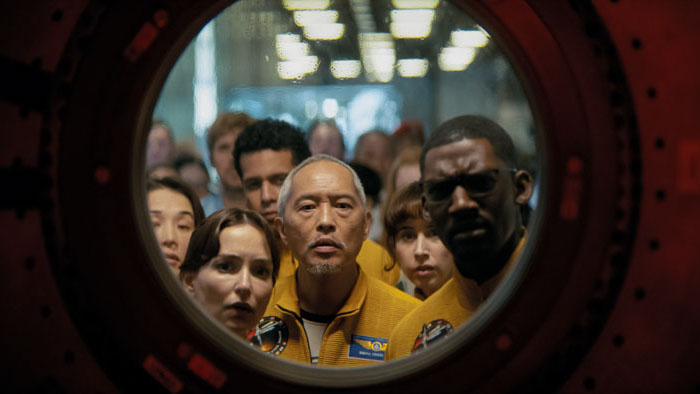
(L to R) Milana Vayntrub stars as Olesya Ilyukhina and Ken Leung as Yao in PROJECT HAIL MARY, from Amazon MGM Studios.
Photo credit: Courtesy of Amazon MGM Studios
© 2026 Amazon Content Services LLC. All Rights Reserved.
“The whole ‘whoopsie, I’m an unqualified astronaut!’ trope is one of the worst in science fiction.”
In both the book and the film, there are backup astronauts who receive the same training in case the first choice can’t go. This matches our current protocol. On Apollo 13, command module pilot Jack Swigert had to replace Ken Mattingly 3 days before launch after he was exposed to measles. But in Project Hail Mary, even that precaution wasn’t enough, and Ryland Grace is forced into service.
Up until the 19th century, this was common practice on sailing ships, and is called press-ganging or Shanghaiing. Ships would often be short-handed, so sometimes gangs would roam ports “pressing” people into service — coercing or forcing people into becoming crew. You might pass out because a suspicious man bought you too many drinks at a bar and just wake up out at sea, with little choice but to embrace your new life as a sailor.
Launch windows
In the film, they say they have to force Grace into service because otherwise they’ll miss their launch window. That doesn’t make a lot of sense. On Earth, we have launch windows because the orbits of things have to line up. In fact, the first Space Shuttle launch was secretly delayed so it would cross paths with a spy satellite that could inspect its thermal tiles. But since this was classified, the flight director said over the open loop at Mission Control, they had to delay to reboot a backup computer. The computer center replied, “Hey, Flight, we don’t have to reboot any backup machine…,” prompting the Flight Dynamics Officer to reply, “You. Do. Now.”