Playing cards can reveal character, create suspense, and carry meaning without a word being spoken. Read more about their role in films.
The Playing Card’s Place in Movie History
There are plenty of objects that instantly tell us something about a movie character. A cigarette can suggest trouble. A briefcase can mean money. A wedding ring can change the meaning of a scene.
Then there is the deck of cards. It can sit on a table without drawing much attention, yet the moment someone starts dealing, the mood changes.
A card game might lead to a confession, a fight, a scam, or a fortune changing hands. Sometimes the cards barely matter. They simply give a scene a particular texture.
That flexibility has made playing cards a surprisingly durable part of movie history.
A Deck Says More Than It Seems
Filmmakers rarely need to explain what a deck of cards is doing in a scene.
Audiences already understand the basic language. Someone is holding cards close to their chest. Another person is watching their face. There is something they do not want the other person to know. That is enough to create tension.
The cards also give actors something physical to work with. A character can shuffle while thinking, deal while lying, or slowly turn over a card while everyone else waits.
A deck can make an ordinary conversation feel uneasy without changing the dialogue.
Card Games Do Not Always Mean Gambling
One of the more interesting things about the prop is that filmmakers can remove the money entirely. A game of solitaire tells a very different story. There is no opponent sitting across the table, so the cards can underline loneliness or routine.
A card trick has another function. It introduces the idea that appearances cannot always be trusted. The audience sees an impossible result and immediately starts wondering how it was done.
That connection between cards and gambling has also survived outside the cinema. Someone looking for online poker sites for Singapore players can now find a game through a screen, while people exploring Online Casino Singapore options can move between different games without ever sitting at a physical table.
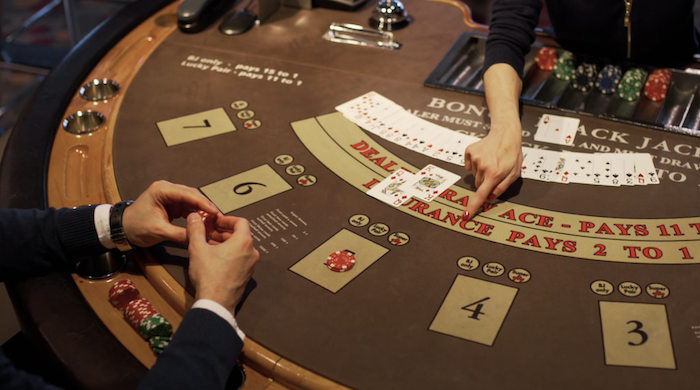
That difference creates some interesting possibilities for filmmakers. The old poker scene gives a director faces, hands, chips, smoke, glasses, and a room full of people reacting to one another. An online game can strip most of that away.
One character might be sitting alone in a dark bedroom, staring at a screen. There is still suspense, but the visual language has changed. The opponent may be nothing more than a username. The dealer may be digital. The cards appear on a screen instead of landing on green felt. For a filmmaker, that isolation can actually be useful.
Poker Became a Natural Movie Language
Poker has probably had the biggest influence on the way cinema uses cards.
The appeal is obvious. Poker is built around incomplete information. Players make decisions without knowing everything, while trying to work out what everyone else knows. That is practically a ready-made film scene.
Rounders built much of its drama around this idea. The cards are important, but the real focus is on reading people. A glance across the table can matter as much as the hand itself.
The same principle works in crime movies. A poker game can put several characters in one room and give each of them something to hide. Money raises the stakes, but suspicion often does the heavier dramatic work.
The best scenes do not require the audience to understand every rule. They understand that somebody has something to lose.
Cards Were Already Visual Objects
Playing cards were designed to be looked at long before cameras entered the picture.
Some historic decks are remarkably elaborate. The Metropolitan Museum of Art, for example, has examples of early European cards featuring detailed figures and decorative imagery. That history helps explain their usefulness on film.
A card has a front and a back. It can be shown or concealed. It can be turned over, held up close to the camera, or left face down on a table. Very few everyday objects offer so many simple visual choices.
There is also a built-in hierarchy. Kings, queens, jacks, aces, and numbered cards already carry different associations. Filmmakers do not need to invent that visual language from scratch.
The Reveal Is Half the Fun
Few props are better suited to a reveal. A character places a card on the table. The camera waits. Another character looks at it. Someone smiles.
The audience may not even know the rules of the game, but they understand that the card matters.
This is part of the reason Casino Royale could build such an extended sequence around poker. The game provides a framework for watching characters lie to one another without necessarily saying that they are lying.
A player who suddenly stops smiling might have received a bad hand. Or they might want everyone else to think they did.
The audience starts looking at faces, hands, and reactions rather than simply waiting for the next card.
That is good cinema because the viewer becomes part of the game.
A Little Comedy Goes a Long Way
Cards are just as useful when the stakes are deliberately low. A character who cheats at a family game can reveal more about themselves than a serious speech would. Someone who takes a friendly game absurdly seriously can become funny without saying much at all.
Because the audience already understands the basic situation, the filmmaker can move quickly. There is no need to explain why somebody hiding an ace under the table is suspicious. We know.
The Prop Has Outlived the Setting
The classic image of cards in movies is still easy to recognize: a table, a stack of chips, several players, and a close-up of someone’s hand.
But the setting has never been the real reason cards work. They are useful because they create uncertainty.
A card can be hidden. A hand can be misread. A player can bluff. A simple turn of the wrist can reveal information that another character desperately wanted to keep secret. That remains true whether the cards are physical or digital.
Cinema has changed its technology many times, but it still loves objects that make an audience curious about what will happen next. The playing card happens to do that with almost no effort.
Sometimes all a scene needs is one card lying face down on a table. The camera can take care of the rest.