The human soul does not live in our brain cells. It lives in the connections between them.
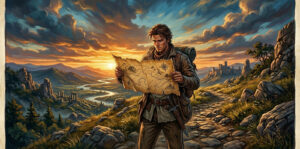
That is why stories matter. A true story is not content. It is a map of familiar emotional and life-experience territory. When a person encounters betrayal, grief, temptation, or tyranny in the real world, they reach for the stories that once rang true. The archetypes function as signposts on that map. They help the audience locate where they are, recognize the terrain, and find the path that leads home.
Jesus taught connection. Real art seeks connection. The opposite of connection is avoidance, and avoidance leads to capture: the conversion of every human relationship into a transaction, every audience into a dependent consumer, every moral horizon into managed uncertainty.
For two decades, the institutional storytelling class has treated the old maps with open contempt. Under the banners of subversion, modernization, and sophistication, they have systematically dismantled the signposts. Heroes are rewritten as exhausted failures or irredeemable oppressors. Moral clarity is treated as naive or dangerous. Redemption arcs are replaced with permanent ambiguity. The result is not greater complexity. It is disorientation.
“A true story is not content. It is a map of familiar emotional and life-experience territory.”
A generation raised on stories that teach them every ideal is a lie, every hero is a fraud, and every traditional virtue is a hidden mechanism of control does not become free. It becomes unmoored. An unmoored person loses trust in their own conscience. With all the facts in front of them, the simplest and most obvious conclusions can still never be reached. They lose the internal capacity to navigate suffering without an external authority telling them what to feel and whom to hate.
This conditioning goes further. People are trained to treat genuine connection itself as a threat, especially any connection that might guide them away from the broken ideas that are already hurting them. Disagreement is reframed as violence. Words are declared harmful. As a result, the person who tries to speak truthfully or offer a different map becomes the enemy. The risk of reaching out rises on both sides: the speaker fears being attacked or cancelled, while the listener has been taught that stepping outside the approved narrative is a form of betrayal. What remains is isolation enforced by mutual fear.
This is not an accidental side effect. It is a feature of a culture that has been taught to distrust its own orientation. Once people can no longer locate themselves on a reliable map, they become easier to manage. Some become dependent consumers, permanently incomplete and reliant on institutional products and authorities to tell them who they are. Others are flattered into something more active. Their ego is told they are the enlightened ones; those who still hold to the older maps are painted as dangerous, and therefore, through that flattery of their egos, their violence against them feels even more righteous. In that state, they can be turned into foot soldiers, useful enforcers willing to use social destruction, professional ruin, or even physical force against anyone who refuses conformity and speaks plainly about what they see happening.
KGB defector Yuri Bezmenov described the long process of ideological demoralization decades ago. Whether or not one accepts every detail of his account, the pattern he named is visible: erode the target’s confidence in its own history, its own heroes, and its own moral vocabulary until it no longer trusts its internal map. At that point the target becomes dependent on the new authorities for direction, and some portion of that target can be mobilized against the remaining holdouts. That wasn’t a conspiracy theory. That was his job as an agent of the U.S.S.R.
“Let them keep the ruins. We will build our own cinema, speak directly to the people they abandoned, and put the signposts back in the ground.”
Corporate entertainment benefits from this condition. An audience that feels complete and oriented is a bad customer for an industry built on endless consumption and managed anxiety. A story that actually satisfies, that sends the viewer back into their life stronger and more capable of real connection, is a commercial threat to an empire that requires perpetual incompleteness.
The independent creator’s task is therefore not to beg the institutions to repair the maps they deliberately neglected. The task is to draw new ones.
When I stand at the workbench shaping foam, running cable controls, and building practical creatures, or AI pipelines* for my upcoming movie Escape From Planet Omega-12, I am not merely making visual effects. I am building the untainted assets of what I want to see in the world. I’m refusing the premise that the only sophisticated posture is cynicism. I am asserting that love still demands courage, that sacrifice still means something, and that flawed human beings can still find the path home. I’m declaring before God and fellow man that I believe in the human soul, and it has worth.
The old institutional cathedral broke the compass because a captive congregation is easier to manage than a free one. Let them keep the ruins. We will build our own cinema, speak directly to the people they abandoned, and put the signposts back in the ground.
The soul lives in the connections. Our job is to make those connections possible again, and to make the risk of offering them worth taking.
Christopher Moonlight is an animator, special effects artist, and the director of the ‘Award This’ winning movie, The Quantum Terror. His upcoming animated sci-fi adventure, Escape From Planet Omega-12, combines traditional film-making special effects with AI to create something never seen before in independent film. You can follow the behind-the-scenes, including tutorials, tips, and tricks, on his YouTube Channel, Substack, and christophermoonlight.productions website.
* And there are upcoming tutorials for those interested.