Central to that shift is Cosm’s concept of “Shared Reality,” a term the team uses deliberately. “We love to transport people,” Scalice explains, describing experiences that feel “like virtual reality, but without a headset.” The difference is crucial: instead of isolating viewers, Shared Reality amplifies collective presence. Jay Rinsky of Little Cinema describes it as a new storytelling canvas, far beyond panoramic formats like ScreenX. “Here you’re really dealing with a full dome… something that feels realistic,” he says, comparing it to Cosm’s sports programming, where it feels “like you’re literally looking into the field.” In this format, films aren’t arbitrarily expanded; they are carefully enveloped, allowing the audience to feel immersed in the world while still watching the original movie intact.
That restraint is by design. Creative Director Kirk Shintani emphasizes that “the film is the hero, and we don’t want to mess with the intent of the film.” Instead, Shared Reality is additive—using environment, motion, and scale to deepen what’s already there. The creative process focuses on three elements: “the visuals, the emotional impact of the moment, and the physical reaction to what you’re watching.” Rinsky frames it as a dialogue with the film itself, noting that the format allows creators to “have a conversation with the original film and a creative dialogue that’s contemporary to our time.”
Cosm’s Shared Reality experiment gained traction quickly with The Matrix, a title Jay Rinsky calls “the ultimate first film” for the format. “The Matrix kind of questions your own sense of what reality even is,” he explains, noting that the 25th anniversary made the timing feel almost accidental in its perfection. What began as a leap of faith soon became proof of concept. Early conversations with studios were cautious, Rinsky admits, because this was “a complete white canvas, a complete new technology,” but once The Matrix debuted, the conversation shifted. Instead of explaining what Shared Reality was, Cosm could show it—and audience reaction did the rest. As Alexis Scalice puts it, one of the most telling responses has been hearing fans say, “I’ve seen this movie a number of times, but I feel like I’ve seen it for the first time today.”
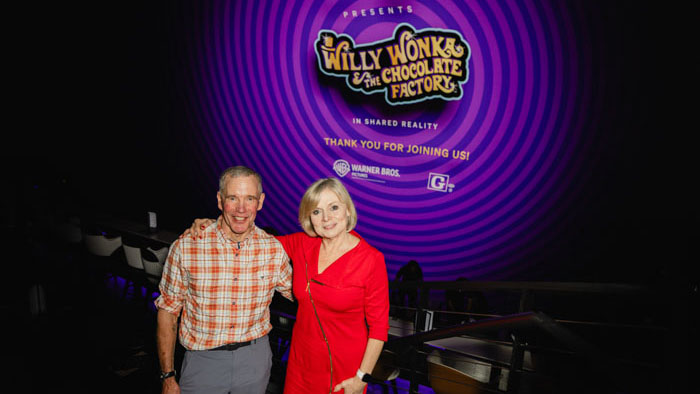
Peter Ostrum (Charlie Bucket) and Julie Dawn Cole (Veruca Salt) attend the Shared Reality premiere of Willy Wonka and the Chocolate Factory at Cosm.
“Once the movie begins, the environment expands around the film, pulling the audience fully inside the world without altering the movie itself.”
That momentum carried directly into the premiere of Willy Wonka and the Chocolate Factory, a film chosen not just for its iconography but for its emotional reach across generations. Scalice describes it as “a family entertainment during the holidays” that allowed Cosm to “reinvigorate a classic and bring in new guests at the same time.” For Creative Director Kirk Shintani, Wonka offered an opportunity to push the format further, particularly in moments such as the Chocolate River and the infamous tunnel. The result was a shared experience where parents revisited a childhood favorite while children encountered it as something entirely new—an outcome Scalice calls “a really amazing cross-generational opportunity.”
Now, all eyes are on Harry Potter and the Sorcerer’s Stone, a project the team openly describes as the next major leap. Scalice frames it as “bringing to life a completely new type of experience for Potter fans all over the world,” while Rinsky calls it “the ultimate world to be thrown into.” The creative challenge, he notes, is honoring the film’s pacing and emotional beats while tapping into the expanded vocabulary of Shared Reality. For Shintani, the guiding principle remains unchanged: “The film is the hero.” But expectations are undeniably higher. As Scalice puts it, the hope is that audiences leave thinking, “I can’t wait to see what’s next.” If The Matrix proved the concept and Willy Wonka broadened the audience, Harry Potter may well determine whether Shared Reality becomes a permanent pillar of theatrical exhibition rather than a fascinating detour.
A recurring theme throughout Cosm’s approach to Shared Reality is a deep respect for the original film. This philosophy contrasts with other premium formats that aggressively alter or extend imagery. From the outset, the creative mandate has been clear. “What we want to do is draw the audience into the film,” Shintani explains. That respect extends down to the most granular creative decisions. Shintani points out that even small changes can have outsized emotional consequences: “If it’s meant to be a tight shot, it’s a really emotional scene. If you’re expanding that out, then it doesn’t become a tight shot anymore, and the emotional resonance for that moment changes.” Jay Rinsky echoes that concern, describing Shared Reality as “a conversation with the original film and a creative dialogue that’s contemporary to our time,” not a replacement for the filmmaker’s vision. The team repeatedly emphasizes that this isn’t about showing audiences more of a scene, but about making them feel closer to it—emotionally and physically—without undermining the original intent.