Margret’s character, and all of the Wittmers, felt true to the real story. Though a bit overwhelmed upon first arriving on Floreana, they adjusted well, built a house and a life, and thrived there; in fact, descendants of the Wittmers are still on Floreana today. The Baroness — flamboyant, self-involved, demanding, selfish, and aggressive — felt genuine as well; though she may come across as over-the-top to some viewers, this is exactly who she was, and it was great fun to see her come to life on screen.
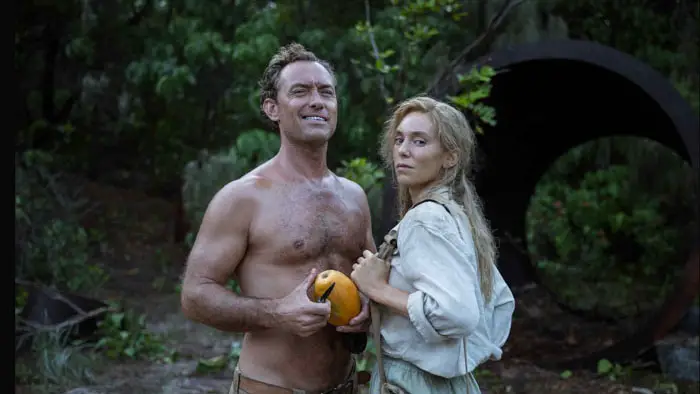
Among the stranger-than-fiction details that Eden includes are that Friedrich had his teeth removed and used stainless steel dentures (Jude Law as Friedrich shows off a gummy smile and pops in the dentures at mealtimes). Another unforgettable real-life incident is that is that Margret gives birth to Floreana’s first native human all alone. One detail is different — in the film, she discovers she’s pregnant after arriving on Floreana, whereas in real life, she and Heinz already knew and, in fact, had chosen the island due to its resident doctor. In real life, as in the film, however, Friedrich was not keen on being of help and did not, until Margret suffered complications later.
I was most intrigued to see how the film ended, as this presented — for me as well as for Howard, I imagine — the biggest challenge: how to conclude a story that has no known conclusion, and how to do so in a way that feels authentic.
What happened to Robert Philippson and the Baronness is still not known, but theories abound: that Friedrich and Heinz killed them. That Rudolf Lorenz did. That the two of them left the island alive and well. The memoirs of Dore and Margret have different theories: Margret reported that the two left on a private yacht for Tahiti on March 27 of 1934 — yet no ships were seen on Floreana around that time. Dore claims to have heard a scream midday on March 19, and she later noticed that some of the Baroness’s things appeared in the Wittmer home. Dore became suspicious of Rudolf Lorenz and Margret Wittmer, and Margret wrote that she suspected Rudolf Lorenz and Friedrich Ritter. To this day, no one knows what happened. Without giving away this part of the ending of either Eden or Floreana, I can say that Howard’s and screenwriter Noah Pink’s idea for what happened to Philippson and the Baroness is perfectly plausible, albeit a bit more dramatic than mine — but it is a film, after all.
“…faithfully reimagined a story I’d spent years researching…”
As for Friedrich’s demise, Dore’s and Margret’s versions are likewise completely different. What happened is that Friedrich died after eating poisoned meat — and he’d been a vegetarian, albeit a lapsed one. According to Margret, Friedrich scrawled a note to Dore before he died, writing, “I curse you with my dying breath.” And according to Dore, Friedrich reached his arms out to her, his gaze “joyously tranquil,” and told her, “I go; but promise you will not forget what we have lived for,” just before he died. The fictionalized version of events is very much the same in both Eden and Floreana — Eden’s version is a bit more cunning (in the best way), and Floreana’s has an unexpected twist.
With so many different ways to tell the story, Eden succeeds in staying true to recorded events while creating endings that are credible and dramatic. Most of all, I enjoyed seeing this story come to life in living color, with amazing cinematography and performances — and, at the end, seeing actual footage of the settlers back in the 1930s. Though most of the movie was shot in Queensland, Australia, Howard includes stunning footage of Floreana Island — and the film captures the sounds that I’d until now heard only in my mind: the constant buzzing of insects that plagued the settlers, the cries of the wild animals that challenged them, and the presence of human neighbors that they’d all fled Europe to avoid.
Midge Raymond is the author of Floreana, a novel inspired by the same events featured in Eden and hailed by the New York Times as “rich, evocative new historical fiction.” Her work has appeared in such publications as the Los Angeles Times magazine, Chicago Tribune, Electric Literature, LitHub, Poets & Writers, and many others.