In September of 2024, Ron Howard’s film Eden premiered at the Toronto Film Festival, just three months before the release of my novel Floreana. Apparently, we’d had the same idea: to reimagine the real-life events of the Galápagos Affair and seek resolution for the still-unsolved mysteries of what happened on Floreana Island in the 1930s.
It’s a story that, for a filmmaker and a novelist alike, is irresistible. In the early 1930s, three small groups of Europeans settled on the uninhabited Galápagos island of Floreana. The first were German lovers Dore Strauch and Friedrich Ritter, who left their spouses in Berlin in 1929 to start a new life together. As they wrote letters home, word got out in European newspapers, which inspired another wave of settlers: Heinz Wittmer, his pregnant wife, Margret; his teenage son, Harry; and, soon afterward, an Austrian woman known as the Baroness, along with her two German lovers, Rudolf Lorenz and Robert Philippson. By 1934, the Baroness and Robert Philippson had disappeared, and Rudolf Lorenz and Friedrich Ritter were dead. The Baroness and Philippson were never seen again — and the other two deaths are shrouded in mystery.
Howard has said he first heard the story of the island’s first settlers fifteen years ago — for me, it was eight — and I imagine he might’ve had the same thought I did, which was “Why has no one told a fictional version of this story?” And then, in the fall of 2024, Eden and Floreana were both out in the world.
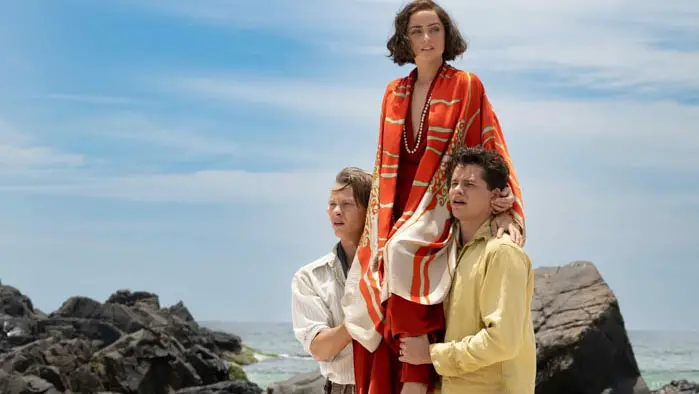
“…the still-unsolved mysteries of what happened on Floreana Island…”
As I’d begun researching the real story years earlier, I discovered there were only a handful of sources available: Dore Strauch’s memoir, Satan Came to Eden; Margret Wittmer’s memoir, Floreana; the book The Galápagos Affair by John Treherne; and the documentary The Galápagos Affair: Satan Came to Eden, directed by Daniel Geller and Dayna Goldfine. And with few sources, I was able to let my imagination take over —my biggest decision was from which point of view to tell my own version of the story: Dore’s, Margret’s, the Baroness’s, or some combination thereof. Ultimately, I chose to re-imagine Dore’s story from the perspective of hidden diaries found by a penguin researcher on the island in the year 2020.
And when, last month, I finally got to see Eden once it arrived in theaters, I loved it not only because it (for the most part) faithfully reimagined a story I’d spent years researching and (re)writing, but it portrayed the Galápagos Affair and its main players in slightly different ways than my own reimagining — and still felt authentic.
While the historical part of Floreana focuses on Dore’s life, Eden summarizes Dore and Friedrich’s arrival in the opening credits and begins with the Wittmers, who had arrived several years after Dore and Friedrich, in 1932. While it’s a natural place to begin the film — because it’s when the Baroness arrives, soon after the Wittmers, that all hell breaks loose — filmgoers do miss out on the story of Dore and Friedrich, which to me was the most fascinating. For one, they were the first to settle on the island, and the others had it slightly easier thanks to them. Additionally, this situation wreaked havoc on their relationship, and I found their descent into bitterness among the most interesting aspects of the historical content.
In Eden, on the other hand, Dore and Friedrich feel rather well matched, whereas Dore’s memoir expresses dismay at how life with Friedrich wasn’t at all what she expected, and she becomes very lonely as he disappears into self-absorption and his own work. Some of this does come across in the film — and they are certainly bonded in their disdain for the other settlers — but Dore’s character feels both stronger and colder on the screen than I’d garnered from the pages of both her memoir and Margret’s.