Have you ever heard the saying, “The enemy of good is great”? Okay, okay, we’ll come back to that one.
You may have heard it said that we are in a spiritual war. How about that one? If you’re online, then probably. But depending on who you ask, the answers to what that means will often be as vague as they are diverse. I believe that this is mostly to do with the fact that a large chunk of this struggle is to keep you and me from understanding who we are as individuals on our personal quest for enlightenment. As to what entity within the collective consciousness is responsible for this, or why it is so important to it that we lose our way, I don’t know. But the struggle is real, and the prize is our identity, our freedom, and our soul.
If you’re wondering why that sounds so dramatic or what it has to do with AI, I first have to take you down a brief history of my career as an underground artist, publishing zines, showing in dive galleries, and working on indie film projects so obscure that they will soon be lost forever in the back alleys of Hollywood history.
My story starts with my music industry parents moving us from England to just outside of Los Angeles, California, where I was poured like water into seven layers of oil, into a hub of entertainment with all its glorious ‘80s action movies, sci-fi, horror, punk rock, heavy metal (my dad’s line of work), comic books, and the budding video store industry. We were a lower-middle-class family, so a chance to take part in any of these things, at any time, always felt special. My mom signed me up as a child model to do a few print gigs, but I never passed a TV audition. As I grew into a teenager, strangely, the idea of being a filmmaker, effects artist, or getting published as an illustrator was viewed as too far out of reach for our ilk.
“For me, AI is the new copy machine. It’s the new late nights at Kinko’s.”
However, the allure of so much happening so near to us captured my imagination. Cutting-edge comic books like The Crow and Dark Horse’s movie tie-ins, monster magazines, and a fresh, new MTV lit up the little TV in the corner of our family room bright enough to cook me into the golden brown of what I would become. As soon as I had my driver’s license and enough money saved up to buy a used car, I was off on my quest to find where I might fit in among all of this.
The first few miles didn’t take me far, only to the perimeter of chaos, where the edgy coffee shops and record stores of my small town and the surrounding ones would host aspiring bands experimenting with and exploring every corner of the ‘90s alternative boom. But as I made my way further, I discovered the Valley and Hollywood. It was filled with eccentric, beautiful girls who knew the coolest goth clubs, art galleries hosting names I knew, giant comic book stores, and ingeniously talented people who didn’t mind if I hung out and took pictures with the camera I always had hanging around my neck. That part will be important later, because almost no one did that back then, and cell phones with cameras wouldn’t truly be a thing for almost another decade.
Something you won’t hear about much, but which was a huge necessity for the scene, was Kinko’s 24-hour copy shop. This was where pre-internet promotional flyers and invites for events could be made in bulk. It became the language of that scene because it was cheaper than silk-screening and traditional printing. A Xerox machine at Kinko’s in the ‘90s was basically a giant, noisy, refrigerator-sized copy robot. You’d lift the heavy lid, lay your original paper face down on the glass like a sacrifice, close it, and press a big green button. It would flash a bright light underneath, hum loudly, and spit out warm black and white paper duplicates using toner powder, one at a time, while people waited impatiently behind you to make copies of their business documents. However, if you went there at, say, 2 AM, it could very likely turn into an empty personal art studio and print shop, with an enthusiastic staff (who were otherwise bored) willing to dish out big discounts.
Here is where I would find my vision, my voice, and my style for the first time. Let me take you through the process, and then I promise we’ll talk about how this ties into AI and our quest for the soul. This is all relevant.
By this time, I was interviewing bands, club DJs, and artists, as well as experimenting with a slice-of-life goth comic I called The Black Lipstick Curse. It was inspired by comic books like The Crow, Sandman, Love and Rockets, and a series called Alec by Eddie Campbell, who was most famous for illustrating From Hell with Alan Moore. I wanted to put it into a zine (an amateur magazine made on a copy machine) I had conceived called Mary’s Mother’s Scream, but there were problems. With no copy editor or spell check, my dyslexia meant that it was riddled with horrific spelling errors. Even more glaring was that because I couldn’t afford a commercial printer, pages run off on a standard copy machine and hand-stapled together made my paintings and photography look muddy and amateurish.
“It’s the new thing that creative people have to test themselves and their creativity against to see what happens.”
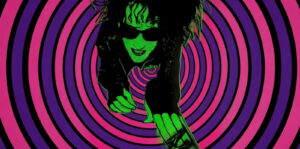
But what I soon realized was that if I blew up a photograph a bit bigger, took that copy, put it back into the machine, and copied it again, after repeating the process three or four times, the result changed. It became a degraded, yet starkly graphic black-and-white image with no muddy gray tones. I could do fun things with that, like paint or draw details onto it, add lace or fishnet, cut it up and paste it back together, and then copy it again to create something that looked slick and unlike anything any other medium could produce. It was my own thing, born out of my willingness to adapt to the limitations of the technology. For me, it was cool because I was being influenced by artists like Alex Ross and Dave McKean, who seemed so cutting-edge by painting what should be drawn, sticking photographs over paintings, and painting over them again. The mark of my soul and the mark of the times I was a product of had fused together to make something no one else could.
And what was the reaction?
Mainly, comments like: “This looks like amateur hour.” Or, “Why are you taking the lazy way out? You should just be drawing this. Why are you spending all of your talent on these no-name freaks who will never be anything?” Or, “Your stories would be better if you changed them to be more like this, so they’ll appeal to a wider audience.” And, “No one is ever going to publish you if they see that you’re just doing everything with copy machines and bad spelling. This work isn’t as good as it needs to be.”
I don’t want to say they were entirely wrong, or that they didn’t mean well, but as Oscar Wilde once said, “There’s nothing more dangerous than advice, and good advice can be absolutely fatal.”
Here, I’ll get to the point. Most of the work wasn’t ready for the big time, but within it there were things that were far better than I even realized at that time, and they would become the kernels of who I am as an artist today, as well as my small part in goth history. The sad thing is that I let the people I listened to compromise that vision for many years, bending and distorting it in service of their much less inspired ideas, leaving me diminished and unhappy, but not understanding why. I could have been a lot further along if I had stuck to my guns and seen the value in working outside of expectations set by people who were too attached to what had already been done before. I couldn’t match the greatness of their expectations, so they were unable to see the good in what I had accomplished, using tools they refused to understand. They saw my efforts as a shortcut for their needs, an attempt to graft themselves onto something they themselves didn’t earn but wanted to be a part of. It didn’t work for them, though, and it didn’t work for me, because I wasn’t made to be that.
Now, I can see those who are against AI reading those last couple of sentences and saying to themselves, “Yes! AI is for people who didn’t earn it. You see? It’s slop and we should all reject it.” But those are the people who just refuse to be convinced of anything, no matter what the evidence says. For me, AI is the new copy machine. It’s the new late nights at Kinko’s. It’s the new thing that creative people have to test themselves and their creativity against to see what happens.
“The struggle is real, and the prize is our identity, our freedom, and our soul.”
The spiritual quest takes many forms for each of us, depending on our makeup as individuals who have different needs and desires as we seek out the truth of our reality and strive to connect to something greater than ourselves, something divine. The spiritual war is with those who have been captured collectively through the black mirror, where a “worm-tongue” whispers that we should be able to turn rocks into bread, carelessly step off of cliffs without consequence, and that we can have it all for the price of causing a little (or a lot of) suffering to those who refuse to live in an echo of malevolent conformity. It is spoken by a bitter deity that demands you worship it by burning down everything around you in some delusional revolt, just because there are still some injustices within it. When it doesn’t work out, the resentment builds even more.
Pardon me, but it’s just too juvenile a concept for me to embrace. Of course, there are injustices in the world. Of course, as we build new infrastructures and data centers there will be tradeoffs. But to pretend that it’s all going to go horribly wrong, that we can’t mitigate risk, that any effort to iterate and scale new ideas must be born out of some sort of corrupt and greedy intent by an all-controlling “one percent” that only take and destroy, rather than the collective efforts of individuals who carry visions within them, and therefore it must all be razed to the ground, is a product of short-sighted and resentful thinking.
Rather than just accepting such a nihilistic and cynical notion, we should be asking ourselves where these ideas are coming from, and what endgame they aim to achieve. They’re certainly not offering a better system in its place, and new ones don’t just spring up out of the ground when the established ones are torn down. Civilization certainly didn’t start that way. It was born out of human beings who were tired of the chaos and starvation of living in the wilderness, their young ones eaten by animals; who struggled in ways we cannot conceive of through famine and disease so that we could live in impossible levels of safety and comfort, free to pursue even greater security, enlightenment, and connection to our fellow mankind.
“The mark of my soul and the mark of the times I was a product of had fused together to make something no one else could.”
What comes next is up to us. Will we just keep repeating the same temptations that lead us into these bizarre and unproductive downward spirals? Will “Stop Oil” become “Stop Data Centers,” blocking traffic and splattering our impassioned works of devotion and vision with corporate-manufactured soup products, on behalf of the veiled voices they worship and who whisper from halfway around the world? They have been brainwashed into being activated sleeper cells for disruption and violence against the freedom we may find; not thinking, not living, only breaking what they see around them, and then wondering why they’re miserable.
Or, will we accept the risks of stepping into yet another unknown frontier, where we not only push the limits of our imagination artistically, but we extend the quality of life we enjoy to places where it’s still needed? Finding cures for cancer and disabilities, extending life, improving health, and enjoying new opportunities to connect with the people we love.
Which way? Because I truly believe it’s not a matter of what’s possible. They both are: the suffering and the possibilities. What really matters is that we believe that we, as human beings, do, if we choose not to throw up our hands and declare it all hopeless, have the right stuff within us to navigate this new and chaotic territory, and find the things we need within ourselves to not only survive, but build it into something better.
Which way? Which way?
Christopher Moonlight is an animator, special effects artist, and the director of the ‘Award This’ winning movie, The Quantum Terror. His upcoming animated sci-fi adventure, Escape From Planet Omega-12, combines traditional film-making special effects with AI to create something never seen before in independent film. You can follow the behind-the-scenes, including tutorials, tips, and tricks, on his YouTube Channel, Substack, and christophermoonlight.productions website.