
Anthropic dropped Claude Fable 5 on June 9, 2026, and it’s been hard to ignore. If you’ve been following AI news at all, you’ve probably seen the benchmarks, the demos, the hype. But hype aside — what does Fable 5 actually do, who is it for, and are there situations where you’d want something different? Let’s walk through it.
What Is Claude Fable 5?
Claude Fable 5 is Anthropic’s most capable publicly available model to date. It belongs to what Anthropic calls the “Mythos class” — a tier of models previously gated behind a restricted program called Project Glasswing. Fable 5 is essentially that same capability, made available to everyone.
The headline numbers: a 1 million token context window, up to 128K output tokens per request, and pricing set at $10 per million input tokens and $50 per million output tokens.
What It’s Actually Good At
The clearest way to describe Fable 5 is: it handles long, hard tasks that previous models needed constant hand-holding to complete.
Coding. Fable 5 writes its own tests, checks its work against design goals using vision, and can run inside agent harnesses like Claude Code for multi-day projects. It delegates to sub-agents, tracks dependencies, and keeps going without constant check-ins.
Knowledge work. Complex research, document-heavy workflows, deep analysis — Fable 5 handles these with minimal oversight. You hand it the goal; it returns finished work for you to review rather than a rough draft requiring another ten prompts to fix.
Vision. It can extract data from charts and scientific figures, rebuild web apps from screenshots alone, and use visual feedback to verify its own outputs. Earlier Claude models struggled with things like playing Pokémon FireRed even with extra tools. Fable 5 completed it with a vision-only setup.
Long-horizon autonomy. When run inside an agent framework, Fable 5 can sustain multi-day projects — planning across stages, routing around blockers, and coordinating sub-agents across the full task.
The Safety Trade-Off
Here’s something worth knowing upfront. Fable 5 ships with safety classifiers that can decline certain requests. If your query touches cybersecurity, biology, chemistry, or frontier AI development topics, it might fall back to Claude Opus 4.8 instead of responding directly. Anthropic says this triggers in fewer than 5% of sessions, so most people won’t notice it. But if you’re doing security research or working in a sensitive domain, it’s something to plan around.
Who Should Be Using It
If you run complex software projects, do heavy research work, or need an AI that can genuinely complete a multi-stage task without babysitting — Fable 5 is the most capable option currently available to the general public. Legal teams, engineering teams, and researchers are already seeing meaningful results with it.
Two Alternatives Worth Looking At
Fable 5 is impressive, but it’s not the right fit for everyone. Maybe the price point is a concern. Maybe you want something you can run as a persistent agent across your tools and apps. Maybe you need a different model for a specific kind of task. Here are two options that are genuinely worth considering.
MyClaw — A Hosted Agent That Stays Running
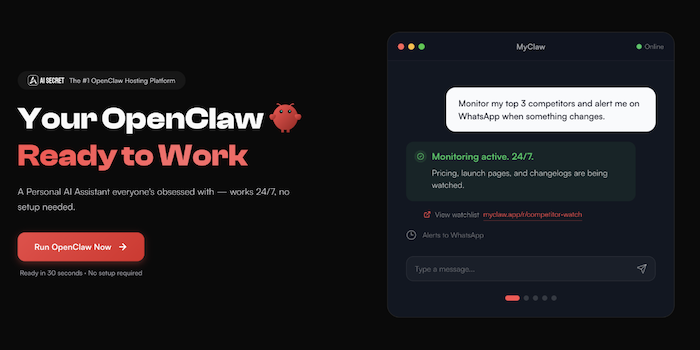
If what you actually want isn’t a raw model but a working AI assistant you can set up once and leave running, MyClaw is worth a close look.
What MyClaw Is
MyClaw is a managed hosting platform for OpenClaw, an open-source AI assistant. The pitch is simple: OpenClaw is powerful, but setting it up yourself is annoying — you have to configure models, connect your tools, build workflows from scratch, and keep the runtime alive. MyClaw handles all of that for you. You get a fully configured, always-on AI agent in about 30 seconds.
What It Can Do
This is where MyClaw goes well beyond “just another Claude wrapper.” It can browse the web, write and run code, generate files, and bring finished outputs back to you — not just answers.
It connects to over 15 channels, including Gmail, Google Docs, Google Sheets, Slack, WhatsApp, Telegram, GitHub, Notion, Jira, and Discord. You can interact with it from wherever you already work, and it can take action across those same tools.
It also runs on a schedule. Set it up to monitor prices, triage your inbox, send daily reports, or watch a webpage — and it keeps going without you touching it again.
One thing that sets MyClaw apart from most AI tools is model flexibility. It’s not locked to one provider. You can route tasks to Claude for reasoning, GPT for coding, Gemini for long context, MiniMax for fast runs, DeepSeek for cost control, and so on. The right model for each job, rather than one model for everything.
Pricing
Plans start at $16.60/month (billed yearly) for the Lite plan, going up to $66.60/month for the Max plan. Each tier gives you a dedicated, private, encrypted container with different CPU, RAM, and storage specs.
How It Differs from Fable 5
Fable 5 is a model. MyClaw is an agent platform. If you want to send a query and get a response, Fable 5 via Claude.ai or the API is the direct route. If you want an assistant that stays running, connects to your actual tools, works on a schedule, and can handle tasks across your apps while you sleep — MyClaw is the better fit.
MiniMax M3 — Long Context and Agent Work at Speed
The second alternative is a model rather than a platform. MiniMax M3 came out on June 1, 2026, and it’s specifically designed for long-context reasoning, coding, and autonomous agent workflows.
What MiniMax M3 Is
M3 is built around MiniMax Sparse Attention (MSA), an architecture designed for ultra-long context pretraining. The result is a model with up to a 1 million token context window — matching Fable 5 — while staying practical in terms of latency and throughput at those extreme lengths.
Input modality covers text, images, and video. If your workflow involves screenshots, documents, charts, or mixed-media inputs alongside code, M3 handles all of that natively.
What It’s Built For
Three main areas: coding and software tasks, long-context reasoning, and agentic workflows involving tool calls and browsing-style retrieval.
On coding benchmarks, M3 scores 59.0% on SWE-Bench Pro — a strong result for software engineering tasks involving real repositories and implementation work. The model is positioned for terminal tasks, large codebase reviews, and implementation-heavy agent sessions.
One demo that stood out from MiniMax’s own testing: in a CUDA kernel optimization task, M3 ran autonomously for about 24 hours, made 147 benchmark submissions, and executed 1,959 tool calls — all while continuing to improve after hitting performance plateaus. That’s not a typical benchmark result. It shows what long-horizon stability actually looks like in practice.
M3 vs Fable 5
Both have 1M context windows. Both handle coding and agent work. The differences come down to a few things:
Fable 5 has deeper integration with the broader Claude ecosystem — Claude Code, Claude Managed Agents, native vision for self-checking work. It’s also the more cautious model in terms of safety guardrails.
M3 is more open in terms of where you can use it. It runs inside MyClaw alongside other models, which means you can slot it into a multi-model workflow rather than committing to a single provider. If speed and cost efficiency matter for long agentic runs, M3’s architecture is designed with that in mind.
If you’re doing pure model evaluation for complex tasks and you want the most capable single model available, Fable 5 is the current benchmark leader. If you want a strong coding and agent model that works well inside a broader tool ecosystem — especially via MyClaw — M3 is a compelling option.
So Which One Do You Actually Need?
Here’s a simple way to think about it:
Go with Claude Fable 5 if you want the most capable AI model available right now for hard coding problems, deep research, and complex long-horizon work. It’s the top of the market as of June 2026, and it earns that title.
Go with MyClaw if what you need is an always-on agent that connects to your tools, runs on a schedule, and handles real tasks across your workflow — not just a model to query. The multi-model flexibility is a genuine advantage if you want to mix and match for different jobs.
Go with MiniMax M3 if you’re doing serious coding and agent work and want a model with 1M context, strong benchmark performance, and the ability to run inside flexible, multi-model platforms like MyClaw.
The honest answer is that these tools aren’t really competing head-to-head. Fable 5 is the raw model for the most demanding individual tasks. MyClaw is the infrastructure layer that makes an AI agent actually useful across your day-to-day tools. And MiniMax M3 is the under-the-radar model that deserves more attention than it’s getting right now.
All three are worth trying in June 2026. The gap between what these tools could do six months ago and what they can do today is significant — and that gap is only going to keep widening.



This is fake news, probably written by AI and scheduled weeks ago with no-one reviewing. Fable 5 is not available as of the date of this article and only was available June 9-12. The article spreads false information