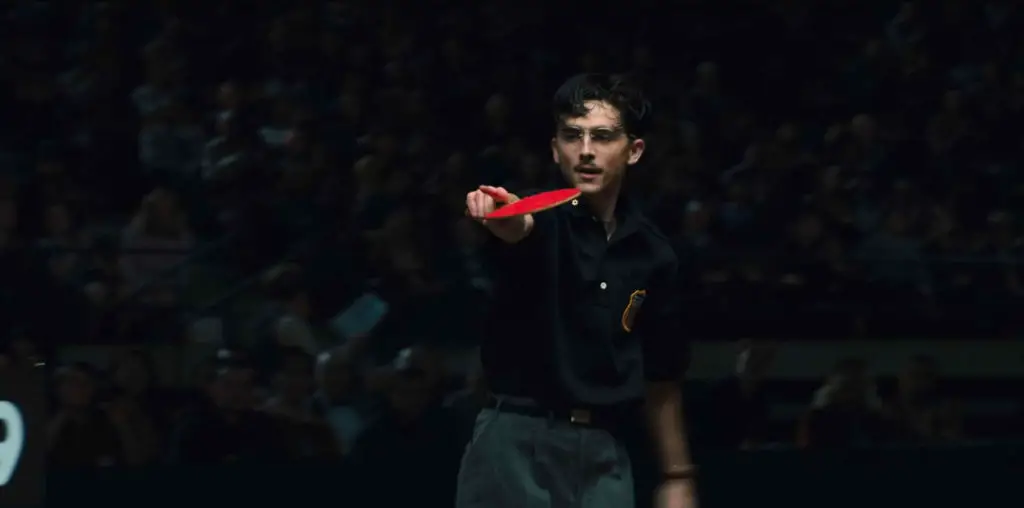
The Safdie brothers’ meteoric rise in Hollywood after just a handful of films came to an abrupt halt when Josh and Benny decided to go their separate ways. For their first solo projects, each made a historical sports film within the same year. Both secured a megawatt star as the lead: Josh bagged Timothée Chalamet, while Benny signed The Rock himself. The mighty Dwayne Johnson to star in The Smashing Machine, a real-life tale of one of the first UFC champions, Mark Kerr. One of those films was a flop, critically and at the box office; it wasn’t the ping-pong one.
Mixed martial artist Mark Kerr paved the path for what ultimately became one of the most popular and profitable sports of all time: UFC. The story details his tumultuous rise to sort-of fame, inevitable addiction, and relationship with Dawn Stapless (Emily Blunt). It is all shot in splendid, grainy beauty by cinematographer extraordinaire Maceo Bishop.
There are multiple reasons why Benny Safdie’s earnest-to-the-core and just-as-flawed film didn’t resonate with audiences. It strives as hard for authenticity as its protagonist does to remain relevant; the strain shows. Whereas, say, The Wrestler — a gritty sports flick/character study this one tries desperately to emulate — flowed smoothly and dug deep, this one remains surprisingly surface-level, despite a truly committed (also to a fault) performance from its lead. While the arthouse crowd balked at the lack of novelty, Johnson’s fans expected more smashing in a film titled The Smashing Machine. Instead, they got a watered-down sports movie, with most of the on-stage tension taken out. And the familial stuff is just so familiar: Mark does drugs, gets violent, Dawn tolerates it, and resolutely stands by his side, as he allows his ego to demolish their lives, bit by bit.
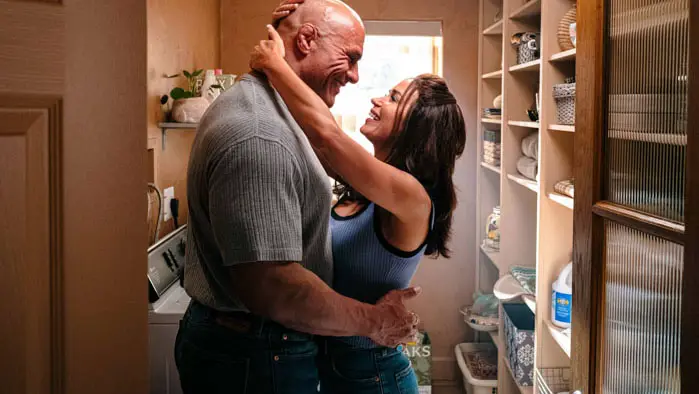
Dwayne Johnson, Emily Blunt. Credit: Eric Zachanowich
“…does drugs, gets violent, Dawn tolerates it, and resolutely stands by his side, as he allows his ego to demolish their lives, bit by bit.”
The make-up is phenomenal as Johnson is barely recognizable under layers of prosthetics. He gives it his all, and…well, sometimes the struggle is real, folks. Mickey Rourke so fully inhabited his role that it didn’t feel like acting; it felt like a man ripping off his skin to reveal his bloody heart and soul. Johnson’s great, but he is not Mark Kerr. He’s Johnson doing a really good impersonation of Kerr. Alas, in a case of fiction-molding-with-reality, Johnson’s star may be fading; I’ll let the next Jumanji prove me wrong.
Emily Blunt is a talented actress, but she’s not given a lot to work with here: yet another conflicted yet grotesquely supportive wife of a self-absorbed, violent egomaniac. Ryan Bader provides poignant support as Mark Coleman, the man who should consider acting for a living; he’s a natural. Ironically, his sequences with Johnson resonate more than the ones between Johnson and Blunt.
The one standout moment that truly approaches the level of subtlety Safdie’s aiming for is the “cactus sequence.” Here, a disheveled Mark rambles on about inconsequential things by the poolside, unable to relax and be content. Along with Blunt’s perfectly calibrated reaction, it has the subliminal tension, that “unsaid thing that matters most,” which I was looking for in the entire film.
Sure, the ending is somewhat inspiring and kind of sad. Safdie is a talented filmmaker who knows how to stage a sequence. I just expected more from this guy and therefore, more from The Smashing Machine. It’s too early to judge, but based on these two films, there’s only one Safdie brother who reigns supreme: the ping-pong one.
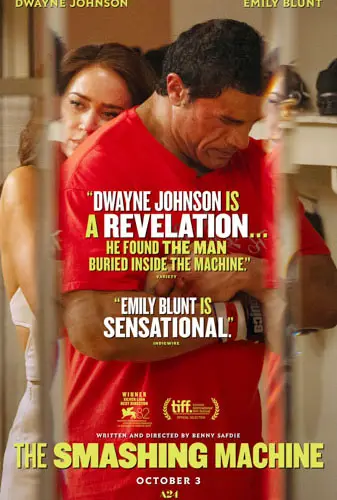
"…the make-up is phenomenal as Johnson is barely recognizable under layers of prosthetics."