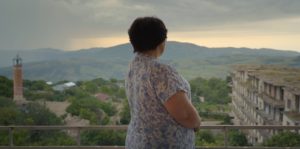
There Was, There Was Not is a documentary in two distinct acts. Through no fault of the subjects or director Emily Mkrtichian, the film was forced to become something different and more harrowing right before the audience’s eyes, so to speak. Bobby LePire had the opportunity to talk with Mkrtichian, who discussed how she pivoted and what went into portraying the tragedy at hand. Most importantly, she dives into survival, trust, and keeping a culture alive.
There Was, There Was Not did not turn out to be the documentary you thought you were making. When war broke out, was your first instinct to keep filming? If so, why?
By the time the war broke out, I had already been filming with these four women for about four years. We had built close, trusting relationships, and I understood their rhythms, their hopes, and the texture of daily life in Artsakh. The film was meant to be a meditation on women’s lives in a post-conflict landscape — on the small, quiet acts of rebuilding that follow war.
When I woke up that morning and saw the headlines, I actually had a ticket to fly home to the U.S. the next day. Instead, I picked up the phone and called each of the women. Sose was already in a car on her way to the front line; Siranush was standing outside the parliament building with drones circling overhead. It was immediately clear that their lives, and the story we were telling, had shifted completely.
Because of my closeness to them, I knew I wasn’t going home. It wasn’t even a question. My first instinct was to stay and keep filming, because in that moment, documenting felt like the only way to hold on to what was happening — to make sure their stories, their voices, their courage didn’t disappear into silence.
Of course, I wasn’t trained for conflict reporting, and I felt the fear and uncertainty of that. But I also understood that if no one documented this moment, it would be as if it never existed — and I couldn’t allow that erasure.
Gayane Hambardzumyan, Svetlana Harutunyan, Siranush Sargsyan, and Sosé Balasanyan are very different women. What drew you to these distinct individuals? And what was it like getting to know them so well?
Meeting each of these women was a gradual, organic process that unfolded over years. I first met Sveta while making a short film about women deminers — she was among the first women in Artsakh to go out into minefields after the 1990s war. I met Gayane and Siranush through mutual friends in Yerevan, both deeply involved in activism and community work, and Sosé through a filmmaking workshop I taught at TUMO in Stepanakert — my students actually chose her as the protagonist for their short documentary, and I was immediately drawn to her spirit.
They’re such different people — across generations, professions, and temperaments, and at times they were even “oil and water.” But what united them was a deep, abiding love for this place and a shared belief that Artsakh could be something better. Each of them, in her own way, was working toward a future built on dignity, care, and possibility.
Getting to know them deeply was both rewarding and challenging. Because I often operated as a single-person crew — camera in hand — that allowed for intimacy: the camera almost became an extension of my gaze and of our relationship-building. There were moments of discomfort, negotiating boundaries, and aligning expectations (for example, how much of their private lives would be included). But over time, many of them entrusted me with parts of their lives that they might not have shared otherwise. That level of trust is the most profound gift you can receive as a filmmaker and as a friend.
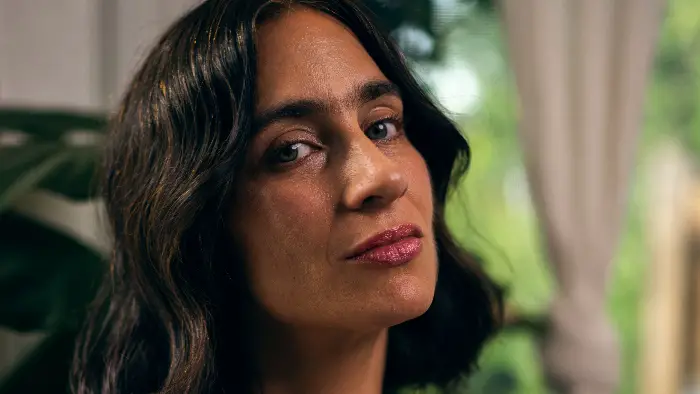
Director Emily Mkrtichian. Photo by Chris Natalie.
“…the camera almost became an extension of my gaze and of our relationship-building.”
There Was, There Was Not now stands as a testament to the culture of Artsakh. What do you hope audiences learn about the country from the documentary?
What I hope people take away from the film is that Artsakh was never just a site of conflict — it was a living, breathing place full of people with deep histories, humor, contradictions, and dreams. For most of the world, Artsakh has only ever existed in headlines about war, and I wanted to show what life there actually felt like — the rhythm of a day, the quiet acts of care, the beauty of ordinary persistence.
When I started filming, I didn’t set out to make a “political” film. Still, in the process, I learned that documenting daily life in a place that’s been so consistently misrepresented is, in itself, a political act. My goal was to give audiences a way to understand this place that we no longer have access to — to see the people of Artsakh as they were before the world stopped seeing them.
These four women are not objects of our sympathy; they are models for how to live in a world increasingly torn apart by violence and displacement. Their strength, humor, and capacity for care are not extraordinary because they survived war — they’re extraordinary because they kept choosing life, community, and imagination in the face of it.
More than anything, I hope the film reminds people that erasure doesn’t just happen through violence, it also happens through silence — and that stories, when told with care, can be a way of keeping a place alive long after it’s gone.
War is chaotic and wild. Filming during one must be doubly so. Was there ever any hesitancy to film while in Artsakh during the war?
Of course — I felt that hesitation every day. I wasn’t trained as a conflict journalist, and I didn’t arrive in Artsakh with the intention of filming a war. I had been making a very different kind of film — one that was slow, intimate, about the texture of daily life and the quiet resilience of women rebuilding after an earlier war.
When the new war began, everything shifted overnight. The air changed. The sounds changed. People I loved were suddenly in danger. My instinct to film was matched equally by fear and uncertainty about what it meant to point a camera in those moments.
At the same time, I watched hundreds of international journalists arrive, stay for two or three days, and then leave — often producing stories that, while not inaccurate, felt painfully incomplete. Those quick dispatches were shaping how the world understood this place and what was happening here. I realized that my being there — with years of connection and relationship already built — was an opportunity to tell a story that could reflect the complexity of Artsakh and the people who lived there, beyond the headlines.
During the war, Sosé said something to me I’ll never forget: she told me that my camera was my weapon. It was my way of fighting — not with violence, but by documenting, by preserving a full and nuanced picture in opposition to the flat one being told from the outside. That stayed with me. It gave purpose to the act of filming, even in the midst of chaos.
There Was, There Was Not was intended as a look at strong females trying to survive so many years after the 1990s war and genocide. What was the original vision and driving theme of that initial documentary?
When I began the film, I wasn’t thinking about making a “war documentary” at all. I was interested in what life looked like after conflict — how women rebuild, how they carry history, and how they continue to dream in a place that has already seen so much loss. My original vision was to make something slow, intimate, and observational — a portrait of women’s lives in post-war Artsakh that could hold both the mundane and the extraordinary.
At the time, I thought of the project as an act of deep listening. I wanted to create a cinematic space where these women could define themselves outside of politics or tragedy — where the focus was on their agency, humor, contradictions, and the ways they shaped their communities day by day.
Even though the war changed everything, that original impulse never left. The film still centers on those same women, and on that same question: how do people hold onto memory, dignity, and imagination in a place that the world has repeatedly tried to erase?