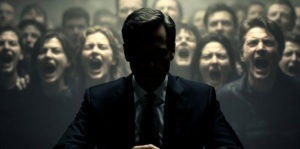
I want you to succeed. Not only that, I want you to do so by doing the things you’re most passionate about, whether it be something you’ve created with your hands, used your voice, or conjured into being with pixels made of light. Chances are, if you’re trying to get it out to a large audience, those pixels are a pathway for the latter. This is the reality of entering the public square for our society, which means that, for better or worse, we have to deal with constant public scrutiny of our work, including a vast legion of over-entitled individuals who believe it is their job to dictate to you how you can or can’t explore ideas, create, or otherwise tell your story. They do this under the guise of claiming to be for artistic integrity, morality, and fighting against the establishment, but today, I’m going to explore just how that exact establishment is counting on these people to help them secure a corporate monopoly over Artificial Intelligence as a tool and the greater means of distribution that independent creators and small businesses depend on so much.
First, let’s briefly explore the fears and arguments against AI as a tool in the hands of creators, and the general online reactions and arguments aimed at those who are pro-AI.
There is the argument that AI is theft and copyright infringement, which has been debunked through the logical examination of the intent or “spirit” of copyright, its place in the public square, and the irrefutable fact that copyright only protects uniquely human-created works outside of the public domain, but not ideas, styles, or processes. This was solidified in the Getty Images Vs. StabilityAI lawsuit where the court ruled that Stability is not liable for secondary copyright infringement as models learn distributions, but do not store copies of works. However, Getty did secure a small victory in that older models would reproduce their watermark, causing brand confusion.
“The establishment is counting on these people to help them secure a corporate monopoly over Artificial Intelligence.”
Their second rebuttal is to claim that everything AI creates is “soulless slop,” a term coined to suggest that everything it creates is an unusable and ugly mess. This is the most easily debunked for the sole reason that people have eyes and can see how good the results can be, including the people making this argument themselves. If it weren’t so, then they wouldn’t be so upset about it, because unusable and ugly means that it has no value or relevance in the advertising and entertainment market.
This brings them to the proposition that AI is taking jobs away from real artists. This ignores that the entertainment industry, the largest supplier of jobs for artists, was already operating in an economic bubble of its own making, artificially inflated by investor capital pumped into a market also artificially inflated by the COVID-era streaming race. This was further incentivized by taxpayer-financed kickbacks, which helped productions spend beyond their profit margins, creating the illusion of sustainable jobs. While AI is helping productions scale back on their expenditures—which does include artists—without it, new projects wouldn’t exist at all, and neither would the few remaining jobs, which would go to the most qualified within what remains of the industry. In short, AI came along just in time to give the industry a fighting chance at rebounding.
The final boss of their arguments may be that people who use AI are lazy, not creative, and are incapable or unwilling to learn art as a skill. This tactic is reliant on ignoring that many individuals adopting AI into their workflow are long-time career artists themselves, often with decades of experience in film making, animation, commercial art, and advertising, in the hopes that they can just shame or intimidate people out of adopting it into their pipeline. We can see that this empowers people with no experience to be able to declare that for one to be creative the work itself must take some measure of time to complete, require a mastery of artisanship, or even be created in some kind of artistic vacuum, where no influence or inspiration taken from what came before can enter the picture, giving the uncreative a form of dictatorial power over the creative under the guise of… what? Morality? Virtue? Certification from an ordained institution? It is deliberately vague, so they can shift the goalpost.
"…The competition isn’t other corporations for them. It’s the next wave of entrepreneurs, or “The guy in a garage”"