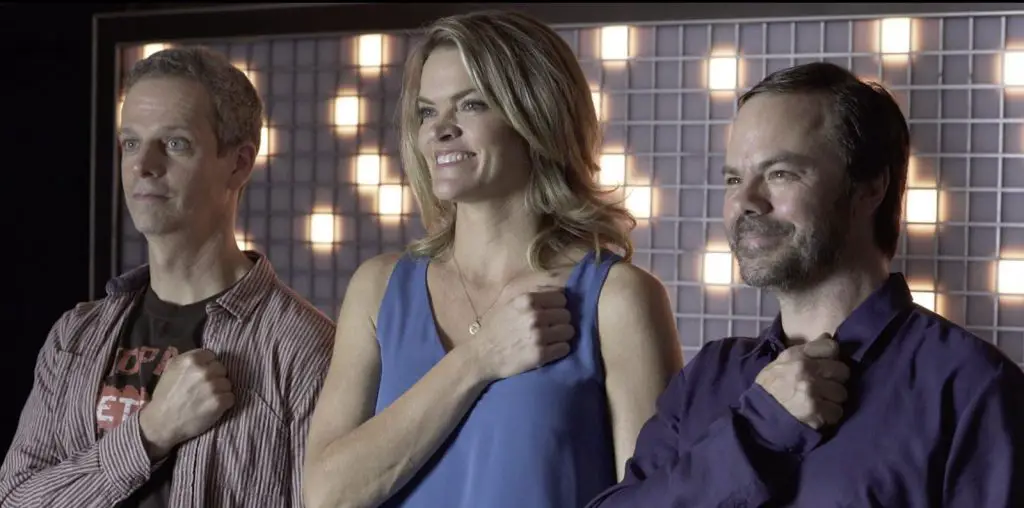
Directed by Tracy Schott, Il Mio Posto a Tavola (My Place at the Table) follows filmmaker and professor Santo D. Marabella as he returns to his birthplace in Aosta, Italy, in search of answers about his past as an adopted child. His story unfolds against the backdrop of the Baby Scoop Era, a postwar period when thousands of infants born to unwed mothers were placed in church-run orphanages and sent abroad for adoption.
As a baby born in Aosta, Italy, Santo D. Marabella was the third of five children given up by their unwed mother and placed in an orphanage run by the church. At the age of four, Santo was adopted by an Italian-American couple who traveled from New York to bring him home. Now a filmmaker and professor, Santo returns to Aosta to answer questions he’s had for decades. His trips start with a visit to the orphanage where he was once cared for by devoted nurses. His journey is shaped by feelings of loneliness and alienation, often shared by adoptees, along with a desire to understand the complex social, religious, and political systems that led to thousands of Italian infants being sent overseas.
With limited information, such as a few names, Santo begins his search for his birth family. He uncovers documents that reveal a brutal truth: his biological parents were abusive and neglectful. They had no intention of reclaiming him, but even those facts are eventually called into question. Digging through immigration records and orphanage logs, he pieces together the broader story of postwar baby trafficking enabled by the Catholic Church and U.S. agencies, which operated under the guise of charity and care.
The documentary culminates in a reunion dinner in Italy, where Santo invites his American family to connect with his roots. He successfully meets his sister Francesca after twenty years, but faces rejection from other siblings, including a brother in deep depression and a sister who refuses to contact him. Despite resistance and heartbreak, Santo finds a thread of connection through a niece willing to speak with him. His journey through Il Mio Posto a Tavola becomes one of reckoning with his past, his identity, and the relationships that both wounded and healed him.
I come to this review from the perspective of an adoptive parent, whose child has a similar story to Santo. Sometimes I find myself wondering what she thinks about her birth parents and the missing pieces of her life that are not answered. Watching Il Mio Posto a Tavola, I can’t help but think that we’re the parents who raised you as an infant…isn’t that enough? Then we delve into questions regarding her health history and a connection to her culture that we can’t provide.
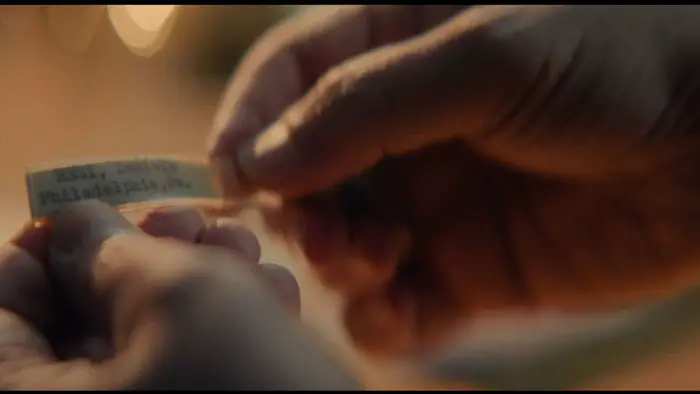
A close-up of Santo D. Marabella holding the tag that once identified him as an orphan
“His journey is shaped by feelings of loneliness and alienation…”
What Il Mio Posto a Tavola shows is that everyone is different. As adoptees, their journeys to finding a sense of self go down many different paths to a range of emotional destinations. For Santo, his journey led to an appreciation of his adoptive parents, while realizing that things were different for his biological siblings.
Il Mio Posto a Tavola also takes us down a historical path when the Catholic Church orchestrated hundreds of thousands of adoptions by stripping babies away from their birth mothers while making them believe it was the right thing to do. It’s not that adoption is wrong in any way. If a baby is not wanted, then it’s right, but the mother needs to be fully on board.
In the end, Santo Marabella leads a thoughtful discussion on the subject of adoption from the child’s perspective and how it affects them as adults. Director Tracy Schott and DP Sebastian Nieves have a beautiful eye, with some amazing wide shots of Santo sipping espresso in the courtyard, as well as intimate moments with friends and family. As adoptive families, the questions will not, and should not, ever end.
For more information, visit the Il Mio Posto a Tavola (My Place at the Table) official website.
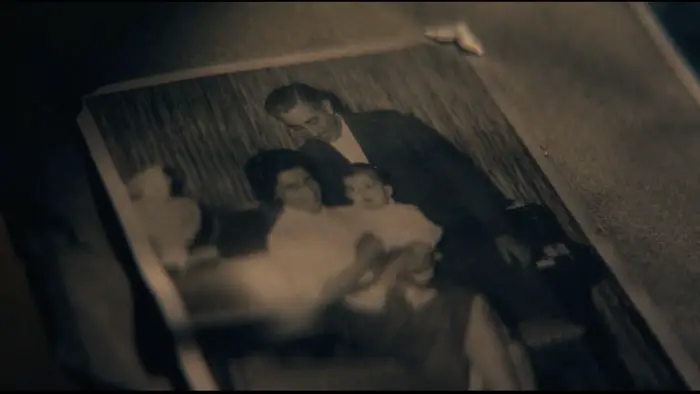
"…we're the parents who raised you as an infant...isn't that enough?"