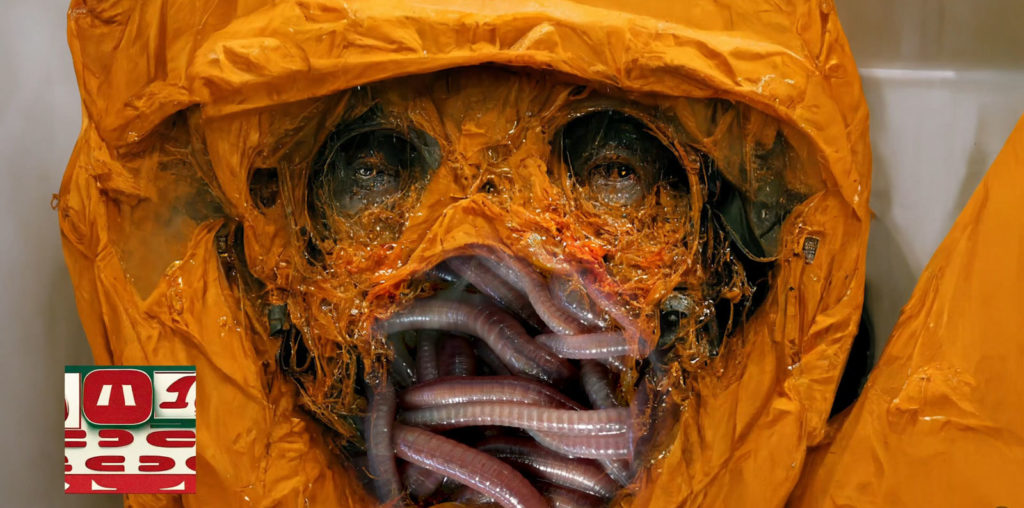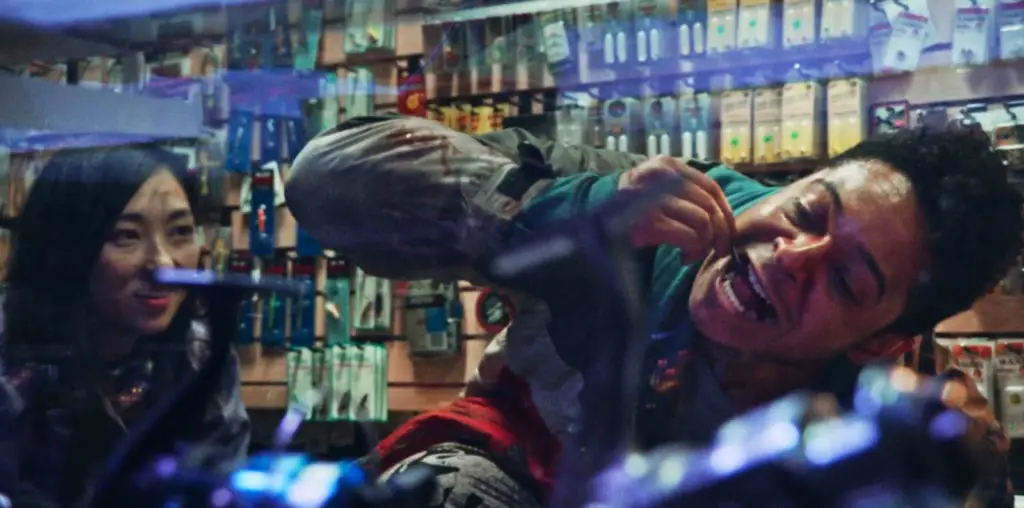
You’d be forgiven for assuming that a film about parasitic worms burrowing into people’s skin would simply revel in grotesquery. What’s surprising about director Sergio Pinheiro’s Wormtown, written by Andrew James Myers, is how deliberately it refuses to stay in that lane. The filmmaker shapes the movie into something far more affecting, weaving moments of tenderness and sorrow into a story that could so easily have been pure B-movie mayhem. The result is a post-apocalyptic horror that’s as interested in the emotional fallout of survival as it is in the writhing creatures turning a small Ohio town inside out.
Set a year after an outbreak in the small town of Ashland, Ohio, the story follows Jess (Caitlin McWethy), Rose (Emily Soppe), and Kara (Rachel Ryu), three survivors sheltering in a makeshift bunker while the “Nightcrawlers” above ground roam in a hive-like trance. The infected are not zombies as such. They’re still alive, still thinking, and still attached to their leader, Mayor Joshua (Jim Azelvandre), whose benevolent radio host routine masks the authoritarian impulse that now drives him. One of the more unsettling layers is the way the worms hollow out the mind without erasing it, turning their hosts into obedient disciples rather than mindless husks.
When Jess’s fragile sanctuary is shattered, the film expands elegantly. Her escape leads to a nearby Amish community, a setting that could have derailed the tone entirely had Pinheiro mishandled it. Instead, the Amish characters are treated with genuine thoughtfulness, becoming part of a wider reflection on communities that resist modernity, and now resist something far stranger. The contrast between the tech-sensitive worms and the low-tech Amish life is a clever story mechanic, but more than that, it gives Jess a reprieve in which her grief has room to breathe.

“…parasitic worms burrowing into people’s skin…”
McWethy carries Wormtown with grounded intensity. Her performance gives weight to scenes that, in less capable hands, might have drifted into caricature. Maggie Lou Rader is equally compelling as Alice, one of the hive’s gently manipulative figures whose maternal instincts have been distorted into a tool for recruitment. Their parallel arcs – with one resisting assimilation, the other soothing people into it – give the film its emotional architecture.
This indie horror flick walks a tricky path. It wants to be a slow-burn character piece, but also a queasy slab of body horror, and the pacing is occasionally the price it pays for that ambition. But when the grisly moments emerge, they land. The practical effects are genuinely skin-crawling with writhing tendrils, burrowing parasites, and a recurring, unnerving image of a “heart worm” pulsing beneath translucent skin. Roy Rossovich’s cinematography finds a bleak beauty amid the decay, bathing landscapes in pale, washed-out light reminiscent of scorched earth.
What hits hardest, though, isn’t the gore or the mythology, it’s the melancholy baked into the lead’s journey and the idea that survival can be as emotionally corrosive as infection. Wormtown may be full of worms, drones, hives, and hosts, but it’s the aching humanity underneath that earns your attention.

"…the aching humanity underneath earns your attention."