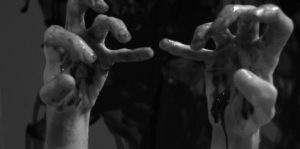
Co-writer/director Domenic Migliore emerges once more from the cinematic darkness, again upon a midnight dreary, with an elegant adaptation of Edgar Allan Poe’s The Imp of the Perverse. The term is a metaphor coined by the author for the self-destructive, irrational human urge to act erroneously or act against one’s own best interests, simply because it is possible to do so. Opulently narrated and starring the mercurially powerful Bill Oberst Jr. (who co-wrote the screenplay), the short horror film acts as the last words of a man, compelled by an internal force to confess to the sudden, inexplicable, perfect murder he committed.
Yet, with the crime committed, and no consequence coming knocking, the anxiety of having triumphed over the laws on men slowly undone our man, and he has no one to mark the occasion or cleverness exerted. The ethereal “call of the void” begins within one. First, at the moment of committing a heinous crime, then, as the gleam of the moment fades, the thrill dies, leaving one with nothing but a victory unshared. Obsession, panic, and the urge to self-destruct are the inner cries that lead our protagonist to the fatal shores of self-sabotage.

“…the last words of a man, compelled by an internal force to confess to the sudden, inexplicable, perfect murder he committed.”
The gorgeous black-and-white imagery is luminous and haunting. The references, suggestions, and symbolism encountered by our killer of the hour perfectly play into the character’s mental state. Oberst’s voice is deep and light, melodious and terrible; exactly as Poe would’ve wanted. The actor’s eyes dance with the fire between the words, in a performance that both elevates and illuminates the text.
As the opening installment of an anthology feature by Migliore, the artistry on display in The Imp of the Perverse makes the promise of more to come, all the more tantalizing. Migliore dancing in the shadows with Poe feels like a match made in heaven. Encore!

"…luminous and haunting."

Thanks for the review, Kent! This film was a true pleasure to bring to life.
– Willy Adkins, Producer
Breaking Fate Entertainment
Thank you for taking a look, Kent. It’s been my favorite Poe piece for decades – I’m gratified that you found this adaptation worthwhile.