Pauline Horovitz’s The Hell of Auschwitz: Maus by Art Spiegelman entangles personal reflection, intellectual interpretation, and investigation into the atrocities of the Holocaust and the graphic novel, which broke the mold, mixing autobiography and illustration with a deeply affecting recollection of one family’s survival through the darkest days in the history of civilization.
As a reader of graphic novels, particularly those of the incomparable Alan Moore, when said author told us, in his published review from the period, to read Art Spiegelman’s Maus, well, who am I to argue with Alan Moore?
Reading Maus at a formative and transformative period in her life, Horovitz became enthralled, and one could say partially traumatized by the experience. After all, Maus isn’t your garden-variety comic book. An unconventional approach to exploring his family’s journey through the horrors of being guests in Hitler’s Nazi Germany, depicted as mice being stalked by cats, Spiegelman, like other influential underground comic luminaries such as Robert Crumb and Spain Rodriguez, took the roads laid down by their contemporaries and started telling personal stories in illuminatingly illustrated ways.
A curious point of interest comes when Spiegelman talks about having to get the first part of Maus out to the public as he was racing against another creative with a similar-sounding name that had him and an animated movie about to cover the same ground. The other guy was Steven Spielberg, and the film was An American Tail.
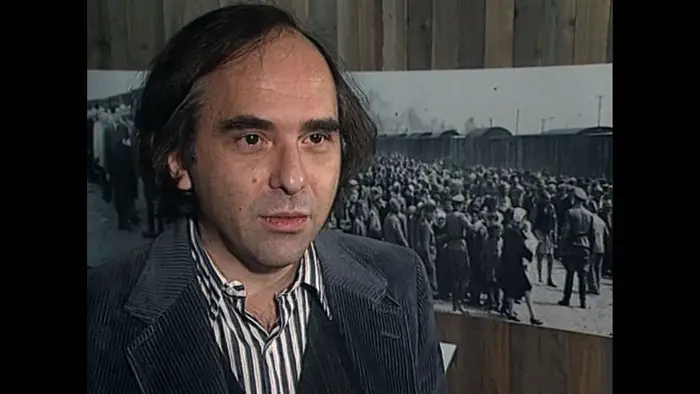
Documentary still of Art Spiegelman speaking on camera with historical imagery behind him.
“…entangles personal reflection, intellectual interpretation, and investigation into the atrocities of the Holocaust…”
Forcing readers to confront the evils of the world blew holes in the corridors of a lot of organizations and thinkers’ libraries of reference. Now, Alan Moore reappears via an archival interview, defending, with his young children under his arms, that he sees no benefit in presenting the youth of tomorrow, a Care Bear-coloured version of a life that reality will happily kick in the teeth with a steel-capped metal work boot.
Framed as partially a portrait of relative of survivors viewpoint, accompanied by key interviews with Pulitzer Prize-winning author himself, along with renowned French historian, Annette Wieviorka, historian of the Holocaust and anti-Semitism, Tal Bruttmann, and comic artist and filmmaker Joann Sfar, each giving insight into the gravity of Spiegelman’s work, but also comparing, contrasting and contextualizing the historical accuracy and rigorous research applied, graphic novels as a serious literary form, Maus’s visual storytelling and impact, the social and cultural implications of Spiegelman’s work, together with specific aesthetics and metaphors.
The Hell of Auschwitz: Maus by Art Spiegelman is the perfect entry vehicle for those curious and have never read Maus. It is immersive yet satisfying in its brevity, with Horovitz, like Terry Zwigoff with Crumb, collating a fleeting while a fascinating portrait of a man and his work that was both ahead of its time in what it was, and bringing a subject of great consternation, such as the Holocaust, into the comic medium and our eternal consciousness, never to be forgotten.
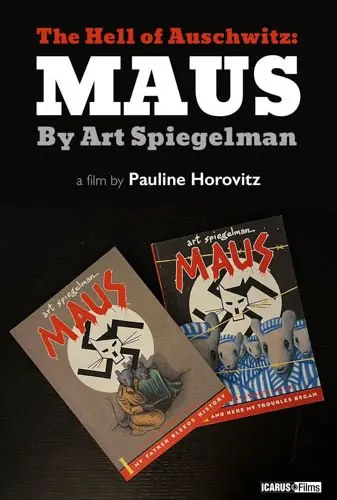
"…mixing autobiography and illustration with a deeply affecting recollection..."