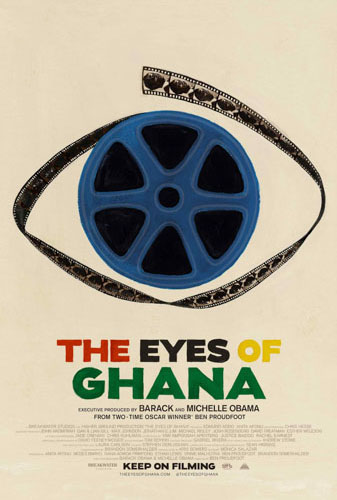
Hesse is an interesting subject, and The Eyes of Ghana shines brightest whenever he is on screen. He’s seen some amazing things through the decades and has a wealth of knowledge and experience. The documentary is also commendable for shining a light on Ghana and the ideas of Nkrumah when he was a visionary. The film looks and sounds amazing, a testament to Proudfoot, who had the support of Higher Ground, Barack and Michelle Obama’s production company.
“…leans heavily into the inspirational part of the story, and that’s understandable.”
The documentary acknowledges that Nkrumah became an autocrat, but minimizes this by having one character say something like, “Well, that’s what they say,” and somewhat tries to pin his tarnished legacy on the next regime, rewriting history. Of course, different people will have different points of view, and this is addressed in the film too, by interviewing random people on the street about what they think about him, to mixed reactions. Hesse has the best response to this. When asked by a student, he responds by saying that it is not for him to judge, he just wants the films he shot out in the world.
The Eyes of Ghana leans heavily into the inspirational part of the story, and that’s understandable. Hesse is an inspiring figure, still fighting to preserve his country’s culture, restore film, and teach the younger generation, even in his 90s. But the film goes a little too hard on this point by adding soaring music and minimizing some of the complexity. For example, Hesse served for years under the next regime. It does touch on this, but doesn’t really get into how that must have affected him. And it doesn’t particularly serve anyone by not better acknowledging the oppression of Nkrumah. I can understand wanting to have an inspirational story, but it makes the film a little too predictable.
The Eyes of Ghana premiered at the Toronto International Film Festival
"…looks and sounds amazing, a testament to Proudfoot..."