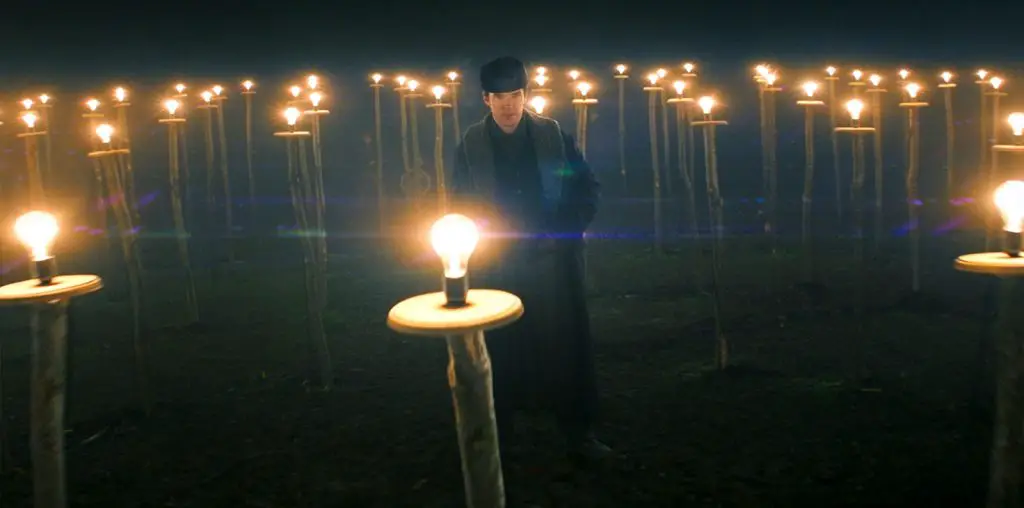
Metaphorically, the bizarre, Kafkaesque world explores the nature of totalitarianism, in which people are forced to play a role, performing for others on the outside, even if their inner lives may be dramatically different. Given a mixture of incentives and coercion, some people can’t take it and “get off the train,” while for others their performative self becomes internalized. Meanwhile, nobody knows who’s watching, who’s really in charge, and confusion abounds. Reality becomes absurdist, partly because everyone left is playing a role, and truth has vanished. In that sense, Sunshine Express is stunning because the metaphor is so deep; it extends to the film’s very form. Can we even believe what the filmmaker is showing us? The final shot is a curveball for the ages, and leaves audience members questioning what we might have thought of the film, knocking us off-kilter with glorious mischief and foreboding.
“…knock[s] us off-kilter with glorious mischief and foreboding.”
None of this is to say that the parts that you can logically make sense of are straightforward. Certain symbolism is obvious — you can ask a person to manage or control a group of people, and they may take on that identity. Others are more sneaky, but understandable, like cops and criminals shifting roles. But some are nearly inscrutable, although I concede there may be cultural references I don’t understand.
The best, most moving art isn’t something neatly wrapped up in a bow, but something that will stir up feelings, emotions, and leave your head churning, trying to find meaning that you can perceive in fragments, but whose totality remains elusive. A week after seeing it, I am still mulling over Sunshine Express, but I do know one thing: it is great art.
Sunshine Express screened at the 2026 Santa Barbara International Film Festival.
"…great art."