
One of the most surveilled countries in the world is Singapore, which is the setting of Yeo Siew Hua’s thriller, Stranger Eyes. When state-controlled cameras are everywhere (even in your home), how can a child go missing?
The film opens with a young family—Junyang (Wu Chien-Ho), Peiying (Anicca Panna), and their little daughter, Bo—spending a wonderful day in the park. In truth, they are replaying a recording taken by Grandmother Shuping (Vera Chen), poring over every frame for clues about Little Bo’s disappearance three months earlier at the request of Officer Zheng (Pete Teo), who has no clues to go on. The process is gut-wrenching for the two, as Junyang retreats into despair, leaning on the official investigation, while Peiying and Shuping feel they need to put in the work to find Little Bo.
One day, while handing out “missing” flyers in the park, a young mother refuses to take a flyer and expresses her concern. Peiying notices her daughter looks just like Little Bo. As the mother heads toward the mall, Junyang begins following her with his cellphone camera, recording her every movement. When the mother mistakenly leaves her daughter unattended in the store, Junyang picks the baby up, only to realize it’s not Bo. Yet, he continues to follow her for the rest of the day.
While Peiying is watching Junyang’s video, she is concerned about this behavior. As they speak, a disc arrives, showing Junyang following the woman around the mall. The video is shot mere feet, if not inches, from Junyang. The two panic as the potential kidnapper was within Junyang’s grasp, and there is nothing to show for it, other than a sick and twisted game.
When you start watching Stranger Eyes, you soon realize that the film is less about solving the kidnapping of a young toddler and more a commentary on the surveillance states, like Singapore and China. What makes Stranger Eyes different from your typical crime/political thriller is that the film doesn’t place much judgment on the idea of surveillance, but looks more at the humanity of being watched constantly.
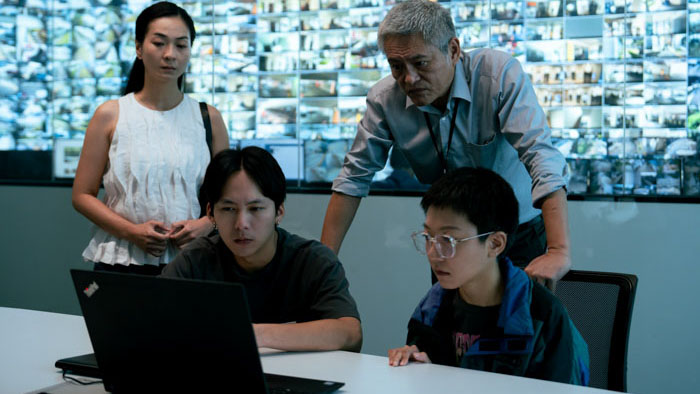
Junyang, Peiying, and Officer Zheng review surveillance footage in Stranger Eyes.
“When state-controlled cameras are everywhere…how can a child go missing?”
Expanding the story, there is a suspect in the kidnapping in Lao Wu (Lee Kang-sheng), a reclusive man caring for his elderly mother. He is the one who followed Junyang at the mall; he also lives across the street from the couple and has a direct line of sight into Little Bo’s bedroom. He’s been filming them, including an affair between Peiying and another man next to Bo’s bed. Lao soon develops an obsession with Peiying following her DJ music livestream and texting with her. When Lao’s identity is revealed, Junyang turns the tables on Lao by becoming his stalker, taking on Lao’s habits and behaviors.
Ultimately, Stranger Eyes becomes an essay on surveillance culture. Yeo Siew Hua finds the art in surveillance, revealing how the act of watching—whether by cameras, strangers, or loved ones—transforms identity, blurs boundaries, and uncovers unsettling truths about how we perceive ourselves. It doesn’t say whether it’s right or wrong, but it exemplifies what happens when someone is watching you 24/7—and when you also choose to put yourself out there to be watched.
In other words, we act differently when we know we’re being watched. The film also shows that when we stalk a person, we start to imitate them. There’s also a social media element, as the images and videos we see online often seem more real than the reality behind them.
Stranger Eyes is a thriller about three average citizens who want to be seen in a world that is constantly watching them. Yeo Siew Hua shows that surveillance isn’t only about control—it’s also about how we see ourselves through someone else’s eyes. In the end, the film leaves us unsettled with the idea that being watched doesn’t just change how we act, it changes who we become.
For more information, visit the Stranger Eyes page on the Film Movement website.

"…Being watched doesn’t just change how we act, it changes who we become."