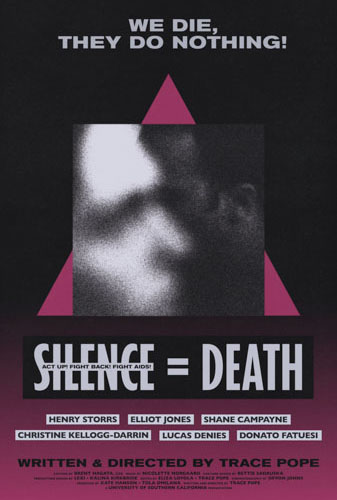
Director Trace Pope’s Silence = Death drops us into a pressure-cooker moment when activists decided that “quietly waiting” was no longer an option. The short moves with the urgency of an era when AIDS deaths were relentless, zeroing in on the human cost behind policy, procedure, and power.
On May 21, 1990, a young gay filmmaker, Jamie (Elliot Jones), prepares to document the most important day of the AIDS crisis. At this point, research on the drug AZT has been moving at a snail’s pace, and the main roadblock is Dr. Anthony Fauci, head of the National Institutes of Health (Henry Storrs). Fauci believes that he is moving at the right pace from a science perspective, but with a person dying of AIDS every 12 minutes, the cure is not being developed fast enough. This brings us to Jamie’s involvement with the AIDS Coalition to Unleash Power (ACT UP) and its leader, Peter (Lucas Denies). On this day, Peter is leading his team of protesters to “STORM THE NIH,” where activists flood the NIH in Bethesda and surround Fauci’s building, chanting, demanding answers, and calling for Fauci’s resignation.
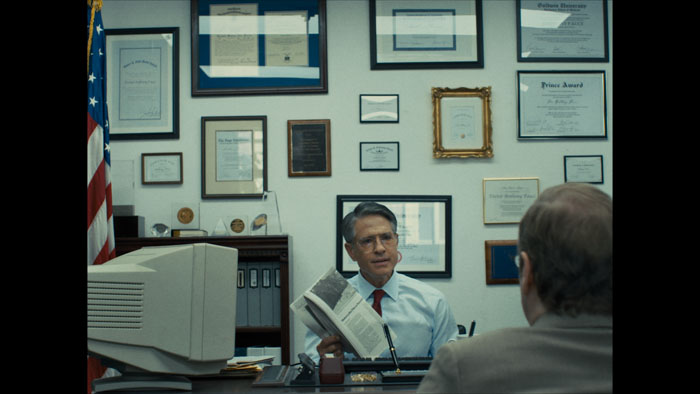
Dr. Fauci in his office in Silence = Death.
“…Peter is leading his team of protesters to ‘STORM THE NIH,’ where activists flood the NIH in Bethesda and surround Fauci’s building…”
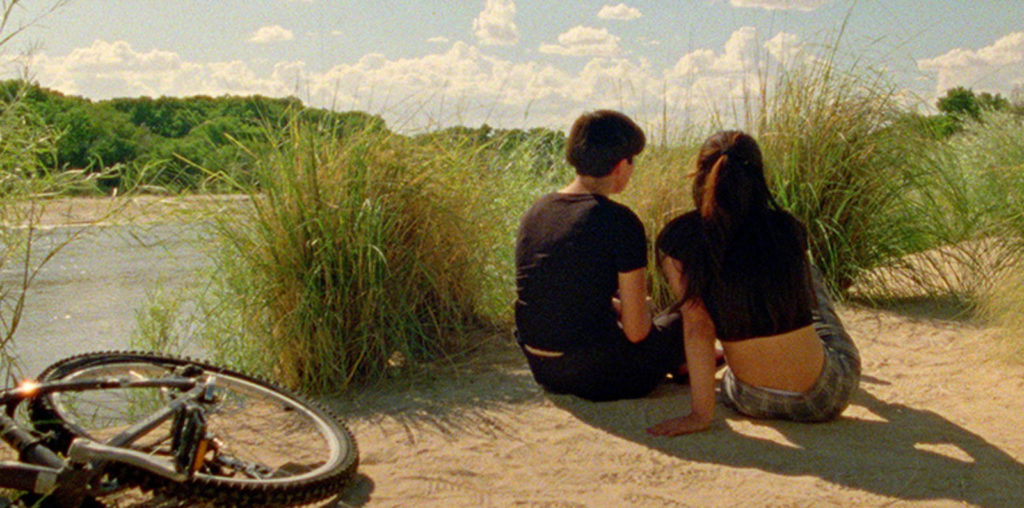
Silence = Death is a historical dramatization of the “STORM THE NIH” event. Filmmaker Trace Pope documents the events from Dr. Fauci’s perspective, as he does not want the attention of a protest that would shine a light on him. We also see Peter and the other protesters planning, organizing, and executing the protest. Lastly, there is Jamie and his partner Patrick, who is dying of AIDS, trying to navigate life day-to-day and hoping to deliver a message Jamie filmed for Patrick to get to Dr. Fauci.
As a film, Pope had access to hours of archival footage from that day and masterfully blends it with his own. As cool as that is, he then delivers great dramatic moments across the three storylines, all culminating in the tense confrontation with the man himself. The filmmaker states that he wanted to connect history to a present-day warning: he points to the NIH terminating grants related to PrEP and PEP on March 19, 2025, describing it as a dangerous halt to vaccine/cure momentum and a “disturbing echo” of 1980s-era neglect — framing the film’s themes around activism versus institutional power, the cost of complacency, and “bearing witness” to queer survival as cycles of discrimination repeat.
Silence = Death accomplishes exactly what Pope set out to do. It teaches me about an event I never knew happened; shows me what happened and the results of the protests; and finally asks what we are doing about it today.
"…drops us into a pressure-cooker moment..."