
Director/writer Joachim Trier and co-writer Eskil Vogt’s Sentimental Value drops us directly into the middle of a multi-generational Norwegian family drama. Gustav Borg (Stellan Skarsgård) is a celebrated film director, past his prime. His last film was 15 years ago, but he still burns with artistic passion fueled by unresolved childhood trauma. His daughters, Nora (Renate Reinsve) and Agnes (Inga Ibsdotter Lilleaas), have inherited his trauma and, as adults, have made it their own. Most of the weight of this dysfunction has fallen on Nora, a theater actress who has bouts of crippling stage fright. As the curtain rises on the chaos of the Borg family, Nora is being physically coerced to stay in her costume and pushed onstage for a performance of The Seagull at the National Theater in Oslo.
We are also introduced to the cradle of the Borg family, their classic Norwegian “Dragon Style” house. Decades of Borgs have been born, lived in, and died in the house. Trier flashes back to the experiences of Gustav’s mother, Karin (Vilde Søyland), joining the resistance against the Nazi’s and then being captured and tortured. Later, she takes her own life in the house, leaving Gustav with an unsolvable enigma that haunts him for the rest of his life.
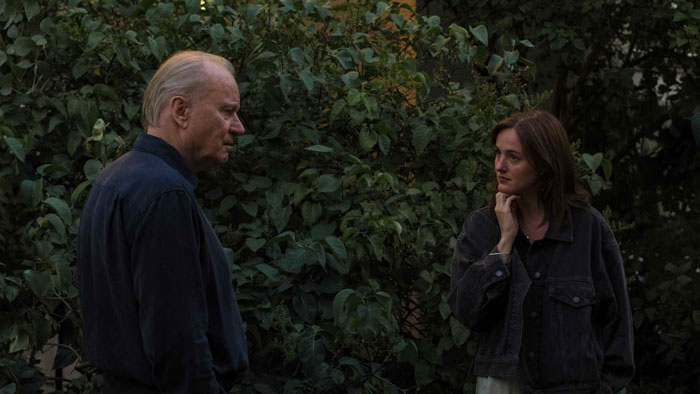
“The family gathers on the occasion of the death of Gustav’s ex-wife…”
The family gathers on the occasion of the death of Gustav’s ex-wife, Nora and Agnes’s mother, Sissel (Ida Marianne Vassbotn Klasson). Gustav appears unexpectedly, as he is seldom around since they divorced. He speaks glowingly of his ex-wife and dotes on his daughters as if their relationships were not strained and sporadic. It turns out that Gustav’s motivation for coming back is that he has written a script for a new film that tells the story of his family, and he wants Nora to play the lead, a fictionalized version of his mother.
What Gustav doesn’t say directly is that the film was not only written for Nora, but that it’s about her as well. He is pinning his hopes on the film to revive his comatose career, and also to show that he understands and loves Nora. The script is a biography, a confession, a love letter, and a plea for absolution. Nora wants none of it. When she emphatically declines, he turns to an American actress he meets in France, named Rachel Kemp (Elle Fanning), to play the role. Everyone involved, including Rachel, knows she’s a poor substitute for Nora, but she wants to work for the great man and puts her doubts aside.

"…a masterwork, with layers of human drama and frailty..."