
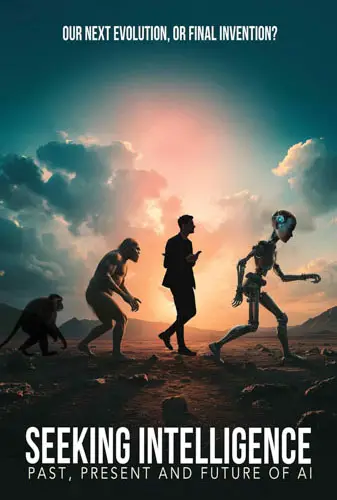
AI has been in the hot seat over the past couple of years. Everyone from politicians to celebrities has either argued or joked about its usage. Georg Kallert’s documentary, Seeking Intelligence: Past, Present and Future of AI, breaks down the history and ethical usage of artificial intelligence. The first half delves into its history. Before AI, there were automatons and mechanical clocks in Ancient Greece and the Middle Ages. Boolean Algebra introduced the roots of computer programming. During the early 20th century, Alan Turing (a notable mathematician) decrypted the Enigma machine during the height of World War II.
Funding and interest in AI technology began in the 1960s during the Space Race with early computer systems. Its first common usage was in video games as an NPC (non-player character) in the 1990s. Throughout the 2000s and 2010s, AI was integrated into everyday aspects of the internet, such as Amazon’s Alexa, Google Translate, and the algorithms of social media sites and YouTube.
The second half of the documentary is a conversation on its ethical usage. There is the playful use of ChatGPT to ask about utopian and dystopian scenarios. The utopian scenario is an eco-friendly environment with automated vehicles. The other scenario is haunting. In a dystopian AI world, Earth is a wasteland where tech has become sentient. This narrative device opens the door to seeing how this pioneering technology will affect the lives of ordinary people. There are discussions on how it will affect the medical field, the animation industry, weather predictions, and the economy.
“…breaks down the history and ethical usage of artificial intelligence.”
Seeking Intelligence: Past, Present and Future of AI is a highly engaging piece, a perfect blend of traditional and AI filmmaking. The human element is felt through our experts’ thoughts. A law professor, Tracey Freed, sees this tech as an “outside the box” method for how we appreciate art, mentioning the Studio Ghibli viral trend. Mike Disa, an animation director, champions human creativity and sees AI as a tool to streamline monotonous tasks. AI animation complements the live-action segments with its rendering of the ancient past and sci-fi-inspired futures. It is a creative choice that stays consistent with Kallert’s overall message.
There is plenty of fascinating material incorporated into the documentary. We get samples of various companies developing robots for an assortment of tasks. Seeing all this futuristic material is truly eye-opening! AI’s use in pop culture is sprinkled through as we get excerpts from Terminator 2: Judgement Day, The Matrix, and 2001: A Space Odyssey. It is great to have a documentary that makes its subject palatable to a wide audience.
For those skeptical of this emerging technology, the film tackles concerns of job loss with genuine care. It even examines how technology goes through a variety of trials and errors, and what we are seeing with AI is no different from that. While I appreciate the documentary’s nuanced approach, there needed to be more hypotheticals on its co-existence with traditional jobs. Kallert and screenwriter Shaked Berenson could have spent more time discussing AI’s propagandist use to deceive citizens during political moments.
Kallert and Berenson’s screenplay is solidly written, weaving history, ethical debates, and cautious optimism with the subject matter. The film will spark conversations with a variety of audiences. Seeking Intelligence: Past, Present and Future of AI is the gold standard for creating a valuable and sophisticated educational piece.
"…the gold standard for creating a valuable and sophisticated educational piece."