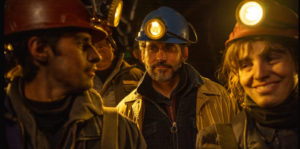
NOW ON NETFLIX! Agustina Macri’s Queen of Coal follows the true story of Carlita Rodríguez, a transgender woman growing up in a remote Patagonian mining town in the early 2000s, where coal mining is both one’s livelihood and the town’s identity. Misunderstood by her family, Carlita finds work and love where she can. Her dream is to work in the mines, as it is respectable work. She also hangs out at the local club at night, looking for love…which always winds up being sex.
After beginning her transition, Carlita is lucky enough to find a job as a coal miner. No one seems to care about her feminine appearance, and she even finds love with a co-worker. She’s competent at her job and appears to be fitting in. As Carlita undergoes gender-affirming surgery and updates her legal identity, her job in the mine is suddenly challenged. Management insists that now that Carlita is officially a woman, she must move to clerical work in the office, citing rules that bar women from underground labor. Carlita refuses and is forced to band together with the town’s LGBT community to fight for her right to work the job she is qualified to do.
“As Carlita undergoes gender-affirming surgery and updates her legal identity, her job in the mine is suddenly challenged.”
After watching Queen of Coal, I was left unimpressed in every way imaginable. Based on an “inspiring true story,” Queen of Coal goes down the standard biopic template beat by beat. This happens, then this happens, then this happens. We’re just seeing scenes from a drama that progresses the typical story of a trans woman fighting to be treated like a woman doing a man’s job in a male-dominated industry (are we missing the irony?). Lux Pascal is fine in the role of Carlita, but I’m not seeing anything groundbreaking or overly praiseworthy in her performance.
I have questions about the story’s authenticity: Is Patagonia the most accepting place for trans individuals in the 2000s? Maybe it was, as the story focuses on a trans woman’s right to work rather than the prejudice and hatred of trans individuals, which is almost insignificant in the movie. Either way, I’ve seen a good number of transition movies, and Queen of Coal is nothing to write home about. There’s nothing here that says you have to see this movie because…
The best reason to see Queen of Coal is the English dubbing. The voices don’t match the faces, and the speech intonations are all off. It’s great. It harkens back to the good old days of English dubbing in movies — not so much the Japanese monster movies, but the European tales like Pippi Longstocking. I can’t help but be mesmerized by the cognitive disconnection between what my ears hear and what my eyes see.
In the end, Queen of Coal never finds a groove beyond its cookie-cutter biopic beats, leaving the story feeling more like a checklist than an authentic human experience, since no two lives are ever the same. A biopic should be a dynamic story of a unique individual, not an issue-based lecture.

"…can't help but be mesmerized by the cognitive disconnection between what my ears hear and what my eyes see."