Journalist Yasha Levine investigates what is a shocker to none: there is massive corruption in California. In his documentary Pistachio Wars, he examines California’s water problem (i.e., the lack of water) and attempts to tie it to The Wonderful Company, the leading supplier of pistachios and pomegranates. You’ve seen the commercials.
His research brings him to a small desert town and farming community in Central California. The region is known for its fertile soil and abundant harvests, but because of government regulation, it is on the precipice of becoming an arid wasteland. This brings us into the orbit of billionaires Stewart Resnick and Lynda Resnick, who own the agribusiness giant The Wonderful Company. Since the last severe California drought, the state shut off water to everyone. In response, it is alleged that The Wonderful Company has taken matters into its own hands and now hoards more water than the city of Los Angeles uses in a year, directing it toward industrial agriculture.
As the narrative deepens, the filmmakers uncover how the Resnicks’ empire benefits from regulatory structures like the so-called Monterey Agreements and the privatization of underground water banks, enabling “paper water” trading and the control of water rights by a few powerful political actors. They also explore the environmental consequences: communities in places like Porterville, Victorville, and, specifically, Lost Hills face water scarcity, contaminated water supplies, and strained infrastructure as farmland expands in former desert or oil-field regions. The town of Lost Hills is composed of Wonderful Company farm workers, and it is slowly decaying and becoming sick from contaminated water, while clean, fresh water is used for the fields.
Finally, the documentary links corporate greed and market domination to geopolitics as the pistachio industry and the Resnicks lobby to keep foreign nuts out of the U.S. We see how the Resnicks’ pistachio production—even framed as a wholesome snack industry—is entangled with U.S. foreign policy, notably Iran being a major competitor in the pistachio market, and how corporate lobbying has shaped agricultural and water policy legislation.
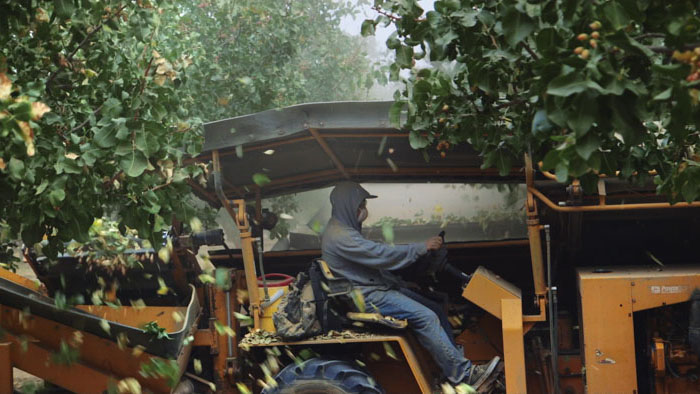
A farm worker operates machinery during pistachio harvest season in California’s Central Valley in Pistachio Wars.
“Journalist Yasha Levine investigates what is a shocker to none: there is massive corruption in California.”
The film thus presents not only a case of environmental devastation and water mismanagement but a broader story of corporate influence, geopolitics, and the hidden cost of what seems like an ordinary food commodity. I took away two key issues from Pistachio Wars. The first is, how the hell did the pistachio nut become one of the primary agricultural businesses in California? I’ve reviewed several documentaries about government corruption in the farming industry, and how the worst thing you can do to our food supply is monocropping. That’s thousands of acres of land dedicated to pistachios, and the Resnicks are a virtual monopoly in the industry, with a market share greater than their competitors combined.
The second is California’s blind eye to water access and management. Because large corporations helped pay for dams and aqueducts, they were given access to more water (OK, fair… I guess), but the problem is that these corporations steal and hoard water, leaving nothing for nearby cities and independent farmers. Worse, the water the towns receive is contaminated by the nearby Chevron processing plant.
I highly recommend Pistachio Wars. Only independent documentaries can uncover what politicians, corporations, and the mainstream media are unwilling to acknowledge. The story is told from the perspective of independent investigative journalist Yasha Levine and has all the thrills of All the President’s Men without the Hollywood drama (OK, I’m being hyperbolic, but it’s an important issue for me as a lifelong Californian). Even if the corporate claims are true — that films like this are anti-corporate propaganda — it’s crucial never to turn a blind eye to any issue where the only thing we’re being told is, “trust us… nothing to see here.”

"…it's crucial never to turn a blind eye..."