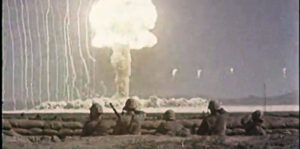
Daniel Everitt-Lock’s documentary, Our Planet, The People, My Blood, follows Alan Owen, the son of a British Atomic Soldier, as he pushes a fight that did not end with his father’s generation. Today, Alan carries the aftereffects of Britain’s nuclear testing legacy even though he wasn’t born at the time of the tests. His current campaign is for recognition and compensation as he takes on the UK Ministry of Defence. Along the way, we learn of a much larger history of nuclear testing carried out by world powers from 1945 to 1996.
From there, the story travels across several countries to hear from people whose lives were shaped by radioactive fallout, uranium mining, and weapons production. We are introduced to Atomic Veteran Brian Unthank, American downwinder activist Mary Dixon, Marshallese elder Jonathan Jackson, Spokane Tribal member Twa-Le Abrahamson, Maralinga Tjarutja leader Jeremy Lebois, Hiroshima survivor Howard Kakita, and historian Bo Jacobs. With their testimony, the film builds a haunting record showing how the effects of nuclear weapons testing affected generations, communities, and continents.
By the end, the documentary lands on a present-day movement built from years of campaigning, parliamentary attention in the UK, and a growing push to make governments answer for the human cost left behind by the bomb.
Watching Our Planet, The People, My Blood forced me to sit with an uncomfortable idea: maybe some of my long-held views about nuclear weapons and the testing that followed World War II are not as solid as I thought. It’s fairly comprehensive in the subjects it touches regarding the testing and production of nuclear weapons.
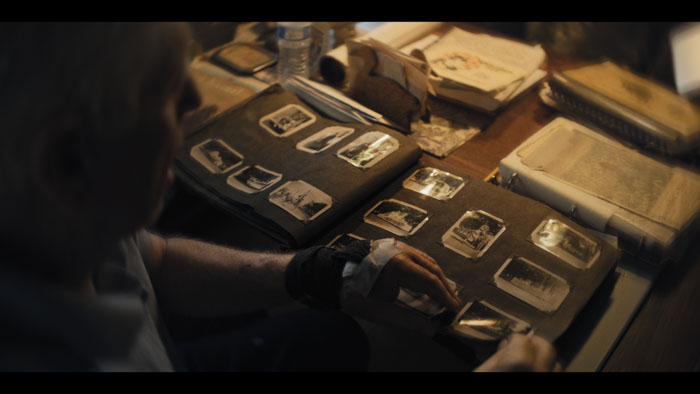
“the story travels across several countries to hear from people whose lives were shaped by radioactive fallout, uranium mining, and weapons production.”
It makes it painfully clear that once governments started playing with weapons of this magnitude, they were dealing with forces they did not fully understand. The immediate effects of a nuclear blast were one thing, but the film shows that the effects of radiation did not simply end when the dust settled. It kept going for years, then decades, and in many cases into the lives of children and grandchildren who were never part of these experiments.
You come away realizing that these were not just tests on empty land or abstract military exercises. Human beings became the guinea pigs. I understand that at the time, many people probably did not know the full consequences. But the damage happened anyway, and the film does not let that fact slip quietly into the background. It makes you wonder if someone needs to be held accountable.
The part that really lodged itself in my brain was the question of whether dropping the bomb was only about ending the war, or whether part of it was also about wanting to see what would happen. I have usually leaned in one direction on that issue, but this film pushed me to stop, reconsider, and admit that I need to look deeper.
The documentary’s real value is in reminding us never to forget, because nuclear weapons are not abstract ideas; they are instruments of destruction with consequences that last for generations. Our Planet, The People, My Blood is a reminder that launching a nuclear weapon has devastating consequences for those living in its shadow, and you wish the leaders in the world’s capitals felt the same way.

"…Human beings became the guinea pigs."