TORONTO INTERNATIONAL FILM FESTIVAL 2025 REVIEW! At the outset of writer-director Karla Badillo’s Oca, a young nun is dispatched on a spiritual and literal journey to seek out a recently appointed archbishop in a distant town in Mexico. The nun, Rafaela (Natalia Solián), is troubled by visions that she can’t explain, but believes them to be a calling to take on the journey. As she is part of an obscure sect, far out in the desert, including only herself and two other nuns, she is charged with connecting with the Archbishop to seek support for their remote mission. Of course, faith and financing immediately come into conflict as the elder sister of her order reveals she is sending Rafaela because the other nun has a family that donates money, and she can’t be risked.
Rafaela encounters situations with people along her way that either challenge or reinforce her faith, but never weaken her resolve to push forward. She is so staunch in her faith that in her mind, every setback is according to the grand blueprint of her deity. There are several main threads that wrap around her journey, showing the viewer distinctly different perspectives based on class differences and defined cultural roles.
When Rafaela’s motorcycle breaks down, a seemingly helpful group of pilgrims offers to add her to their group, but ultimately proves unwilling to assist her toward her goal. That group contains a young girl who is a social outcast who sees in Rafaela a kindred spirit.
“…a young nun is dispatched on a journey to seek out the guidance of a new archbishop…”
Later, Rafaela meets a paratrooper named Gabriel (Leonardo Ortizgris) who shares with her his ideas. Finally, she encounters a wealthy woman named Palmira (Cecilia Suárez) and her driver, Manuel (Gerardo Trejoluna). Palmira lives in luxury and privilege with her beautiful car and with Manuel as her employee. However, she lives in a kind of servitude, as her way of life is financed by her rich husband. In that way, the car and the lifestyle, in fact, own her.
Each encounter sets a challenge, reveals something about the people along the way, and makes for a distraction on the journey. The inherent misogyny and classism in this society show their ugly faces, made worse by the tacit acceptance of these inequalities by everyone involved.
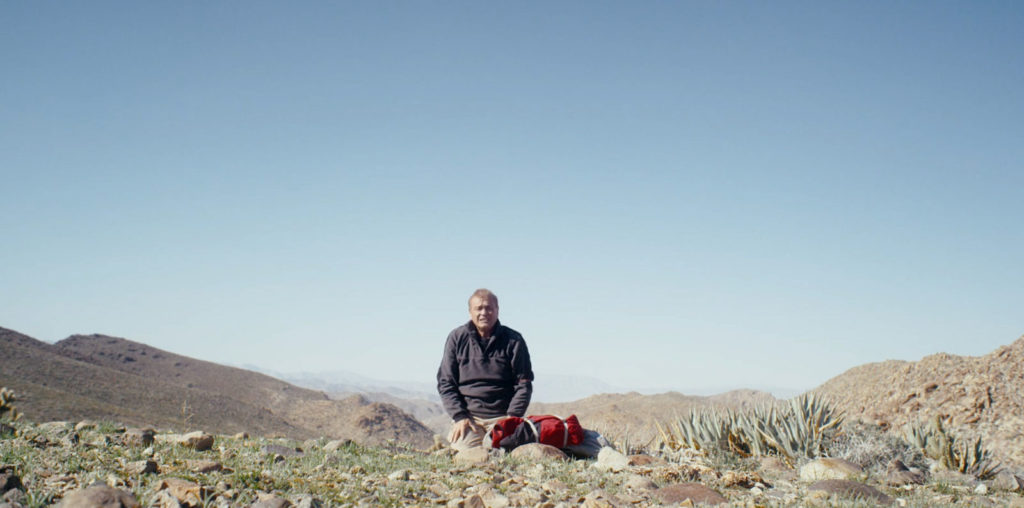
The film moves slowly, with beautiful vistas of the desolate desert landscape, accompanied by a soundtrack fit for a church service. Performances are intentionally understated. Badillo ruminates quietly on many essential questions through sharp allegorical observation and incisive revelation of different lives demarcated by faith, culture, and finances. She challenges the tenets of these divisions gently in her exploration. What the viewer takes from this film will depend greatly on what they bring to it. For an audience unfamiliar with this culture, Oca is a way to consider the issues outside of their own cultural framework.
Oca screened at the 2025 Toronto International Film Festival.

"…sharp allegorical observation and incisive revelation of different lives..."