Although No No Girl might be a fictional story, its director and writer, Paul Daisuke Goodman, desires to tell this story is a reality. Based in a significant period of American history, Goodman draws on the legacy of Japanese internment during World War II to uncover a buried mystery that ultimately brings a modern-day family together.
No No Girl focuses on a fourth-generation Japanese family and their discovery of love letters written by their recently deceased grandmother, Bachan, during a time when Japanese Americans were forced to leave their homes and relocate to internment camps under an Executive Order, which eerily echoes 2025. After Bachan’s death, her grandchildren and family find the letters, leading them to search for buried treasure and uncover long-hidden secrets. Many families sent to Japanese internment camps could not take their belongings with them and buried them.
The youngest in the family, Sue (Mika Dyo), is curious about the letters and her grandmother’s internment experience, which no one else wants to acknowledge, especially Uncle Bob (Chris Tashima), a family elder and leader, and Sue’s mother Gail (Jyl Kaneshiro), who is conflicted due to a past she prefers to forget. Other family members provide comic relief throughout the film, and their desire to find the treasure ultimately fosters respect for Sue’s determination. Her patience is endearing, as most people wouldn’t tolerate some of her family’s shenanigans.
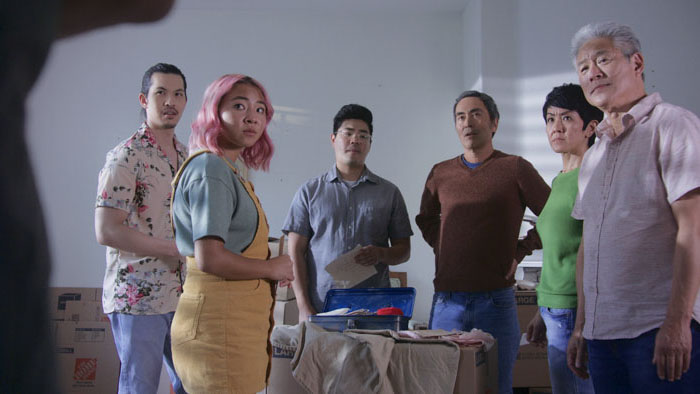
The family reacts to the discovery of their grandmother’s hidden letters in No No Girl.
“A fourth-generation Japanese family…discover love letters written by their recently deceased grandmother.”
Goodman uses this historical period to illustrate how both visible and hidden histories extend across multiple generations, including the present. Three generations later, a discovery reveals the trauma and truth of an ancestral past. Linking the family to the treasure and lingering anti-Japanese sentiments, Goodman draws many parallels between the present and the past through a house that Joan (Hannah Leigh), a white, young, and precocious woman, is selling on behalf of her grandmother. Joan, a musician with a bossy, mean-girl attitude, is someone Sue knows because of her music. Joan becomes the focal point for Sue’s family, but not without a sting that highlights the legacy of generational racism in today’s world.
Rooted in ideas about family, identity, nationality, pride, and property, No No Girl explores how the past and present influence each other. Through extended moments of reflection and silence, Goodman allows emotion and questions to linger throughout No No Girl. Beautiful lighting and camera work are also prominent and distinctive in the film. As an independently made project with dedicated actors, it tells a thought-provoking story, especially with an ending that reminds us why we should care about No No Girl.

"…beautiful lighting and camera work..."