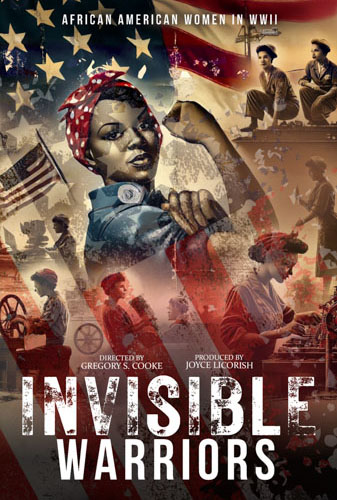
Writer-director Gregory S. Cooke’s Invisible Warriors: African American Women in World War II is a clear and well-defined documentary that explores the wartime experiences of 600,000 Black “Rosie the Riveters.” These pioneering women fought racism and sexism to help win the war and create job opportunities in industry and government for themselves and future generations of African American women. These dedicated women rose to the occasion to support their country while communities demanded they use separate bathrooms and drinking fountains, among other basic suppression tactics, including being denied the right to shop for clothes, sit down to eat, and be served because of the color of their skin. Although degraded and demeaned, these strong women stood firm and did their work.
Cooke gathered many overlooked stories of African American women who courageously served on the home front during World War II, especially before they passed on, as their stories would die with them. Their triumph over the double stigma of being Black and female demonstrates the resilience and strength that reshaped the employment landscape for all future generations of African American women.
Through archival footage, images, and reels featuring Black women throughout this period of history, Invisible Warriors provides an in-depth account of these women and their dedication to supporting the war effort, with a timeline of events interspersed with interviews with Susan King, Marian Reid, Ruth Wilson, Alice Amaro, Bernice Bowman, Birdia Bush, Gwen Faison, Willie Mae Govan, and Dr. Dorothy I. Height. Several world-class scholars are featured, having dedicated their careers to teaching and documenting social, historical, and political phenomena related to Americans whose experiences have been traditionally marginalized because of race or gender.
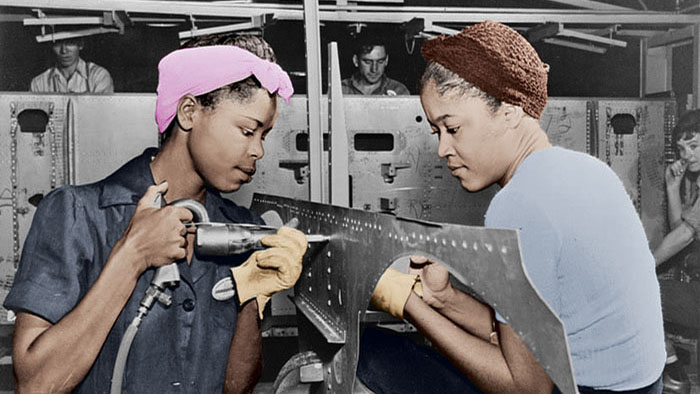
Leudell Mitchell and Lavada Cherry at work in a WWII-era factory, spotlighted in Invisible Warriors: African American Women in World War II.
“…explores the wartime experiences of 600,000 Black ‘Rosie the Riveters.'”
Cooke focuses on women who left their lives as domestics and sharecroppers to work in factories and government offices, which is interesting because most went on to careers that broke boundaries for African American women in the workplace. Their interviews are candid and inspiring, especially with the excellent narration by Regina Robinson, who provides a big-picture view of what was happening with a positive yet realistic approach. Robinson’s narration is key to the appeal of Invisible Warriors: African American Women in World War II.
From memories of working in the Navy yard and factories and other war efforts, these women wanted to help the cause and the boys, which made them feel special, patriotic. They were part of a community coming together, buying war bonds, volunteering, working with the Red Cross, and giving blood. The so-called Eleanor Clubs, created from Eleanor Roosevelt’s belief in equality for women, were supposedly filled with Black women who no longer would work for white women as maids. It was understood that every woman had a job to do as they watched brothers and relatives go to war—trading aprons and scrub buckets for blowtorches and overalls.
Alongside 20 million other women, these Black women built the arsenal of democracy, constructing battleships, cultivating victory gardens, and purchasing war stamps, while white women, known as “Rosie the Riveters,” were visible. These 600,000 Black women were invisible. They were supportive in a racially segregated society and were discriminated against in the U.S., even as they fought fascism abroad. They were fighting the far right at home, too. Yet there was a breakthrough. These independent and self-sufficient women were paying bills and managing the family’s affairs when the war ended. When men were home, things had changed.
An excellent effort to preserve history for future generations to learn from, Invisible Warriors: African American Women in World War II is an important historical film that Cooke put an incredible effort into creating a solid historical account, featuring personable interviews and pointed choices in archival imagery, which is abundant. It offers a refreshing perspective on women’s U.S. history, supporting a belief in patriotism that all people matter and are part of a structure that has allowed progress to occur. Invisible Warriors could not be more apropos than in our current times for looking back to move forward.
"…an excellent effort to preserve history for future generations to learn from."