Diane Keaton was primarily known as an accomplished, talented actress, but she was also a director, with her debut coming in her unusual 1987 documentary, Heaven. She filmed a large, diverse group of people asked for their views on an afterlife: What is heaven? Is there sex in heaven? How do you get to heaven or hell? What are they like? What kind of rewards do you think heaven holds? What does God look like?
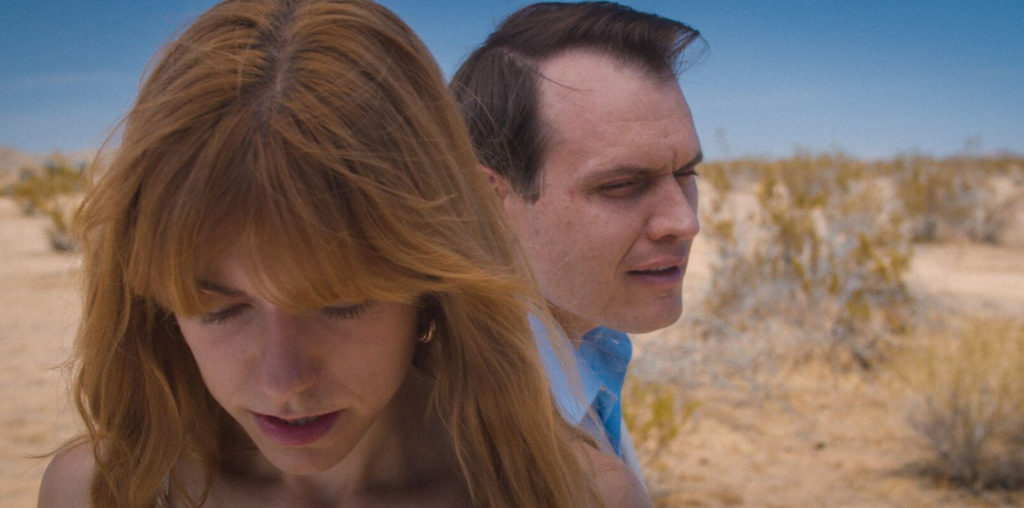
The interviewees include thoughtful church leaders, pompous evangelicals, bohemian free spirits, those of questionable mental health, and ordinary people. She even includes remarks by famous fight promoter Don King as well as members of her own family. She chose strange camera angles and artsy, odd white sets with off-axis lighting and shadows playing over the faces of the speakers. The film is mostly black and white, with occasional clips in color. The overall effect is unsettling.
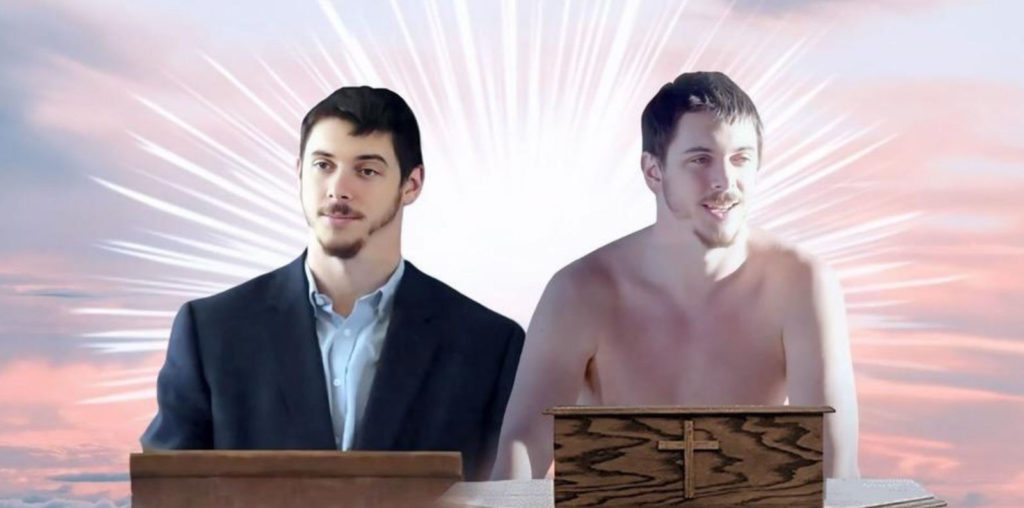
There is loud passion among the speakers for what they imagine heaven to be; in some cases, they are emphatic to the point of mania. There are two young men at odds over whether a supreme being cares about human life. One of them is dressed in the robes of a spiritual devotee, and the other is in street clothes with a conservative haircut. They engage in a spirited exchange about karma. There is another debate between an older man, a believer, and an atheist that devolves into a shouting match. The believer shows searing contempt for the atheist, using scripture as justifications for his arguments. The cultural biases of the time are on full display with statements like “God could not be a woman.”

“…a diverse group of people asked for their views on heaven and the afterlife…”
Some of the clips featured in Heaven are so hokey that they are reminiscent of the overwrought opening to Plan 9 From Outer Space by psychic The Amazing Criswell. Interviews are intercut with montages and film clips, and an anxiety-inducing cacophony of frantic screams layered over explosions. There are also whimsical clips from films Metropolis, Green Pastures, Stairway to Heaven, and A Guy Named Joe, starring Spencer Tracy as a World War II pilot who goes to heaven after being killed in action.
Raised in a secular household, Keaton was an agnostic, but with curiosity about faith, an itch she seems to scratch in this film. She was also an intelligent woman with a sharp, wry sense of humor, and it seems possible 40 years on that she is making fun of the more out-there rants. One cannot help but wonder if she was poking at the tawdry carnival sideshow aspect of the more radical believers. Certainly, she knew that some of this material would be seen as fringe or outright crazy. The publicist aptly describes Heaven as “Norman Rockwell meets Salvador Dali.” Interestingly, Keaton did not interview anyone from other faiths, such as Judaism or Islam, which would have been compelling for contrast.
This film has an impressive soundtrack featuring a score from Oscar-winning composer Howard Shore, best known for The Lord of The Rings trilogy, and songs by Lionel Richie, The Residents, The Dream Academy, and Sam Cooke. Heaven has been given a full digital restoration and is remastered in HD, resulting in crisp, clean audio and video. While it was poorly received in 1987, it is solid gold viewing in 2025 as a time capsule and playful look at the religious culture of 40 years ago.
Learn more at the official Heaven website.

"…solid gold viewing as a time capsule of U.S. religious culture 40 years ago."