With Marvel Studios’ Fantastic Four: First Steps now available on Disney+, the last leg of our fantastic journey is the 1967 Hanna-Barbera Fantastic Four animated series. I have to admit that the show went into syndication when I was a child. With its limited animation and star-studded voice cast, how does this compare to Marvel’s final version?
Reed Richards (Gerald Mohr), Sue Storm (Jo Ann Pflug), Johnny Storm (Jac Flounders), and Ben Grimm (Paul Frees) are four scientists who head into space on a mission that goes sideways when their ship is blasted by cosmic rays. Upon their return to Earth, the team discovers their bodies have changed: Reed can stretch and reshape, Sue can turn invisible, Johnny can burst into flame and fly, and Ben becomes a super-strong rock-skinned powerhouse. Based out of New York’s Baxter Building, the group—known as the Fantastic Four—finds their transformation has unleashed a bevy of super- and insane-villains. Unlike most heroes, though, the Fantastic Four are public with their powers and dubbed the front line of defense for New York City.
Across the 20 episodes of Fantastic Four, Marvel’s first family is pulled from one crisis to the next as villains, monsters, and invaders test the limits of their powers and teamwork. A former friend of Reed Richards, Doctor Doom, repeatedly tries to foil Reed whenever he can, often with schemes meant to turn the citizens of New York against him. Pulled straight from the comics, the Fantastic Four go up against the Mole Man, Diablo, and even the Super-Skrull, a shape-shifter possessing all the individual powers of the FF.
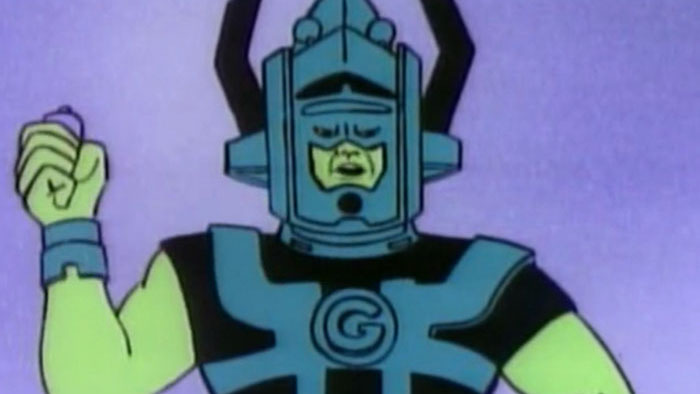
Galactus looms large in the 1967 Hanna-Barbera Fantastic Four cartoon.
“…their transformation has unleashed a bevy of super- and insane-villains.”
The formula used for the Fantastic Four was simple for both adults and children. In each episode, a problem arose when a super-villain attempted to fulfill some nefarious plan. The Fantastic Four would have to use some combination of their powers to defeat the villain and come out victorious in the end. Sometimes the solution came from Reed’s intellect. Though I’ve read only a few of the classic FF comics, when the story was good on the page, it was good on television—a quick commentary on Marvel drawing from the source material rather than assuming it needs a “modern update.”
As a young boy watching the series in the 70s, what was uber-cool about the Fantastic Four was having four sets of powers, not just one. All the gear porn throughout the series provided imaginative fun as well. Reed’s lab was a playground of tools and weapons. Let’s also not forget the Fantasti-car.
Yes, the animation, especially the sound effects, is dated. But hearing Paul Frees’s voice brought back so many memories, especially of the Haunted Mansion at Disneyland. I’ll submit that serialized animation hasn’t improved much since then. Computers allow us to add more detail, but television is still about cutting corners by reusing action, backgrounds, and the same sound effects for everything.
Fantastic Four, the 1967 animated series, is perfect for getting to know these superheroes from the comics, and its storytelling is still far better than anything Marvel Studios has put out since Avengers: Endgame.

"…what was uber-cool about the Fantastic Four was having four sets of powers..."