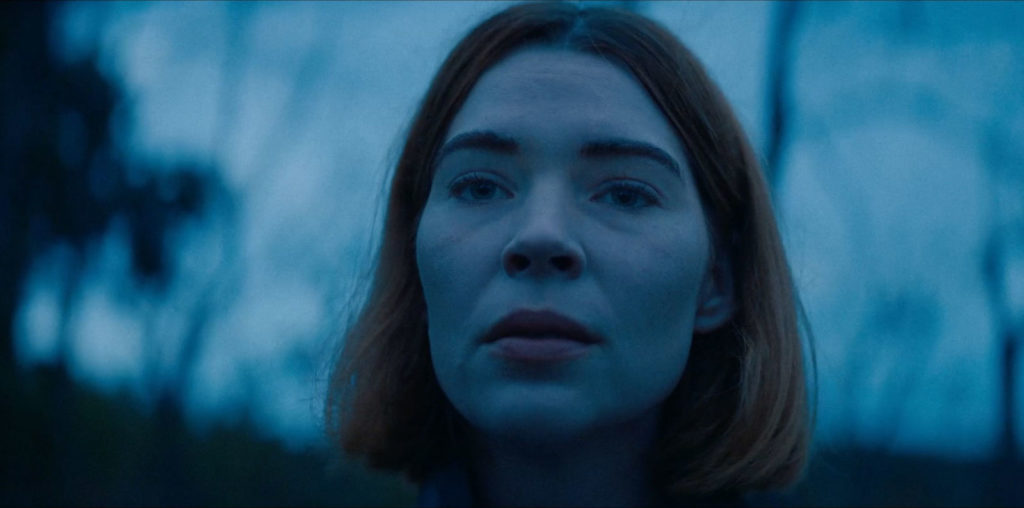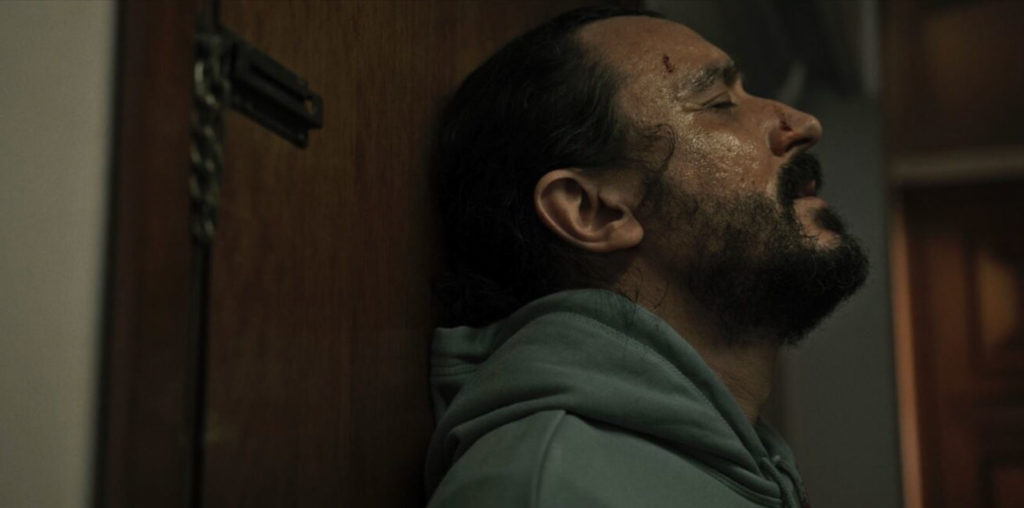
Crumb Catcher takes a premise that sounds like a lost sitcom pitch and plays it in a social nightmare of obligation. Written and directed by Chris Skotchdopole, from a story by Skotchdopole, Larry Fessenden, and Rigo Garay, the picture begins with newlyweds Shane (Rigo Garay) and Leah (Ella Rae Peck) at their reception, being photographed. The dialogue between them and others is on the edge of an argument and underlying tensions of the moment. The same mood in the drive to the honeymoon cottage, where it’s one learns that Shame is a writer and Leah is his publisher. Shane’s past is filled with childhood trauma from his family. There is some trouble with the wedding cake during the reception, and Shane fails to thank her mother for the reception, which he did not care for in the first place, as he wanted to elope.
Later on, Shane wakes up the morning after his wedding with a headache and zero memory of the previous night. Worse: an envelope containing the wedding guests’ cash gifts is empty. The situation changes when he receives a text from a woman named Rose (Lorraine Farris) hinting that the two of them got intimate. Shane’s confusion is matched only by Leah’s determination to ignore anything that might spoil their honeymoon. So off they go to their getaway: a posh, secluded woodland home supplied by Leah’s boss, where all is quiet, tasteful, pristine. A perfect location for things to go wrong, and they do.
A late-night knock at the door interrupts their attempt at newlywed fun and games. Standing outside is John (John Speredakos), the odd, overly friendly caterer from the wedding the night before, who made remarks about Shane’s used car. He claims he brought the missing wedding cake topper. John initiates himself into their home, has a glass of water, puts it down on a table, ignoring a coaster that irritates Leah. He drones on about absurd details when he finally reveals he’s also come to pitch a device he invented, which is a bizarre contraption called the “crumb catcher.” It turns out to be a sort of handheld vacuum designed to sweep table crumbs into a funnel. He insists Shane and Leah sit for a full presentation. Then the truth detonates: Rose is John’s wife, and she’s the same woman who texted Shane. She has a video of the alleged encounter. If Shane doesn’t invest in John’s crumb-collecting dream machine, the video goes straight to Leah. It’s blackmail with a smile that only gets more deranged as the night progresses.

“If Shane doesn’t invest in John’s crumb-collecting dream machine, the video goes straight to Leah.”
Speredakos is a bull in a China shop throughout Crumb Catcher. He’s huge, sweaty, oblivious, clumsy, with the temperamental volatility. The man adds menace to each of his lines. He makes every stumble, every loud gesture, every sudden turn feel like an accidental tragedy waiting to explode. Peck’s performance always hints that her character’s exhaustion is something they are resigned to, a sort of grasping at “crumbs” to live on. Shane and Leah are the “normal” ones. Leah responds logically, sharply, almost icily. Shane, however, is a frustrating mystery. Garay internalizes guilt instead of suspicion.
Skotchdopole uses the Hitchcock metaphor of creating suspense when showing a conversation between people, with the audience knowing there is a bomb under the table to solid effect. Leah notices John’s weapon right away. Much like the aformentione master, the filmmaker also infuses humor. The comedy arises not from punchlines but from the horrible social bind of being too polite to throw an intruder out of your home, much like Who’s Afraid of Virginia Woolf. It’s a nightmare built entirely from the dread of not wanting to be rude, which itself is interesting because social media is filled with people who are rude continually to the point of hate. This is hugely similar to Duncan Birmingham’s Who Invited Them which is about a married couple who have a housewarming party to show off to their colleagues and superiors. When the guests have already left, the hosts suddenly discover an unfamiliar couple in the house who enter their lives.
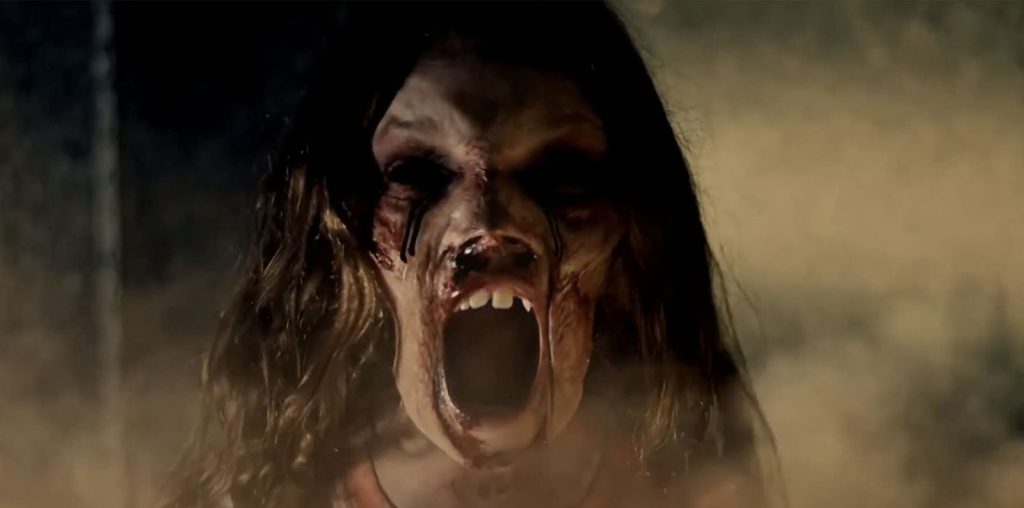
Visually, Crumb Catcher leans into disorientation. Drunken POV effects distort the frame. The film is largely confined to the house, giving it a theatrical feel. The editing keeps the action going well, even the car chase towards the end is well-handled. The picture is a wonderful example of social horror, fear of strangers who are not what they seem, worth a look for the production values well used, and the committed actors.

"…a wonderful example of social horror..."