
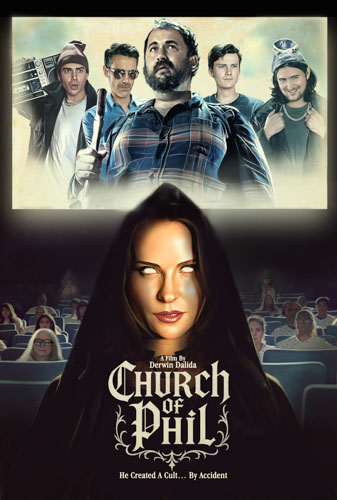
Derwin Dalida’s Church of Phil takes an absurd premise—an average man accidentally becomes a cult leader—and uses it to explore the fine line between devotion and delusion. Phil (Patrick McGrath) is the maintenance guy at a movie theater. He fixes projectors, seats, and whatever breaks. One day, his co-worker Lily (Desiree Manly) is prepping the theater for the evening crowd, and they start talking—really talking. They discuss important subjects like what’s better—The Shining or The Exorcist. While Lily is a slacker in life, Phil is a dreamer and has his heart set on moving to the Shire…more New Zealand. Meanwhile, Phil’s taking prescription meds for insomnia called Eclypto. But to Phil, he’s not sure if the pill is curing his problem or simply creating new ones.
There are other crazy characters in Phil’s world. His roommate, Trey (Phillip Bahnam), and Trey’s buddy, Lonnie (Alex Kravitz), are stoner regulars at the theater, splitting their time between toking at either the movies or the strip club. Phil also has his almost-mentor, Mr. Kemp (Ray Buffer), who encourages him to take some initiative in his life and, Matrix-style, choose which pill he’ll take when it comes to love. When Lily invites him to a party, Phil goes and immediately regrets it. He doesn’t know anyone. His anxiety levels go through the roof. Whether it’s the Eclypto or something else, Lily sees Phil arguing with himself, with demons that don’t exist except in his own head.
That night, Phil had a dream of being pursued by Lily in a purple robe, as only a cult member would wear. He also finds himself face-to-face with the devil. Thank God, it was only a dream…or was it? In fact, the next morning, Phil finds Lily kneeling before an altar…an altar to him. She’s in a cult, and somehow, in this hazy in-between state of waking and sleeping and medicated numbness, Phil comes to learn that he is the cult’s messiah of sorts. Phil is caught between dream and reality, between what Eclypto showed him and what actually happened. The cult is real. When Phil rejects it—when he says he’s done, he’s leaving, he’s getting out—Lily comes to his apartment and sacrifices herself to him.

Phil is surrounded by cult members during a worship scene in Church of Phil.
“In fact, the next morning, Phil finds Lily kneeling before an altar…an altar to him.”
This is only the end of the first act, when Church of Phil flies off the rails. Next, Phil and Lonnie have to figure out what to do with Lily’s body. In fact, Lonnie takes it upon himself to let the cult know what happened to her to disastrous results…for Phil. Then there are even more psychotic cult members than Lily. Speaking of Lily, her twin sister turns out to be a federal agent.
First, Church of Phil will find a particular place in the hearts of film fans. The love affair between Phil and Lily is all based on film and the agreements and disagreements that keep us in the theaters and talking long after the last reel has run. Then I love how it takes a deeply dark turn, inspired by The Life of Brian, with Phil becoming a cult’s reluctant figure. After learning what danger the cult is bringing to his community, Phil is forced to end the cult once and for all.
Writer, director, and everything else. Derwin Dalida has a firm grasp on the vision and tone of his story. He knows when to be sweet, funny, and downright dark. All this to say, he keeps his delicate story held together without falling apart. Church of Phil may become a cult comedy about cults. As an indie film, it feels like a community project from Camarillo, California. I’ve had the fortune to spend some time in this small community, and Dalida captures the film’s rural backdrop beautifully. Without overhyping the film, the feeling I had from the beginning was “let’s go nuts.”
For more information, visit the Church of Phil official Instagram page.
"…Dalida has a firm grasp on the vision and tone..."