SUNDANCE FILM FESTIVAL 2026 REVIEW! Director/writer Makato Nagahisa presents the dramatic feature film Burn. Ju-Ju (Nana Mori) is a teenage girl in Tokyo with a terrible stutter. Her vicious father considers her speech impediment to be a moral failing and severely beats her and her sister regularly. He tells her that her soul is tainted. After his untimely death, their mother continues the abuse, and she runs away, landing in the Kabukicho neighborhood, located in Tokyo’s Shinjuku district. It is Japan’s largest red-light district, full of colorful neon lights and nightclubs. She has been invited to Tōyoko Square after reaching out to someone on social media named Kami, who tells her there is a place for misfit kids there.
In Kabukicho, Ju-Ju is embraced by a band of outcast youths, where she feels belonging and affectionate family dynamics for the first time. They live together, led by Kami, who turns out to be a corrupt adult who provides food and drugs. After an extreme night of partying, she overdoses and wakes to find herself in the hospital. The hospital sends her to a temporary shelter with other children. She is soon back at Tōyoko Square.
You can see where this is going. Ju-Ju is inevitably, inexorably, drawn into prostitution. Her new friend Mitsuba shows her the ropes, calling it “sugar daddy” dating. Ju-Ju goes along with it in order to save up 10 million yen, thinking she will rescue her younger sister, who still lives at home with their abusive mother. After her first sex for pay experience, Ju-Ju flashes back to her father telling her that she was tainted, and she believes it to be true.
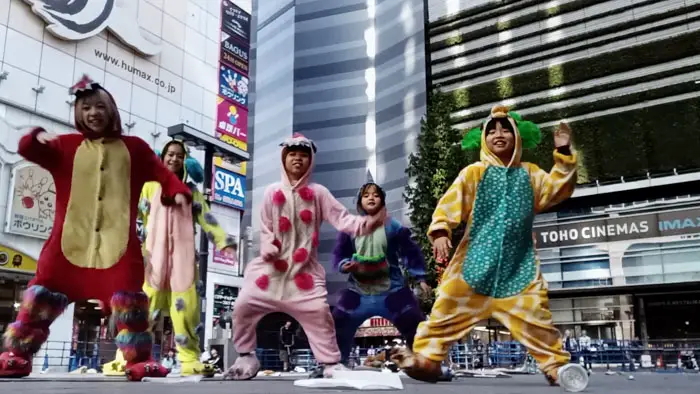
An, Kanade, Itohi, Yuzuki and Cocoro appear in BURN by Makoto Nagahisa, an official selection of the 2026 Sundance Film Festival. Courtesy of Sundance Institute.
“… Her father considers her speech impediment a moral failing and severely beats her …”
Nagahisa shocks the viewer with his depiction of life on the street for the lost young people. In real life, this culture is known as “Tōyoko kids,” encompassing those who live in the streets or just hang out in the city spaces near the Toho building and the cinema plaza. The sex scenes are shocking and horrifying, despite not being graphic. The youth of the girls makes them even more repulsive. They are still children.
The lights are bright and colorful, and the music pounds through the night, but none of that makes the hollowness any more bearable. The kids seem not to know, nor care, about what comes next. They live in an eternal “now” that both comforts and batters them.
The shots often crop the actor’s faces, and the lighting is low for inside scenes, creating distance between the characters and the audience. We are not invited into this world; we are its voyeurs. There is a vérité aspect to the cinematography as well, with shaky cam shots and the look of a documentary. Nagahisa employs a variety of styles and includes some CGI fantastical elements. The film is reminiscent of Kids from 1995, where the same kind of empty city existence among a group of disaffected teens is shown in New York. Nana Mori fully engages in her performance as Ju-Ju, delivering the character with heartbreaking authenticity.
As the film winds down, it becomes clear that it’s not about getting to some sort of conclusion or making a point. We are simply with Ju-Ju as it all plays out. From an American perspective, that is an unconventional way to close out a movie, but it’s honest and makes perfect sense. There is beauty in this downward spiral that isn’t about salvation or absolution.

"…beauty in the downward spiral that isn’t about salvation or absolution..."