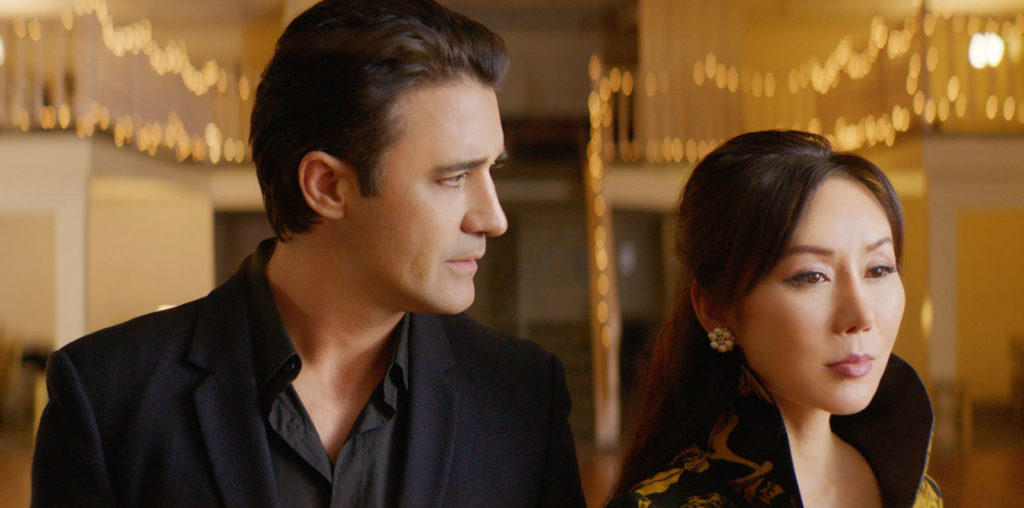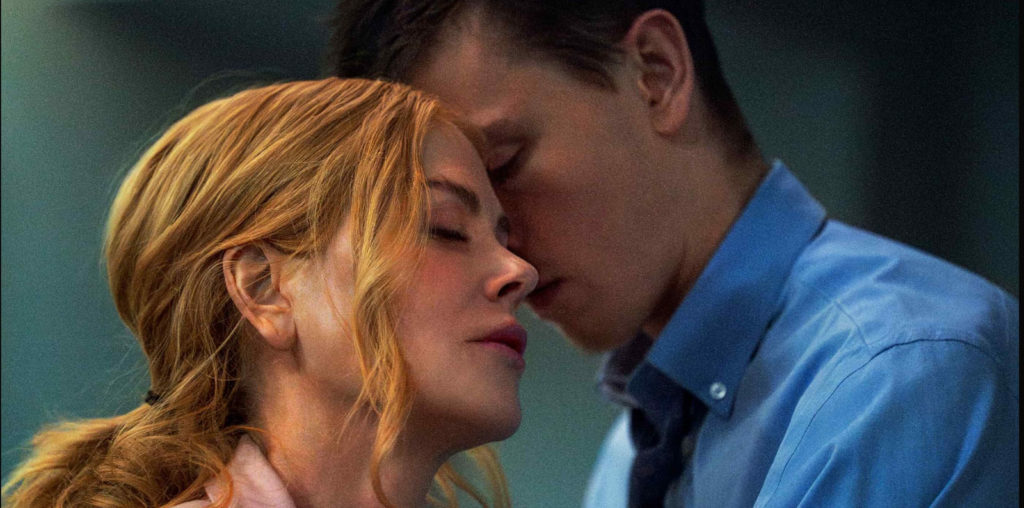
An Evening Song (for three voices) is an arthouse drama with elements of horror, neo-noir, and 1950s melodrama. Director and screenwriter Graham Swon creates an engaging period piece. Set in 1939, a couple from a metropolitan city moves to the Midwest in need of a change. Barbara (Hannah Gross) is an acclaimed author and poet who is haunted by the death of her father. Her husband, Richard (Peter Vack), is a writer for a pulp magazine; he suffers from writer’s block and is in search of inspiration. When collecting his thoughts at a Lutheran church, he meets a scarred young woman, Martha (Deragh Campbell). Martha is quiet and devout in her Lutheran beliefs; after meeting Richard, she is hired as their maid. Simultaneously, a killer known as the “Hairy Man” is killing livestock and abducting children in this small town.
Martha becomes an object of erotic obsession for the couple. Richard appreciates her beauty and intelligence in finding subtext in his lowbrow writing. Barbara becomes attracted to Martha due to her raw connection to the spiritual world. These forbidden affairs occur as the couple grows distant. As Martha becomes closer to them, she finds a new sense of freedom and sheds her strict religious beliefs.
Graham Swon’s film stylistically echoes the works of David Lynch, Alice Rohrwacher, and Douglas Sirk. It is surreal, dreamlike, and deals with taboo subject matter in a tasteful way. Swon and his cinematographer, Barton Cortright, shoot the film through a hazy lens. This recalls the pastel style of early 20th-century artist N.C. Wyeth. Swon’s editing technique is brilliant as he incorporates dissolves and superimpositions to entrench the viewer into the headspace of our leads.

“Set in 1939, a couple from a metropolitan city moves to the Midwest in need of a change.”
His small cast carries the film through poetic monologues and ethereal performances. Deragh Campbell is a striking presence onscreen; her face has a porcelain quality. Her character, Martha, is enigmatic. She is a Rolodex of archetypes: ingenue, tragic monster, and forbidden beauty. Peter Vack’s performance feels like a cross between Cary Grant and James Stewart, except the everyman type is given Wes Anderson-like neuroticism. Rae Swon’s production design is a balanced color palette. For example, Barbara is an icy socialite type and costumed in glamorous dark colors. Alex Lane’s sound design is both supernatural and naturalistic, which creates an unusually calm tone. This creative approach works to offset the immorality taking place.
I would be remiss not to mention the state of Iowa. The state’s cornfields and pastoral environment is another character in the film. Iowa’s rural locale creates a dichotomy as Swon’s characters feel trapped in their problems. This also subverts the cliches of melodrama where interiors symbolize a character’s repressed emotions.
Arthouse films can either be exercises in the craftmanship of cinema or monotonous slogs. An Evening Song (for three voices) is a wonderfully composed blend of straightforward storytelling and cinema’s finest visual techniques. If anything, Swon’s film proves you can use lowbrow and highbrow elements to create a compelling work.

"…Deragh Campbell is a striking presence onscreen; her face has a porcelain quality."